Table of Contents
ToggleHow to Predict Powell’s and Trump’s Words and Trade the Market
In trading, words matter. Sometimes, a single sentence from Federal Reserve Chairman Jerome Powell or former President Donald Trump can move the markets more than technical charts or economic data. That’s why traders who learn to anticipate these statements often gain an edge. Let’s break down how you can predict their words and position yourself in advance.
Understand the Role of Jerome Powell
Powell’s words carry weight because he sets the tone for U.S. monetary policy. Interest rates, inflation, and employment data all influence his language. When Powell sounds hawkish (favoring higher rates), markets usually react with a stronger dollar and weaker stocks. When he sounds dovish (favoring lower rates), stocks rise and the dollar weakens. By tracking inflation reports, jobs data, and Fed meeting minutes, you can predict whether Powell is likely to be hawkish or dovish before he speaks.
Watch the Federal Reserve Calendar
Powell rarely speaks without reason. His most impactful comments happen during press conferences, policy meetings, and major economic events like Jackson Hole. Traders should mark these dates on their calendars. If inflation has been hot, expect Powell to talk tough. If the economy shows weakness, expect him to soften his tone. Anticipating the theme allows you to plan trades ahead of time instead of reacting too late.
Trump’s Words and Market Reactions
Donald Trump may no longer be in office, but his words still influence markets, especially during elections or policy debates. Trump’s style is unpredictable, but his main focus has always been trade, tariffs, and the stock market. A tweet or statement about China, oil, or the U.S. economy can cause instant volatility. The key is understanding his priorities—he usually favors policies that boost markets and jobs.
Learn the Language of Politics
Powell speaks in measured, technical terms, while Trump is more direct and emotional. Traders must learn to read between the lines. For Powell, subtle words like “moderate” versus “significant” can change market expectations. For Trump, strong words like “great,” “fake,” or “disaster” often signal the direction of his policy stance. The more you study their word choices, the better you’ll predict market moves.
Use Market Sentiment as a Guide
Before Powell or Trump speak, look at how markets are positioned. If investors expect a dovish Powell and he confirms it, stocks may rally further. But if he surprises with hawkishness, markets can reverse sharply. Similarly, if traders expect Trump to criticize China and he does, it might already be priced in. The surprise factor is what creates the biggest opportunities.
Build a Trading Strategy Around Words
The best way to trade speeches is with a plan. Scalpers may trade the initial volatility, while swing traders wait for the dust to settle. Using stop-loss orders is essential since markets can whipsaw in seconds. Also, avoid chasing moves after the first reaction—wait for confirmation through price action.
What’s the difference between Powell’s speeches and regular economic data releases?
In trading, both Powell’s speeches and economic data releases can move markets. But they’re not the same. Understanding the difference helps traders know which events to prioritize and how to react.
Economic Data: Facts and Figures
Economic data releases, like Non-Farm Payrolls, CPI (inflation), or GDP, are raw numbers. They give traders a snapshot of how the economy is performing. These numbers are scheduled in advance, published at set times, and are the same for everyone. For example, if CPI comes in higher than expected, traders know inflation is hot, and markets adjust quickly.
Powell’s Speeches: Interpretation and Guidance
Unlike data, Powell’s speeches are not just about facts—they’re about interpretation. He explains what the numbers mean for monetary policy. More importantly, he gives guidance about the future. A single phrase like “higher for longer” can shift the entire market outlook. This is why his words often have more lasting impact than one data point.
Timing of Impact
Economic data creates an instant reaction. Within seconds of release, algorithms and traders price in the new information. Often, the market stabilizes within minutes. Powell’s speeches, however, create waves of volatility. Markets react immediately to his tone, then shift again as traders digest the meaning. The impact can last hours, days, or even weeks.
Certainty vs. Uncertainty
With data, there’s certainty—numbers are what they are. Traders can compare them against forecasts and adjust positions. With Powell’s speeches, uncertainty is higher. His language is carefully chosen, and small changes in wording spark debate. Traders may argue whether he sounded more hawkish or dovish, creating back-and-forth swings in price action.
Short-Term vs. Long-Term Effect
Economic data often drives short-term moves. For example, a strong jobs report might push the dollar higher for a day or two. Powell’s guidance, on the other hand, shapes the long-term trend. If he signals multiple rate hikes ahead, investors adjust portfolios for months. That’s why Powell’s speeches are seen as market-defining moments.
The Human Factor
Economic data is mechanical—just numbers. Powell’s speeches add a human factor. Tone, body language, and even hesitation can send signals. Traders watch live for not just what he says, but how he says it. A cautious tone can be read as concern, while confident wording reassures markets. This emotional layer makes his speeches harder to predict but potentially more rewarding to trade.
Putting It Together
Think of it this way: economic data is the fuel, and Powell’s speeches are the steering wheel. The data shows the state of the economy, but Powell decides the policy direction based on it. Traders who follow both—watching data and anticipating Powell’s reaction—are best positioned to catch big market moves.
“Close-up of a trader analyzing Powell’s expressions on a live stream, with a laptop showing forex charts.
Powell’s words are carefully chosen, but his delivery sometimes reveals more than the script. A Traders who pay attention to these small details sometimes catch clues about whether he is more worried about inflation or growth. These micro-signals can be just as valuable as the official statement.
Body Language Meets Market Charts
Imagine a trader watching Powell speak live, while forex charts flicker in real time. As Powell raises his eyebrows or stresses a particular word, the chart reacts instantly—currencies spike or dip within seconds. This shows the unique link between body language and price movement. It’s a rare combination where psychology meets technical analysis.
Why Expressions Matter in Trading
Markets are not only moved by data—they’re moved by confidence, fear, and expectations. Powell’s expressions add an emotional layer to his policy stance. A serious, firm tone suggests determination to fight inflation, which often strengthens the dollar. A softer expression and reassuring words suggest flexibility, which tends to lift stocks. Traders who learn to read this emotional layer gain an edge.
Real-Time Reaction Is Key
Unlike data releases, which are processed instantly by algorithms, Powell’s speeches unfold in real time. This gives human traders a unique opportunity. By carefully observing his facial expressions and tone, they can react a second faster than the algorithms that only read text. In a fast-moving forex market, that one second can be the difference between profit and loss.
The Risk of Over-Interpretation
Of course, there’s a danger in reading too much into expressions. Powell may simply pause to find the right word, not because he’s signaling fear. That’s why experienced traders don’t rely only on his face—they combine it with the content of his speech, recent data, and overall market sentiment. It’s about blending signals, not chasing shadows.
Expressions as Part of a Bigger Strategy
For professional traders, analyzing Powell’s body language is one tool among many. It works best when combined with technical analysis, fundamental data, and market positioning. For example, if inflation is already high and Powell looks tense while discussing it, that double confirmation may signal a strong dollar rally.

“Split image: Powell speaking calmly on one side, gold price charts fluctuating on the other side.”
One of the most striking contrasts in the financial world is how calm Jerome Powell looks when he speaks, compared to the wild swings that follow in markets like gold. Imagine a split image: on one side, Powell delivers a measured statement with steady composure; on the other side, gold charts jump up and down with every word. This captures the essence of how speeches and market psychology collide.
Why Gold Reacts So Quickly
Gold is highly sensitive to monetary policy signals. When Powell hints at higher interest rates, gold usually falls because rising yields make non-yielding assets less attractive. But when he suggests a softer stance, gold often rallies as traders look for safety against potential inflation or economic slowdown. The metal doesn’t wait for confirmation—its price reacts instantly.
Calm Delivery, Explosive Impact
Powell is trained to remain calm. He avoids emotional language and presents himself as steady and reliable. But that calm tone doesn’t prevent markets from overreacting. Traders know every sentence could shift expectations for interest rates, inflation, and the dollar. That’s why, while Powell looks composed, gold charts often look like a rollercoaster.
The Psychology Behind the Moves
When Powell speaks calmly, some traders may feel reassured. But others may wonder: is he underestimating risks? This split interpretation leads to volatility. Markets reflect crowd psychology, and gold—being a global safe haven—often amplifies those emotions.
Long-Term vs. Short-Term Reactions
Powell’s words can have both short and long-term effects. Short-term traders may scalp the immediate spikes in gold when his tone shifts. Long-term investors, however, focus on the broader message. If Powell signals extended high rates, gold could trend lower for months. If he signals easing ahead, gold could build a strong uptrend. The calmness of his delivery doesn’t change these dynamics—it just hides the storm brewing beneath.
Reading Between the Lines
The key to trading gold around Powell’s speeches is not just listening to the words, but understanding the context. Was inflation data strong last week? Did bond yields spike recently? If yes, a calm Powell might actually be more hawkish than he appears. Conversely, if he acknowledges economic weakness while speaking calmly, gold bulls may see it as confirmation for a rally.
Strategy for Traders
For traders, the best approach is preparation. Mark Powell’s speech dates, analyze recent data, and decide in advance what tone would be bullish or bearish for gold. During the speech, don’t get distracted by his calm appearance—focus on the words and how they align with expectations. Gold’s first move is often emotional, but the second move usually reveals the real trend.

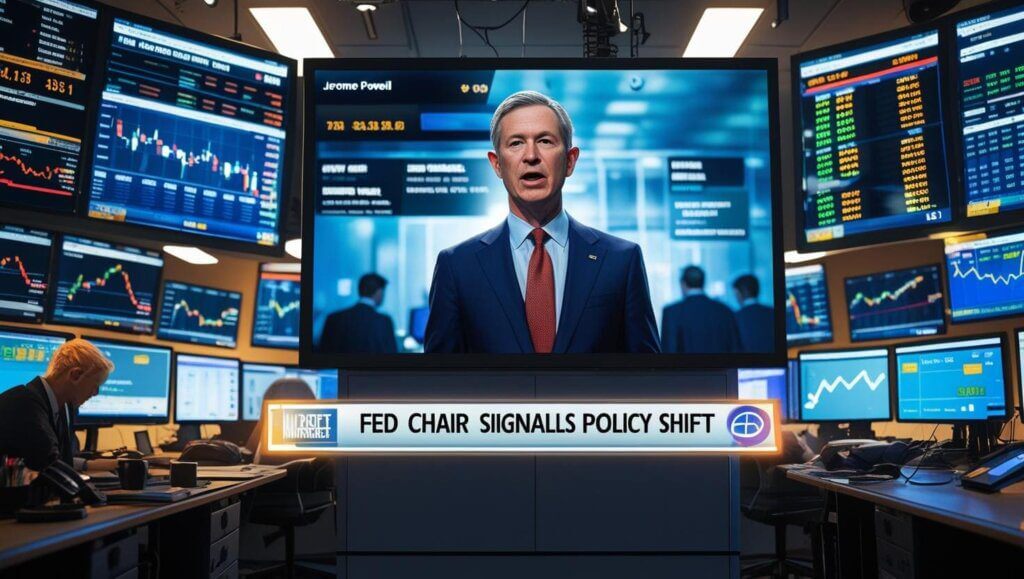
“A financial market newsroom showing Powell on TV with breaking news ticker: ‘Fed Chair Signals Policy Shift’.”
Picture a financial newsroom filled with flashing tickers, breaking news banners, and Powell’s face on the TV.
Why Newsrooms Amplify Powell’s Words
Powell’s speeches often start as calm, technical statements. But once news outlets flash them as breaking news, the message reaches millions at once. Traders sitting in front of their terminals don’t need to watch the full speech—just one bold headline can set them in motion. That’s why markets often react faster to the news ticker than the speech itself.
The Power of a Policy Shift Headline
Few phrases cause bigger ripples than “policy shift.” It signals that the Federal Reserve may be changing direction—either tightening faster or loosening sooner. For investors, this means adjusting expectations about interest rates, inflation, and growth. The dollar, stocks, bonds, and commodities all respond at lightning speed.
Instant Reactions Across Markets
The moment Powell’s policy shift hits the screen, volatility explodes. Currency pairs involving the U.S. dollar surge or sink. Gold and oil spike as traders look for safe havens or growth signals. Stock indices swing violently as investors recalculate the cost of borrowing. A single sentence, amplified by the newsroom, becomes a global market mover.
Traders vs. Algorithms
In today’s markets, it’s not just humans reacting. Algorithms scan headlines in milliseconds and execute trades before most people can even read the ticker. That’s why the first wave of reaction is often chaotic. Human traders then step in during the second wave, interpreting the deeper meaning behind Powell’s words. This mix creates layers of volatility.
Why Context Still Matters
A breaking news ticker doesn’t tell the whole story. For example, “Fed Chair Signals Policy Shift” could mean tightening or easing—it depends on the context. Smart traders don’t just react blindly. They cross-check the headline with recent inflation numbers, jobs reports, and Powell’s past tone. That’s how they separate noise from real opportunity.
“Trader’s desk setup with economic calendar open, showing Powell’s speech highlighted as a high-impact event.”
At every trader’s desk, one tool stands out—the economic calendar. It lists all the major events that can move markets. Among jobs data, inflation reports, and earnings releases, Powell’s speech often appears in bold red, marked as a high-impact event. And for good reason: his words can move the global economy.
Why Traders Track the Calendar
The economic calendar is more than a schedule—it’s a roadmap for volatility. It shows when key data and speeches are coming, so traders don’t get caught off guard. Powell’s events are always marked as critical because the Federal Reserve sets the direction of interest rates, and that decision affects every asset class.
Powell’s Words vs. Data Releases
Unlike simple data like CPI or GDP, Powell’s speeches carry an extra layer of interpretation. His tone, choice of words, and even the questions he answers can send markets flying in either direction. That’s why his name on the calendar stands out—it warns traders to be ready for sudden moves.
Preparing Before the Event
Traders who see Powell’s speech highlighted in red don’t wait until the last second. They prepare. This means checking recent inflation numbers, bond yields, and Fed minutes to guess what Powell might say. If inflation is running hot, he may sound hawkish. If growth is slowing, he may sound dovish. Preparation allows traders to build a plan before volatility hits.
Market Reactions in Real Time
When Powell speaks, markets often respond instantly. Forex traders see the dollar spike or drop within seconds. Stock traders watch indexes whip up and down. Gold and oil can swing wildly. By knowing the exact time of his speech from the calendar, traders can decide whether to trade the volatility or stay out until the dust settles.
Risk Management During Speeches
Highlighting Powell’s speech as “high impact” is also a warning. Sudden spikes can hit stop losses or trigger margin calls if a trader isn’t careful. That’s why many reduce position sizes, widen stops, or avoid trading right before the speech. Protecting capital is as important as chasing profits.
The Second Wave of Moves
The first market reaction to Powell is often emotional. Algorithms and headlines trigger knee-jerk moves. But the second wave is where the real opportunity lies. Once traders digest the meaning of his words, the trend becomes clearer. Those who study the calendar know when to wait for this second move instead of rushing in.
Why It’s Always Highlighted
Not every speech makes headlines, but Powell’s do. His decisions shape interest rates, inflation outlook, and investor confidence. That’s why his speeches are always flagged in red on calendars—they are the moments when markets can change direction for weeks or even months.

“Trader’s desk setup with economic calendar open, showing Powell’s speech highlighted as a high-impact event.”
Every trader knows the value of an economic calendar. It’s the roadmap of the financial world, showing when critical events are scheduled. On that calendar, some events are marked in bold red—these are high-impact events. And one name that always shows up there is Jerome Powell. His speeches are highlighted because they can shake global markets in minutes.
Why the Calendar Matters
Trading without a calendar is like sailing without a map. It tells traders when jobs data, inflation numbers, or central bank meetings are due. But Powell’s speeches stand apart. The Federal Reserve Chair’s words guide interest rates, and interest rates guide almost every market—from forex and stocks to gold and crypto.
Powell’s Words Carry Extra Weight
Unlike standard reports that deliver numbers, Powell delivers interpretation. He explains what the Fed thinks about those numbers and hints at future moves. A simple phrase like “we may need to keep rates higher for longer” can send the U.S. dollar soaring. That’s why traders highlight his speeches on their screens—they are not just events, they are turning points.
Preparing Before the Speech
Seeing Powell’s speech on the calendar is a warning to prepare. Traders review inflation, jobs, and bond yields to predict his tone. If inflation has been strong, he may sound hawkish. If growth is slowing, he may sound dovish. Building scenarios in advance helps traders stay ahead instead of reacting blindly.
Volatility at the Desk
When the clock ticks to the scheduled time, the trader’s desk comes alive. Forex charts flicker, stock indexes jump, and gold spikes up or down. This is why the event is marked as high impact. It doesn’t just move one market—it moves them all at once.
First Reaction vs. Second Reaction
The first reaction is often extreme. Algorithms trade the headlines instantly, causing sharp spikes. But the second reaction—the one that comes after traders digest the meaning—is usually more reliable. Smart traders know the difference and wait for confirmation before entering big positions.
Managing the Risk
High-impact events can mean high rewards, but also high risks. That’s why traders cut position sizes, set stop-loss orders, or even stay out during the speech. The goal is to survive the volatility and only trade when the picture becomes clear. Highlighting Powell’s event on the calendar is not just a reminder of opportunity—it’s also a reminder of caution.
Why It’s Always Highlighted
Few figures move markets like Powell. His words can strengthen or weaken the dollar, lift or sink stocks, and spark global reactions. That’s why, on every economic calendar, his speeches are marked in red. They are moments that can define the market’s direction for weeks.