1. Introduction
What Is Futures Trading?
Futures trading is a type of financial trading where buyers and sellers agree to buy or sell an asset at a predetermined price on a specific future date. These assets can include commodities like oil and gold, stock indices, or currencies. Instead of owning the asset immediately, traders speculate on its future price movement. Understanding how to trade futures is essential before entering this market because it involves contracts, leverage, and margin requirements that differ from traditional trading.
Why People Are Attracted to Futures Trading
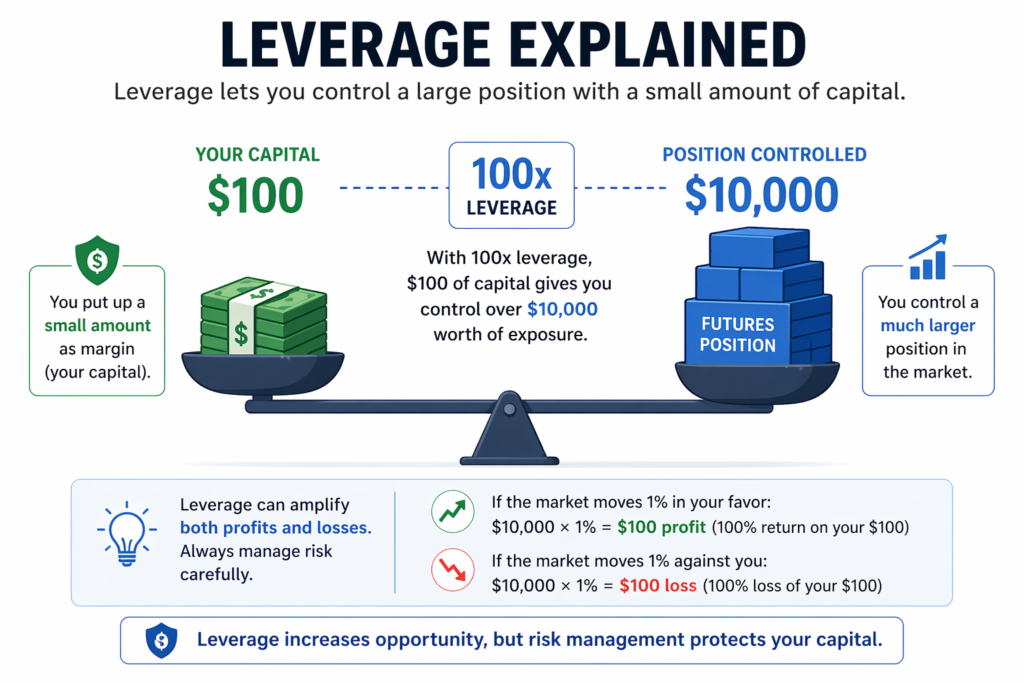
Many people are drawn to futures trading because of its high profit potential and flexibility. One major reason is leverage—traders can control large positions with a relatively small amount of capital. This means that even small price movements can lead to significant gains. As a result, more people are actively learning how to trade futures to take advantage of these opportunities.
Another attraction is the ability to profit in both rising and falling markets. Unlike traditional investing, futures traders can go “long” (buy) or “short” (sell), depending on market direction. This flexibility makes it appealing for those who want to explore different strategies and improve their understanding of how to trade futures in various market conditions.
Liquidity is also a key factor. Futures markets are highly active, which allows traders to enter and exit positions quickly. This fast-paced environment attracts individuals who are interested in short-term trading opportunities and want to master how to trade futures efficiently.
Finally, many people are motivated by the potential to build a full-time income through trading. While success is not guaranteed, the idea of financial independence encourages traders to study charts, develop strategies, and continuously refine how to trade futures as a professional skill.
2. Can You Really Make Money with Futures Trading?
Short Answer: Yes, but…
Yes, you can make money in futures trading—but it’s not as easy or as fast as many people think. The market offers real opportunities, but only for those who truly understand how to trade futures and are willing to put in the time and effort to develop their skills.
Reality vs Expectations
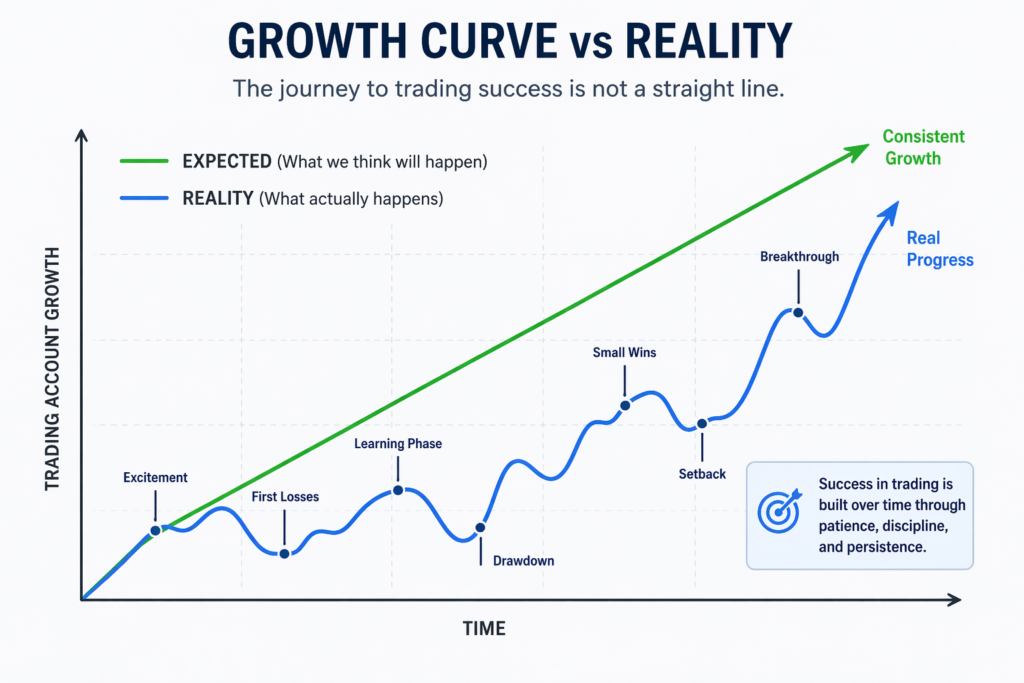
Many beginners enter the market with high expectations. They see social media posts showing huge profits and assume success comes quickly. However, the reality is very different. Learning how to trade futures takes time, practice, and discipline. Most traders go through losses before they become consistently profitable.
In reality, futures trading is not about luck—it’s about strategy, risk management, and emotional control. Traders who take shortcuts or ignore the learning process often lose money. That’s why understanding how to trade futures properly is more important than chasing quick profits.
Another key difference between expectation and reality is consistency. Making one profitable trade is easy, but making consistent profits over time is difficult. This is where most traders struggle. Those who succeed are the ones who continuously refine their strategies and improve their knowledge of how to trade futures in different market conditions.
Risk is also often underestimated. Because of leverage, small mistakes can lead to large losses. Many beginners expect a steady income but face volatility instead. This is why mastering how to trade futures includes learning how to manage risk and protect your capital at all times.
3. How Futures Trading Works
Understanding the mechanics behind futures markets is essential if you want to master how to trade futures effectively. At its core, futures trading is about contracts, leverage, and calculated decision-making.
Contracts Explained
A futures contract is a legal agreement to buy or sell an asset at a fixed price on a specific future date. These contracts are standardized and traded on exchanges, which ensures transparency and liquidity.
For example, a crude oil futures contract might represent 1,000 barrels of oil. When you trade it, you’re not necessarily buying physical oil—you’re speculating on the price movement.
To truly understand how to trade futures, you need to know that traders rarely hold contracts until expiration. Instead, they buy and sell contracts before the expiry date to profit from price changes.
Example of a Trade
Let’s break it down with a simple example to make how to trade futures easier to understand:
- You believe the price of gold will rise
- You buy one gold futures contract at $2,000
- Each price movement of $1 equals a $100 change in your position (depending on contract size)
If the price rises to $2,050:
- You make a profit of $50 × contract value = $5,000
If the price drops to $1,950:
- You incur a loss of $50 × contract value = $5,000
This example shows how leverage amplifies both gains and losses. That’s why successful traders focus not just on profits, but on protecting their capital.
4. How Traders Make Money in Futures
Making money in futures trading comes down to understanding price movements, choosing the right trading style, and spotting opportunities others might miss. To succeed, traders must learn how to trade futures with precision, discipline, and a clear strategy.
Price Movements (Long & Short)
The primary way traders make money is by predicting price direction.
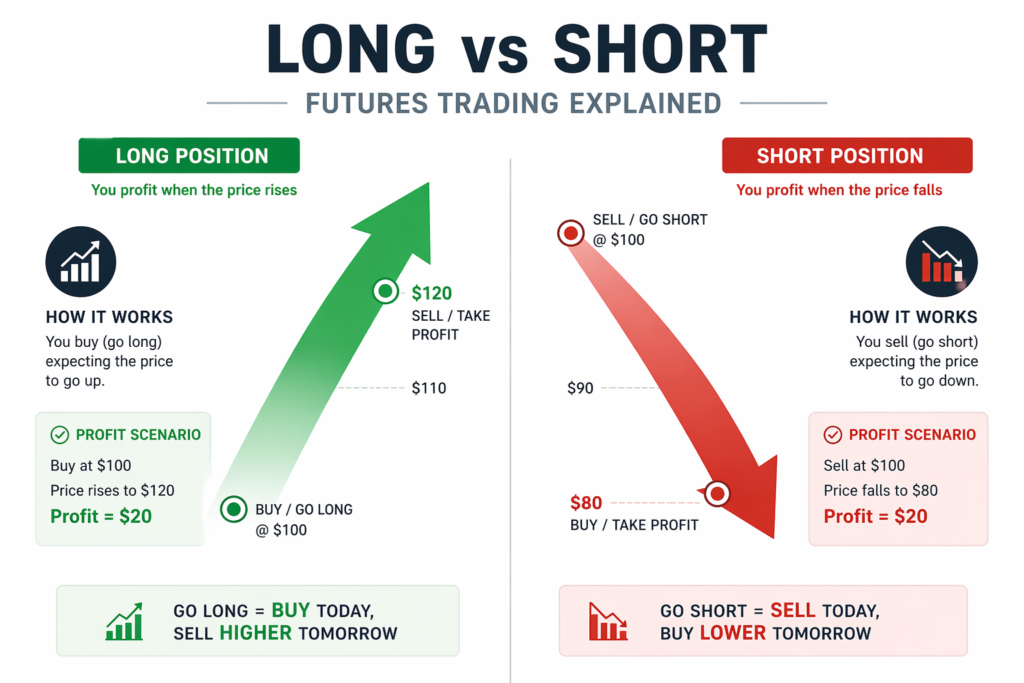
- Long Position (Buy): You profit when the price goes up
- Short Position (Sell): You profit when the price goes down
This flexibility is what makes futures trading powerful. Unlike traditional investing, you’re not limited to bullish markets. Mastering how to trade futures means knowing when to go long and when to go short based on market conditions.
Even small price changes can generate profits due to leverage, which is why timing and analysis are critical.
Scalping, Day Trading, and Swing Trading
Different traders use different styles depending on their personality, time availability, and risk tolerance.
1. Scalping
This involves making multiple quick trades to capture small price movements. Scalpers rely heavily on speed and precision. To succeed, they must deeply understand how to trade futures in fast-moving markets.
2. Day Trading
Day traders open and close positions within the same day. They avoid overnight risk and focus on intraday price action. This style requires strong discipline and a solid grasp of how to trade futures using technical analysis.
3. Swing Trading
Swing traders hold positions for several days or weeks, aiming to capture larger price moves. This approach is less intense than scalping but still requires a clear understanding of trends and how to trade futures effectively over time.
Arbitrage Opportunities
Arbitrage is a more advanced strategy where traders take advantage of price differences between markets.
For example:
- Buying a futures contract at a lower price in one market
- Selling it at a higher price in another market
The profit comes from the price gap. While this sounds simple, arbitrage requires speed, technology, and deep market knowledge. It’s another area where understanding how to trade futures can give experienced traders an edge.
5. Key Advantages of Futures Trading
Futures trading has gained massive popularity because of its unique advantages compared to other financial markets. To fully benefit from these advantages, traders must understand how to trade futures effectively and responsibly.
High Leverage
One of the biggest advantages of futures trading is high leverage. This allows traders to control large positions with a relatively small amount of capital.
For example, instead of investing $10,000, you might only need $1,000 to open a position. This means your potential profits can be significantly higher. However, losses can also be amplified, which is why learning how to trade futures with proper risk management is essential.
High Liquidity
Futures markets are known for their high liquidity, especially in popular assets like oil, gold, and stock indices.
High liquidity means:
- Faster trade execution
- Minimal price slippage
- Easier entry and exit from trades
This is particularly beneficial for active traders like scalpers and day traders. Understanding how to trade futures in liquid markets helps you take advantage of quick price changes.
Ability to Profit in Both Directions
Unlike traditional investing, futures trading allows you to make money whether the market is going up or down.
- In a rising market, you take a long position
- In a falling market, you take a short position. This flexibility gives traders more opportunities compared to markets where profits depend only on price increases. Mastering how to trade futures means recognizing market trends and positioning yourself accordingly.
6. Major Risks You Must Understand in Futures Trading
Before getting involved in futures trading, it’s important to understand that while the profit potential is high, the risks are equally significant. Many beginners enter the market focused only on gains, but ignoring risks often leads to fast losses. Below are the major risks you must be aware of in futures trading.
1. High Volatility
One of the biggest risks in futures trading is high market volatility. Prices in futures markets can move very quickly within minutes or even seconds. While this creates profit opportunities, it also increases the chance of sudden losses. A small price movement against your position can significantly impact your account.
2. Margin Calls
In futures trading, you don’t need to pay the full contract value upfront. Instead, you trade using margin (borrowed capital). If the market moves against your position and your account balance falls below the required level, you receive a margin call. This means you must deposit more funds immediately, or your position may be automatically closed at a loss.
3. Emotional Trading
Emotions play a huge role in futures trading success or failure. Fear and greed often lead traders to make impulsive decisions, such as closing trades too early or holding losing positions too long. Emotional trading usually results in inconsistent performance and long-term losses.
4. Overleveraging
Leverage is one of the most attractive features of futures trading, but it is also one of the most dangerous. Overleveraging means taking excessively large positions compared to your account size. While it can increase profits, it can just as easily amplify losses and wipe out your account quickly.
7. Proven Strategies to Make Money in Futures Trading
To succeed in futures trading, you need more than luck—you need proven strategies that help you make consistent and informed decisions. The right approach can turn market movements into real opportunities. Below are some of the most effective strategies used by professional traders in futures trading.
1. Trend-Following Strategy
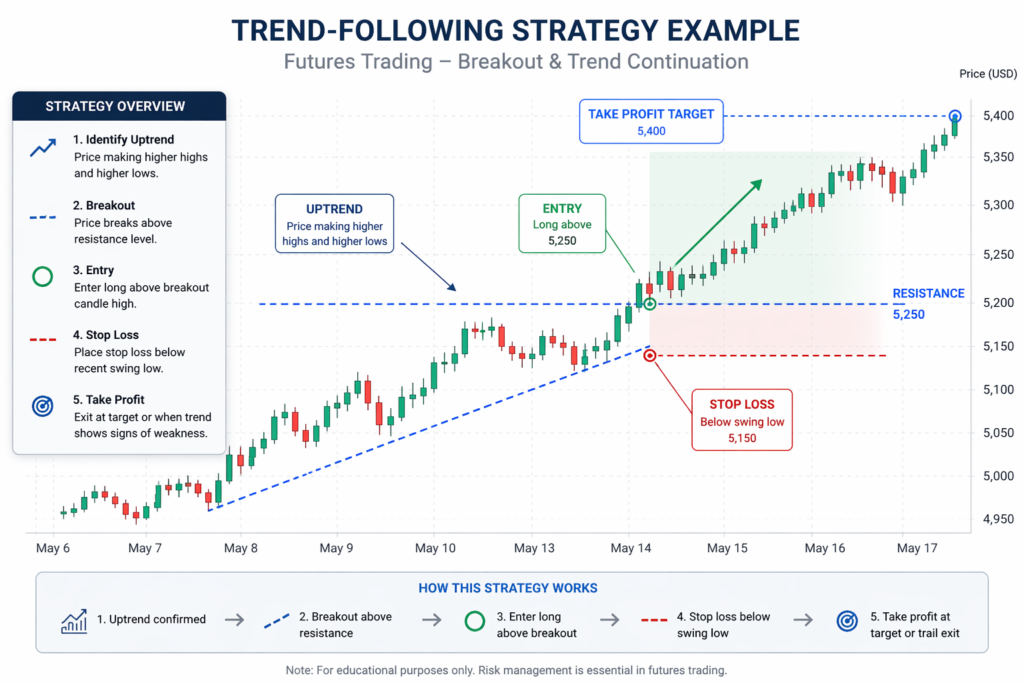
The trend-following strategy is one of the simplest and most powerful methods in futures trading. It involves identifying the direction of the market—either upward (bullish) or downward (bearish)—and trading in that direction. Traders often use tools like moving averages and trendlines to confirm trends. The idea is clear: “the trend is your friend.” By following strong trends, traders can ride momentum and capture larger profits.
2. Breakout Strategy
A breakout strategy focuses on entering trades when the price breaks through key levels of support or resistance. In futures trading, breakouts often signal the start of a strong price movement. When the market breaks above resistance, traders go long; when it breaks below support, they go short. This strategy works best in markets with high volatility and volume, where price movements are more decisive.
3. Range Trading
Range trading is ideal for markets that are not trending but moving sideways between support and resistance levels. In this futures trading strategy, traders buy near support and sell near resistance. It requires patience and precise timing, as entering trades in the middle of the range can be risky. Indicators like RSI (Relative Strength Index) are often used to identify overbought or oversold conditions within the range.
4. News-Based Trading
News-based trading involves making decisions based on economic events, reports, and global news. In futures trading, major announcements such as interest rate decisions, employment data, or geopolitical events can cause sharp price movements. Traders who stay updated with the news can take advantage of these sudden opportunities. However, this strategy requires quick decision-making and strong risk management due to unpredictable volatility.
5. Scalping Strategy
Scalping is a short-term strategy where traders make multiple trades in a day to capture small price movements. In futures trading, scalpers rely on high liquidity and tight spreads. This approach requires focus, speed, and discipline, as profits per trade are small but frequent.
6. Swing Trading Strategy
Swing trading involves holding positions for several days to capture medium-term price movements. Unlike scalping, this strategy is less stressful and allows traders to analyze the market more calmly. In futures trading, swing traders often use technical analysis and chart patterns to identify entry and exit points.
7. Hedging Strategy
Hedging is used to reduce risk rather than generate direct profit. Traders or investors use futures contracts to protect their existing positions from adverse price movements. For example, a business might use futures trading to lock in prices and avoid losses due to market fluctuations.
8. Is Futures Trading Good for Beginners?
Many new traders are attracted to futures trading because of its high profit potential, but it’s not always the best starting point. Understanding both the advantages and drawbacks is essential before deciding if futures trading is right for you.
Pros of Futures Trading for Beginners
1. High Profit Potential
One of the biggest advantages of futures trading is leverage. With a relatively small amount of capital, traders can control large positions, which can lead to significant profits if the market moves in their favor.
2. Ability to Trade Both Directions
In futures trading, you can profit whether the market is rising or falling. This flexibility allows beginners to take advantage of different market conditions.
3. High Liquidity
Futures markets are usually very liquid, meaning trades can be executed quickly with minimal price slippage. This is especially helpful for beginners who want smooth entry and exit points.
Cons of Futures Trading for Beginners
1. High Risk and Volatility
The same leverage that increases profits also increases losses. Beginners often underestimate how quickly markets can move against them.
2. Complex Market Structure
Futures trading involves contracts, margin requirements, and expiration dates, which can be confusing for new traders without proper education.
3. Emotional Pressure
Fast-moving markets can lead to stress, fear, and impulsive decisions. Many beginners struggle with discipline, which can result in losses.
Who Should Avoid Futures Trading?
- Complete Beginners with No Market Knowledge
If you don’t understand basic trading concepts, jumping into futures can be risky. - People with Low Risk Tolerance
If you are uncomfortable with the possibility of losing money quickly, this market may not suit you. - Undisciplined Traders
Those who struggle with emotional control or risk management should avoid futures trading until they develop a solid plan.
FAQs
1. Can You Make a Living Trading Futures?
Yes, it is possible to make a living from futures trading, but it is not easy. It requires strong skills, discipline, risk management, and consistent performance over time. Most beginners lose money at first, so it’s important to treat trading like a business, not a shortcut to quick wealth.
2. How Much Capital Do You Need?
The amount of capital needed for futures trading depends on the market and your strategy. Some brokers allow you to start with a few hundred dollars, but realistically, traders often begin with at least $2,000–$10,000 to manage risk properly. More capital gives you better flexibility and reduces the impact of losses.
3. What Is the Safest Futures Strategy?
There is no “completely safe” strategy in futures trading, but some are considered lower risk than others. Trend-following with proper stop-losses, swing trading, and risk-controlled position sizing are generally safer approaches. The key is not the strategy itself, but how well you manage risk.
4. Is Futures Trading Better Than Forex?
It depends on your goals and trading style. Futures trading offers centralized exchanges, better transparency, and often lower spreads, while forex provides more flexibility and 24/5 trading. Some traders prefer futures for reliability, while others prefer forex for accessibility.
5. Is Futures Trading Good for Beginners?
Many people search this question because futures trading can be complex. While beginners can learn it, it’s generally recommended to start with education and demo trading before risking real money.
Yes, it is possible to make a living from futures trading, but it is not easy. It requires strong skills, discipline, risk management, and consistent performance over time. Most beginners lose money at first, so it’s important to treat trading like a business, not a shortcut to quick wealth.
The amount of capital needed for futures trading depends on the market and your strategy. Some brokers allow you to start with a few hundred dollars, but realistically, traders often begin with at least $2,000–$10,000 to manage risk properly. More capital gives you better flexibility and reduces the impact of losses.
There is no “completely safe” strategy in futures trading, but some are considered lower risk than others. Trend-following with proper stop-losses, swing trading, and risk-controlled position sizing are generally safer approaches. The key is not the strategy itself, but how well you manage risk.
It depends on your goals and trading style. Futures trading offers centralized exchanges, better transparency, and often lower spreads, while forex provides more flexibility and 24/5 trading. Some traders prefer futures for reliability, while others prefer forex for accessibility.
Many people search this question because futures trading can be complex. While beginners can learn it, it’s generally recommended to start with education and demo trading before risking real money.
Conclusion
Futures trading offers a powerful opportunity for those who want to grow their wealth, but it comes with serious responsibility. The same features that make futures trading attractive—leverage, liquidity, and the ability to profit in both rising and falling markets—also make it risky if not handled properly.
The final verdict is simple: futures trading is not a shortcut to success, but a skill-based activity that rewards discipline, patience, and continuous learning. Traders who take the time to understand the market, manage risk effectively, and control their emotions can unlock its true potential.
At the same time, ignoring risk management or relying on luck can quickly lead to losses. That’s why responsibility is the key factor. Every successful trader approaches futures trading with a clear plan, realistic expectations, and strict rules to protect their capital.