1. Introduction
What is Trading?
Trading is the process of buying and selling financial assets such as currencies, commodities, stocks, or derivatives with the goal of making a profit. Traders aim to take advantage of price movements in the market, whether prices go up or down. In today’s digital world, trading has become more accessible than ever, allowing individuals to participate in global markets from their own devices. Two of the most popular markets are futures and forex, which is why the topic of futures trading vs forex has gained significant attention among beginners and experienced traders alike.
Why Compare Futures Trading vs Forex?
Understanding the differences between these two markets is essential before you start trading. The debate around futures trading vs forex helps traders identify which market suits their goals, risk tolerance, and trading style. While both offer opportunities to profit, they operate differently in terms of structure, liquidity, regulation, and risk exposure.
When analyzing futures trading vs forex, traders often look at factors such as leverage, trading hours, and market volatility. For example, forex markets run 24 hours a day, while futures markets follow specific exchange hours. These distinctions can significantly impact your strategy and profitability.
2. What Is Futures Trading?
Definition of Futures Contracts
Futures trading is based on standardized agreements known as futures contracts. A futures contract is a legal agreement to buy or sell an asset at a predetermined price on a specific future date. These assets can include commodities like oil and gold, financial instruments like stock indices, or even currencies. Unlike spot trading, where transactions happen instantly, futures contracts are settled at a later date, making them unique when comparing futures trading vs forex.
In discussions around futures trading vs forex, futures contracts stand out because they are traded on centralized exchanges. This means pricing is transparent, and all participants see the same market data, which adds a layer of trust and regulation that some traders prefer.
How Futures Trading Works
Futures trading works by speculating on the future price of an asset. Traders can either go “long” (buy) if they expect prices to rise or go “short” (sell) if they anticipate a decline. The goal is to profit from price movements rather than owning the actual asset.
One key feature of futures trading is leverage. Traders only need to deposit a small percentage of the total contract value, known as margin, to control a much larger position. This is an important factor often highlighted in futures trading vs forex, as both markets offer leverage but in different ways.
Another important aspect of how futures trading works is daily settlement, also known as “mark-to-market.” This means profits and losses are calculated and updated at the end of each trading day. When comparing futures trading vs forex, this mechanism can affect risk management strategies and capital requirements.
Additionally, futures contracts have expiration dates, which means traders must close or roll over their positions before the contract expires. This is a major difference often discussed in futures trading vs forex, since forex trading does not involve contract expirations in the same way.
Overall, understanding how futures trading works is essential when evaluating futures trading vs forex, as it helps traders decide which market structure, risk profile, and trading environment best suits their needs.
3. What Is Forex Trading?
Definition of Forex Market
Forex trading, also known as foreign exchange trading, involves buying and selling currencies in the global marketplace. The forex market is the largest and most liquid financial market in the world, where currencies are traded in pairs such as EUR/USD or GBP/JPY. Unlike centralized exchanges, forex operates through a decentralized network of banks, brokers, and financial institutions. This structural difference is one of the key points often highlighted in futures trading vs forex comparisons.
When traders explore futures trading vs forex, they quickly notice that the forex market runs 24 hours a day, five days a week. This continuous operation allows traders to react to global economic events in real time, making it highly attractive for those who prefer flexibility in their trading schedules.
How Currency Trading Works
Currency trading works by speculating on the value of one currency relative to another. In every trade, you are simultaneously buying one currency and selling another. For example, if you believe the euro will strengthen against the US dollar, you would buy the EUR/USD pair. If the price increases, you make a profit; if it decreases, you incur a loss.
Leverage is also a major feature in forex trading, allowing traders to control large positions with a relatively small investment. This is another important factor discussed in futures trading vs forex, as both markets offer leverage but with different levels of regulation and risk exposure.
Additionally, forex trading does not involve contract expiration dates like futures trading. Positions can be held as long as margin requirements are maintained. This flexibility is often emphasized in futures trading vs forex, especially for traders who prefer not to deal with time-limited contracts.
Another key aspect of how currency trading works is the use of spreads—the difference between the buying and selling price. These spreads represent the cost of trading and can vary depending on market conditions and brokers. When analyzing futures trading vs forex, understanding these cost structures is essential for effective risk management.
4. Key Differences Between Futures Trading and Forex
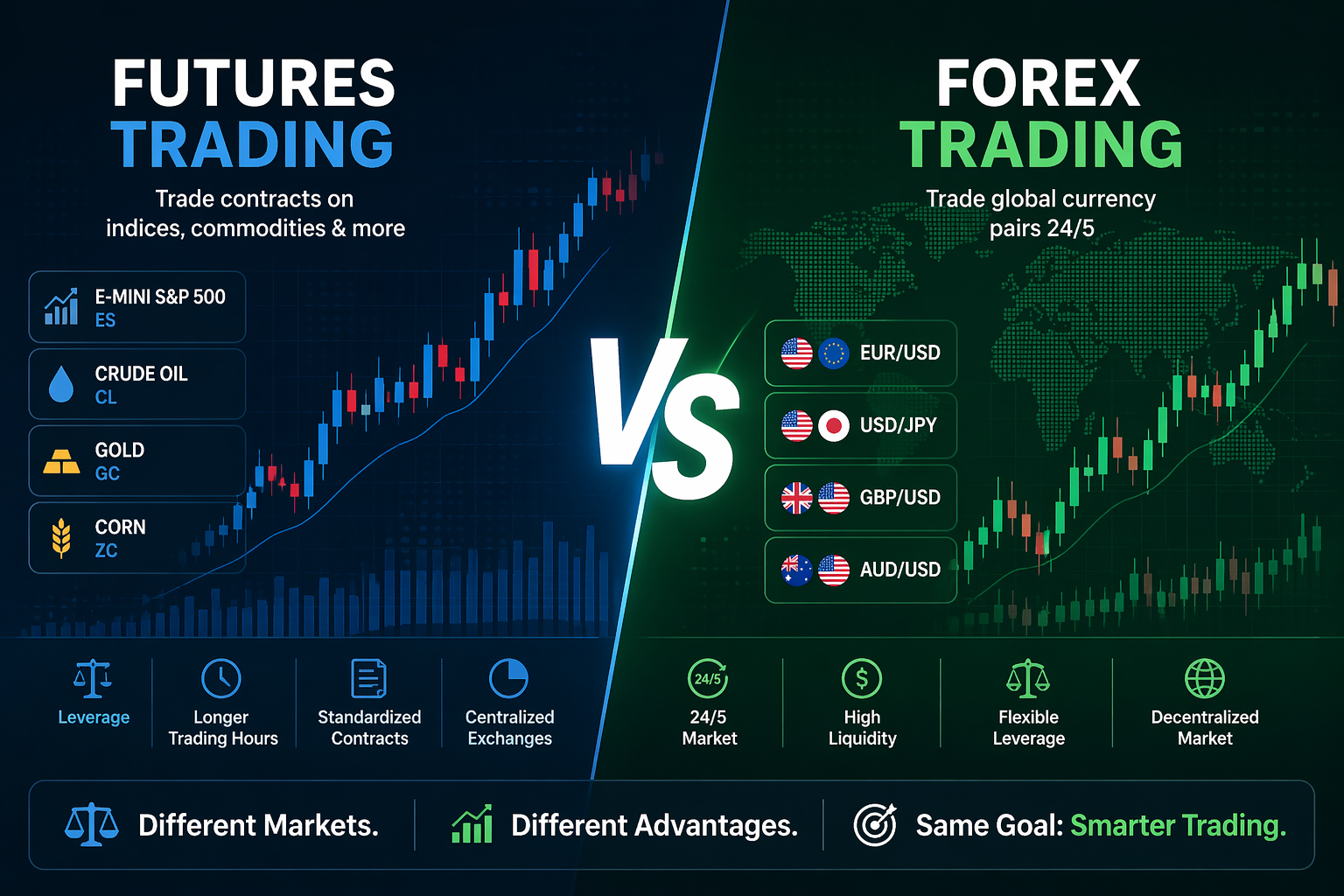
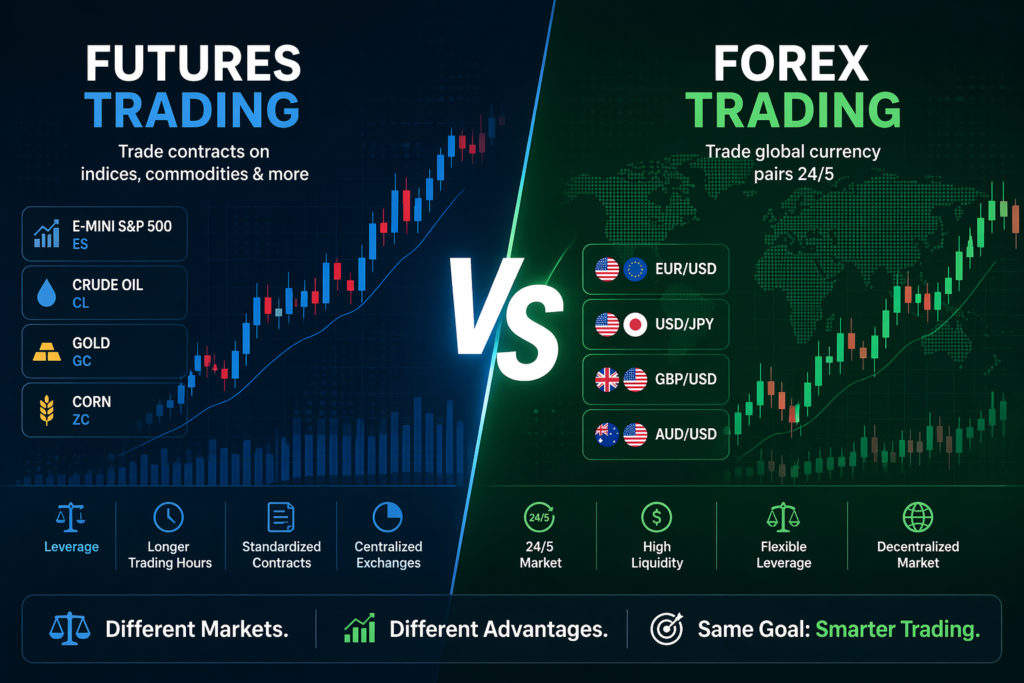
When comparing futures trading vs forex, it’s important to understand the core differences that set these two markets apart. Each has its own structure, trading environment, and risk profile, which can significantly impact your trading decisions.
Market Structure
One of the biggest distinctions in futures trading vs forex is market structure. Futures trading takes place on centralized exchanges, where all trades are standardized and regulated. This ensures transparency, as every trader sees the same prices and data. In contrast, the forex market is decentralized, operating through a global network of banks and brokers. This means pricing can vary slightly depending on the broker you use.
Trading Hours
Another key difference in futures trading vs forex is trading hours. The forex market operates 24 hours a day, five days a week, allowing traders to participate at almost any time. Futures markets, however, have specific trading sessions depending on the exchange, although many major contracts offer extended hours. This difference can influence your trading strategy, especially if you prefer flexibility.
Liquidity
Liquidity refers to how easily assets can be bought or sold without affecting their price. In the debate of futures trading vs forex, both markets are highly liquid, but forex is the largest financial market in the world, offering extremely high liquidity. Futures markets also provide strong liquidity, especially for popular contracts like oil or stock indices, but may be less liquid than forex during off-peak hours.
Leverage
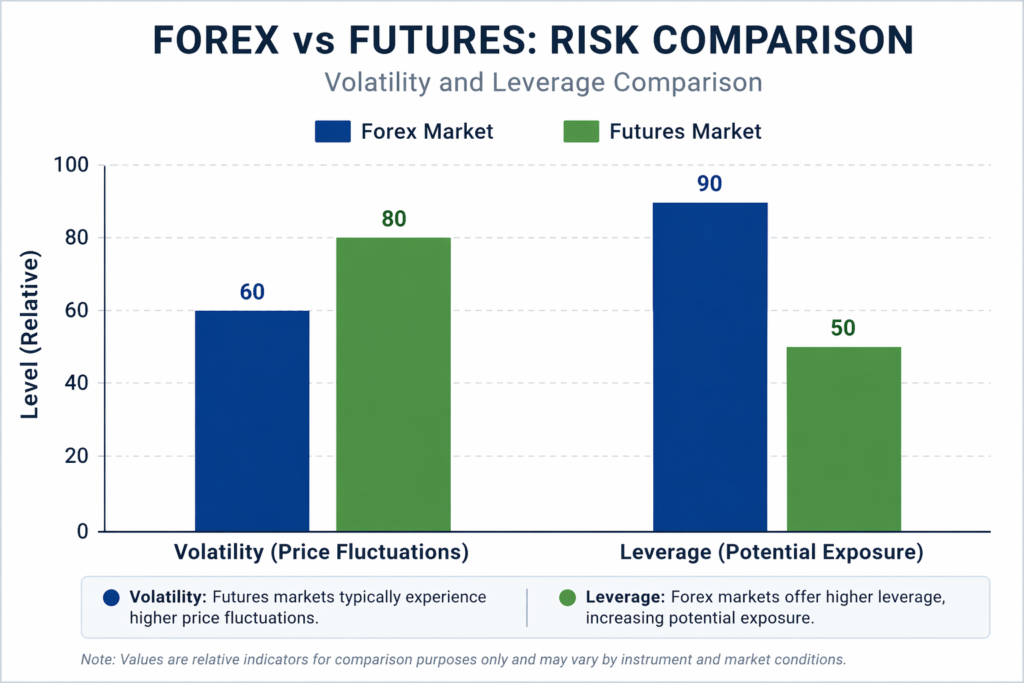
Leverage is a crucial factor when evaluating futures trading vs forex. Both markets allow traders to control large positions with a small amount of capital. However, forex brokers often offer higher leverage compared to futures exchanges. While this can increase potential profits, it also significantly increases risk, making proper risk management essential in both markets.
Regulation
Regulation is another major point of comparison in futures trading vs forex. Futures markets are typically highly regulated by official exchanges and governing bodies, providing a structured and secure trading environment. Forex regulation, on the other hand, varies depending on the country and broker. Some brokers operate under strict regulations, while others may not, which can affect safety and reliability.
5. Pros and Cons of Futures Trading
When analyzing futures trading vs forex, it’s important to understand the advantages and disadvantages of futures trading. This helps traders decide whether this market aligns with their goals, experience level, and risk tolerance.
Advantages of Futures Trading
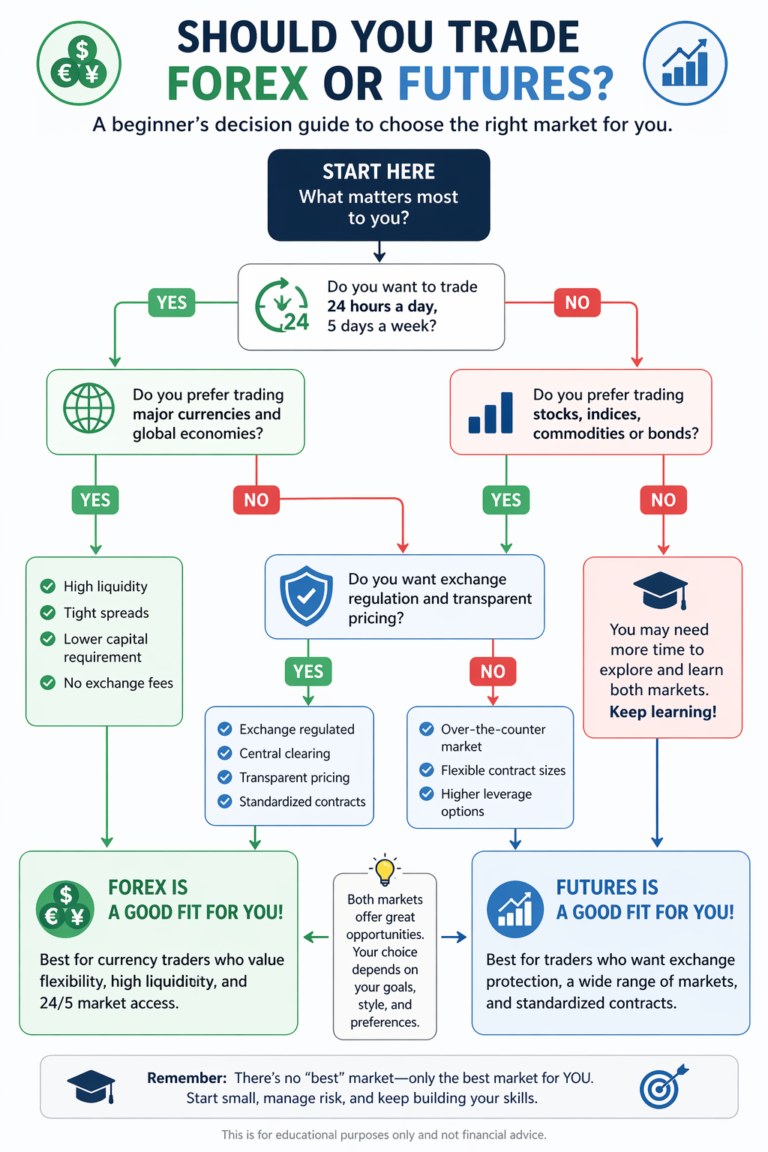
One of the biggest benefits highlighted in futures trading vs forex is transparency. Futures markets operate on centralized exchanges, which means all traders see the same prices and data. This reduces the chances of price manipulation and creates a more reliable trading environment.
Leverage is also a key advantage. Futures trading allows traders to control large contract sizes with a relatively small margin. When discussing futures trading vs forex, this leverage can lead to significant profit opportunities if used wisely.
Additionally, futures trading offers the ability to profit in both rising and falling markets. Traders can go long or short بسهولة, making it flexible for different market conditions. This is another point often mentioned in futures trading vs forex comparisons.
Finally, futures markets are highly regulated, which provides a sense of security for traders. Compared to some forex brokers, this strong regulatory framework is a major advantage in the futures trading vs forex debate.
Disadvantages of Futures Trading
Despite its benefits, futures trading also comes with notable drawbacks. One major disadvantage in futures trading vs forex is the complexity. Futures contracts can be difficult for beginners to understand, especially with factors like expiration dates and contract specifications.
Another downside is the risk associated with leverage. While leverage can amplify profits, it can also lead to large losses. In the context of futures trading vs forex, futures trading often requires strict risk management to avoid significant financial setbacks.
Futures contracts also have expiration dates, which means traders must close or roll over positions. This adds an extra layer of decision-making that is not present in forex trading, making it a key difference in futures trading vs forex.
Additionally, futures markets do not operate 24/7 like forex. Limited trading hours can restrict opportunities, especially for traders who prefer flexibility. This limitation is often discussed in futures trading vs forex comparisons.
Lastly, the capital requirements for futures trading can be higher compared to forex. This can be a barrier for beginners who want to start with a smaller investment, making it an important consideration when evaluating futures trading vs forex.
Understanding these pros and cons will help you make a smarter decision and choose the trading market that best fits your financial goals and trading style.
6. Pros and Cons of Forex Trading
Advantages of Forex Trading
When discussing futures trading vs forex, the forex market stands out for several strong advantages that attract both beginners and experienced traders.
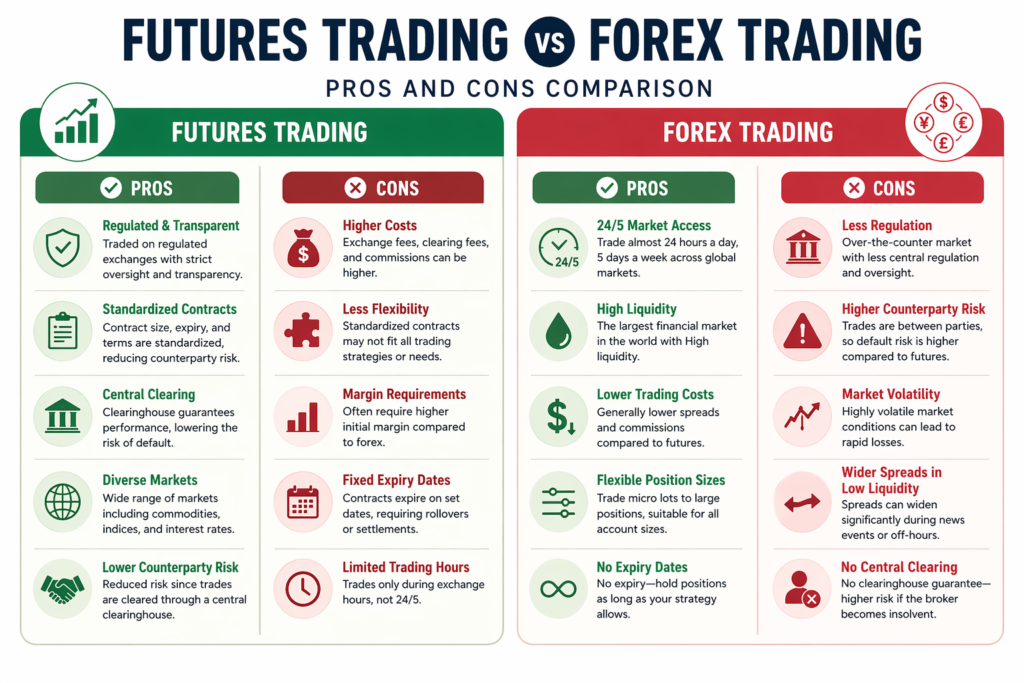
One of the biggest advantages is accessibility. Forex trading allows you to start with a relatively small amount of capital compared to futures. In the comparison of futures trading vs forex, this low entry barrier makes forex more appealing for new traders who want to test the market without risking large sums of money.
Another key benefit is 24-hour market access. The forex market operates five days a week, 24 hours a day, allowing traders to enter and exit trades at almost any time. This flexibility is a major highlight in futures trading vs forex, especially for people who cannot trade during fixed hours.
High liquidity is also a major advantage. Forex is the largest financial market in the world, meaning there are always buyers and sellers available. In futures trading vs forex, this high liquidity ensures tight spreads and fast trade execution, which is ideal for active traders.
Forex trading also offers high leverage, enabling traders to control large positions with a small investment. While this increases potential profits, it also requires careful risk management. This is a commonly discussed factor in futures trading vs forex, as leverage plays a major role in both markets.
Another advantage is the simplicity of trading. Forex trading focuses mainly on currency pairs, making it easier to understand compared to the wide range of futures contracts. When comparing futures trading vs forex, many beginners find forex more straightforward to learn and start with.
Lastly, forex trading does not involve contract expiration dates, allowing traders to hold positions as long as they want (as long as margin requirements are met). This flexibility is often highlighted in futures trading vs forex, especially for swing traders and long-term traders.
7. Capital Requirements
Understanding capital requirements is essential when comparing futures trading vs forex, as it directly affects how much money you need to start and how you manage risk.
Minimum Investment Comparison
One of the biggest differences in futures trading vs forex is the minimum investment required. Forex trading is known for its low entry barrier. Many brokers allow you to start with as little as $10 to $100, making it accessible for beginners. This is why, in the debate of futures trading vs forex, forex is often the preferred choice for traders with limited capital.
On the other hand, futures trading typically requires a higher initial investment. Depending on the contract (such as oil, gold, or index futures), traders may need hundreds or even thousands of dollars to meet the minimum margin requirements. When analyzing futures trading vs forex, this higher capital requirement can be a challenge for new traders.
However, while forex allows smaller starting amounts, it’s important to note that trading with very low capital can increase risk due to over-leveraging. This is a key consideration in futures trading vs forex, as both markets require proper risk management regardless of starting capital.
Margin Differences
Margin is the amount of money required to open and maintain a trading position. In futures trading vs forex, margin works differently in each market.
In futures trading, margin is set by the exchange and is relatively fixed. Traders must maintain an initial margin to open a position and a maintenance margin to keep it open. If the account balance falls below this level, a margin call occurs. This structured system is often highlighted in futures trading vs forex because it adds discipline and transparency.
In contrast, forex margin is typically set by brokers and can vary widely. Forex brokers often offer very high leverage, which means lower margin requirements. While this allows traders to open larger positions with less capital, it also increases the risk of significant losses. This flexibility is a major talking point in futures trading vs forex, as it can be both an advantage and a disadvantage.
Overall, when comparing futures trading vs forex, forex is more accessible for beginners due to lower capital requirements, while futures trading offers a more structured margin system that may appeal to experienced traders seeking discipline and transparency.
8. Futures vs Forex: Which Should You Choose?
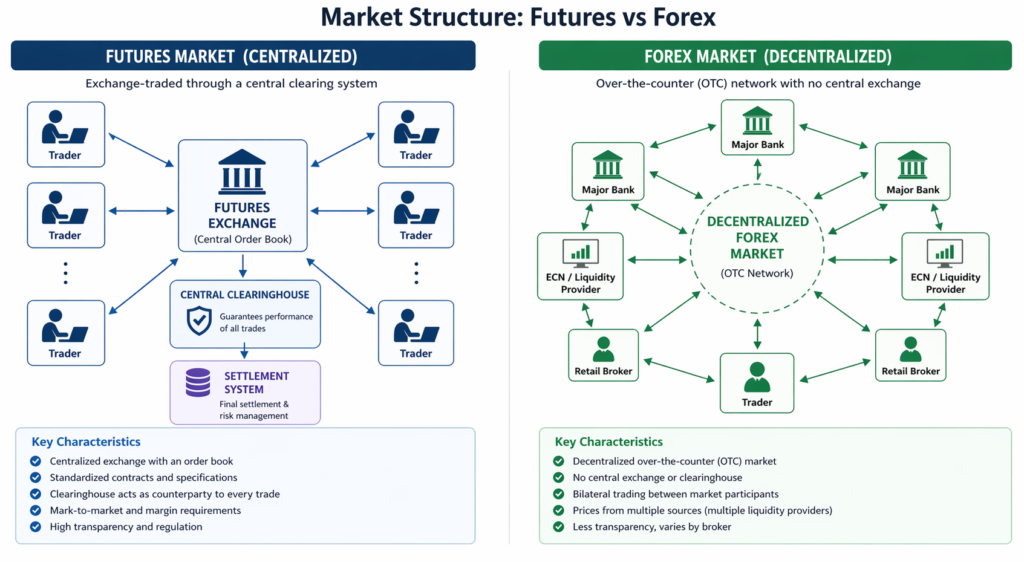
Choosing between these two markets depends on your personal situation, trading style, and financial goals. The comparison of futures trading vs forex is not about which one is better overall, but which one is better for you.
Based on Your Goals
Your trading goals play a major role in deciding between futures trading and forex. If you are looking for a structured and transparent market with centralized pricing, futures trading may be the better choice. It is often preferred by traders who want consistency and discipline in their trading environment.
On the other hand, if your goal is flexibility and the ability to trade anytime, forex trading is more suitable. In futures trading vs forex, forex stands out because of its 24-hour market access, making it ideal for part-time traders or those with busy schedules.
Based on Your Capital
Capital is another key factor in futures trading vs forex. If you are starting with a small budget, forex trading is generally the better option. It allows you to open positions with minimal capital and offers more accessibility for beginners.
However, if you have a larger amount of capital and prefer a more regulated and structured system, futures trading may be more appropriate. In the discussion of futures trading vs forex, futures often require higher margin but provide more standardized trading conditions.
Based on Your Risk Tolerance
Risk tolerance is perhaps the most important factor when choosing between futures trading vs forex. Both markets involve leverage, which can amplify profits as well as losses.
If you are comfortable with higher risk and can manage leverage effectively, futures trading might suit you. It offers strong volatility and structured risk management through margin requirements.
If you prefer more flexibility in position sizing and risk exposure, forex trading may be a better fit. In futures trading vs forex, forex allows traders to adjust their lot sizes more easily, which can help in controlling risk—especially for beginners
9. Final Verdict
When it comes to choosing between the two, there is no absolute winner in the debate of futures trading vs forex. The best choice depends entirely on the type of trader you are, your experience level, and how you approach risk and capital.
For beginners and low-capital traders, forex is often the better starting point. In the comparison of futures trading vs forex, forex stands out due to its low entry requirements, flexible position sizes, and 24-hour market access. It allows new traders to learn the basics without committing large amounts of money.
For experienced traders and professionals, futures trading may be the better option. In futures trading vs forex, futures offer a more structured and transparent environment through centralized exchanges. This makes it ideal for traders who value consistency, regulation, and standardized contract conditions.
For part-time traders, forex has a clear advantage. The ability to trade anytime during the day or night makes it easier to fit into a busy schedule. This flexibility is a major reason why many choose forex in the futures trading vs forex comparison.
For disciplined, strategy-focused traders, futures trading can be more suitable. The fixed contract sizes, margin requirements, and expiration dates encourage a more structured approach, which can help improve long-term consistency when comparing futures trading vs forex.
For risk-tolerant traders, both markets offer opportunities, but futures trading may provide a more controlled environment due to regulated leverage and margin systems. Meanwhile, forex offers higher flexibility but can expose traders to greater risk if not managed properly—another important factor in futures trading vs forex.