Introduction
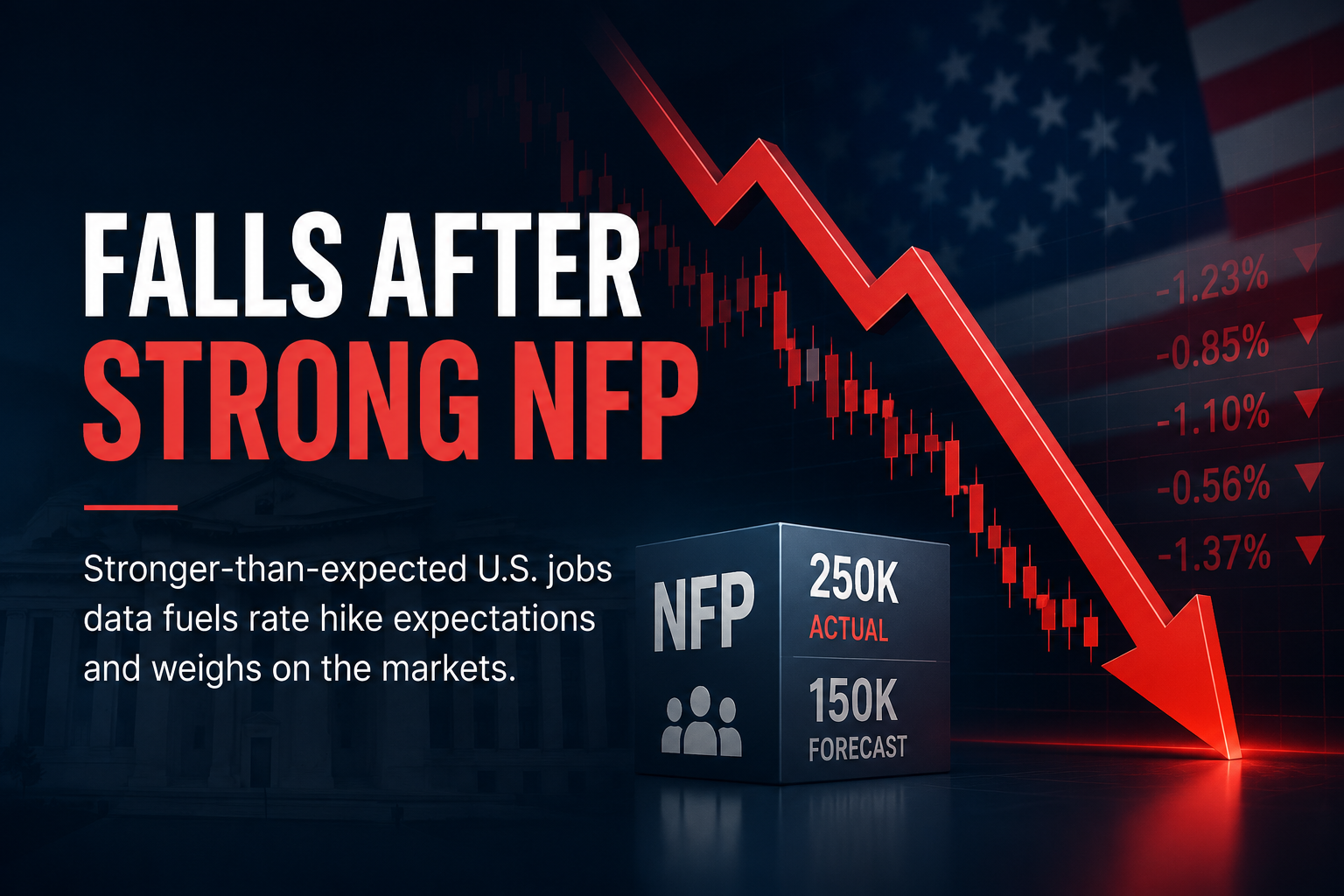
Every month, traders around the world closely watch the release of the Non-Farm Payrolls (NFP) report because it is one of the most influential economic events in the financial markets. Within minutes of the announcement, major assets such as gold, the US dollar, and stock indices can experience sharp price swings. For gold traders, understanding Why Gold Falls After Strong NFP Data is essential because these movements often create both opportunities and risks.
If you have ever wondered Why Gold Falls After Strong NFP Data, you are not alone. Many beginner traders see gold prices drop immediately after a strong employment report but struggle to understand the economic forces driving the move. Without knowing the relationship between employment data, interest rates, the US dollar, and investor sentiment, it is easy to make costly trading decisions.
This guide will clearly explain Why Gold Falls After Strong NFP Data using simple language and real-world examples. Instead of relying on complex financial jargon, you’ll learn the economic logic behind gold’s reaction to stronger-than-expected jobs data and how professional traders interpret the market.
By the end of this article, you will understand Why Gold Falls After Strong NFP Data, how the NFP report influences Federal Reserve expectations, why a stronger US dollar often pressures gold prices, and what trading strategies can help you navigate NFP day with greater confidence. Whether you are new to gold trading or looking to improve your market analysis, learning Why Gold Falls After Strong NFP Data will help you make more informed trading decisions during one of the most important economic events each month.
What Is the Non-Farm Payroll (NFP) Report?
The Non-Farm Payroll (NFP) Report is one of the most influential economic reports in the world. Every month, millions of traders, investors, economists, and financial institutions closely monitor this report because it often triggers significant movements in the financial markets. Understanding the NFP report is especially important if you trade forex, gold, stocks, or cryptocurrencies.
If you’ve ever wondered Why Gold Falls After Strong NFP Data, the answer starts with understanding what the NFP report measures and why markets react so strongly to it.
What Is the Non-Farm Payroll (NFP) Report?
The Non-Farm Payroll (NFP) Report is a monthly employment report that measures the number of jobs added or lost in the United States, excluding certain categories of workers.
It tracks employment changes in most industries except:
- Farm workers
- Private household employees
- Non-profit organization employees
- Active military personnel
- Self-employed individuals
Because it covers the majority of the U.S. workforce, the NFP report is considered one of the best indicators of the country’s economic health.
A stronger-than-expected report usually signals economic growth, while a weaker report may indicate slowing economic activity.
Understanding this report also helps explain Why Gold Falls After Strong NFP Data, as employment numbers directly influence expectations for interest rates and the value of the U.S. dollar.
Because it covers the majority of the U.S. workforce, the NFP report is considered one of the best indicators of the country’s economic health.
A stronger-than-expected report usually signals economic growth, while a weaker report may indicate slowing economic activity.
Understanding this report also helps explain Why Gold Falls After Strong NFP Data, as employment numbers directly influence expectations for interest rates and the value of the U.S. dollar.
Who Publishes the NFP Report?
The Non-Farm Payroll Report is published by the U.S. Bureau of Labor Statistics (BLS), a government agency under the U.S. Department of Labor.
The BLS collects employment data from thousands of businesses and government agencies across the country to provide an accurate picture of labor market conditions.
Each report typically includes:
- Total non-farm payroll employment
- Unemployment rate
- Average hourly earnings
- Average weekly working hours
- Labor force participation rate
- Revisions to previous months’ employment data
These figures help investors evaluate the strength of the U.S. economy and anticipate future monetary policy decisions by the Federal Reserve.
The NFP report is released once every month, usually on the first Friday of the month.
Release Time
- 8:30 AM Eastern Time (ET)
- 1:30 PM GMT (during standard time)
- Timing may vary slightly depending on daylight saving adjustments.
The report summarizes employment data from the previous month.
Why Traders Prepare Early
Market participants often prepare well before the release because:
- Volatility increases sharply.
- Spreads can widen significantly.
- Gold and forex prices may move hundreds of pips within minutes.
- Trading volume rises dramatically.
This is one reason many traders study Why Gold Falls After Strong NFP Data before trading the news, as understanding the relationship can help them manage risk more effectively.
Why the NFP Report Matters
The Non-Farm Payroll report is considered one of the most important economic indicators because employment is closely tied to overall economic growth.
When businesses hire more workers:
- Consumer spending generally increases.
- Economic activity expands.
- Business confidence improves.
- Inflationary pressures may rise.
Conversely, weak employment growth can signal slower economic activity and reduced consumer demand.
Impact on the Federal Reserve
The Federal Reserve closely watches employment data when deciding whether to:
- Raise interest rates
- Lower interest rates
- Keep monetary policy unchanged
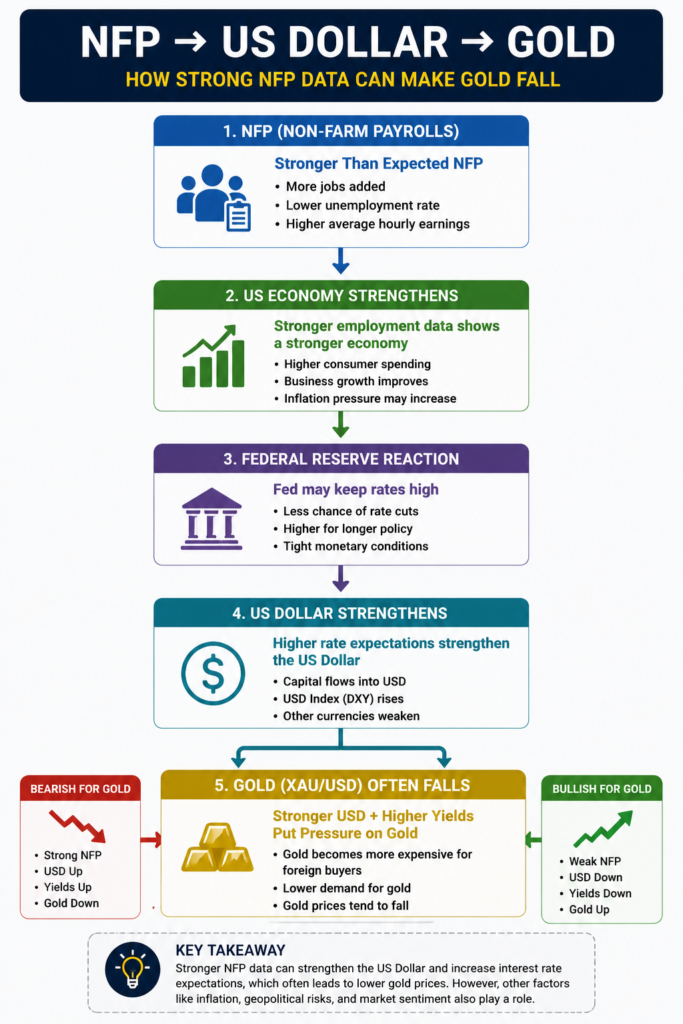
A strong jobs report may encourage the Fed to maintain higher interest rates, while weak employment numbers can increase expectations for rate cuts.
This monetary policy connection is a major reason Why Gold Falls After Strong NFP Data is one of the most searched questions among traders.
Does Gold Always Fall After Strong NFP?
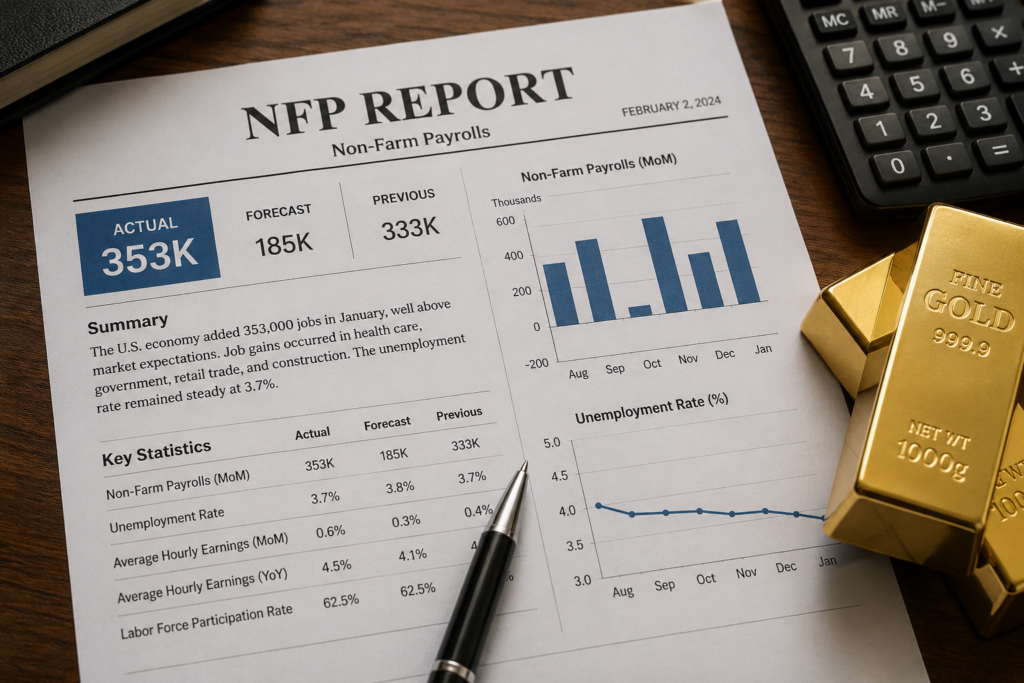
Many traders assume that Why Gold Falls After Strong NFP Data has a simple answer: strong jobs data equals lower gold prices. However, the reality is much more complex. While gold often declines after a stronger-than-expected Non-Farm Payroll (NFP) report, it does not always fall. Multiple economic factors influence how the market reacts, and understanding them is essential for making informed trading decisions.
If you want to understand Why Gold Falls After Strong NFP Data, you need to look beyond the headline payroll number. Professional traders analyze several supporting indicators before deciding whether to buy or sell gold.
1. Market Expectations Matter More Than the Headline
Financial markets are forward-looking. Before the NFP report is released, economists and analysts publish forecasts for expected job growth.
For example:
- Expected NFP: 180,000 jobs
- Actual NFP: 190,000 jobs
Although the report is technically stronger than expected, the difference may not be large enough to surprise investors. In this case, gold may remain stable or even rise if traders have already priced in a stronger report.
2. Wage Growth Can Change the Market Reaction
Average Hourly Earnings are one of the most important parts of the employment report.
Strong wage growth suggests:
- Higher consumer spending
- Rising inflation pressure
- Increased likelihood of Federal Reserve interest rate hikes
Higher interest rates usually make gold less attractive because gold does not generate interest or dividend income.
3. The Unemployment Rate Is Equally Important
Another major factor is the unemployment rate.
A lower unemployment rate generally indicates a healthy labor market and supports a stronger U.S. dollar, which can put downward pressure on gold prices.
However, there are situations where:
- Payrolls increase
- Unemployment unexpectedly rises
This mixed economic signal creates uncertainty. Instead of selling gold aggressively, investors may wait for additional economic data before taking positions.
This explains why Gold Falls After Strong NFP Data depends on the complete employment report rather than a single statistic.
4. Revisions to Previous NFP Reports
Many beginner traders ignore revisions to previous months’ employment data, but institutional investors pay close attention to them.
For example:
- Current NFP: +250,000 jobs
- Previous month’s revision: -120,000 jobs
Although the latest report appears strong, large downward revisions may weaken confidence in the overall labor market.
Real Historical Examples: Why Gold Falls After Strong NFP Data
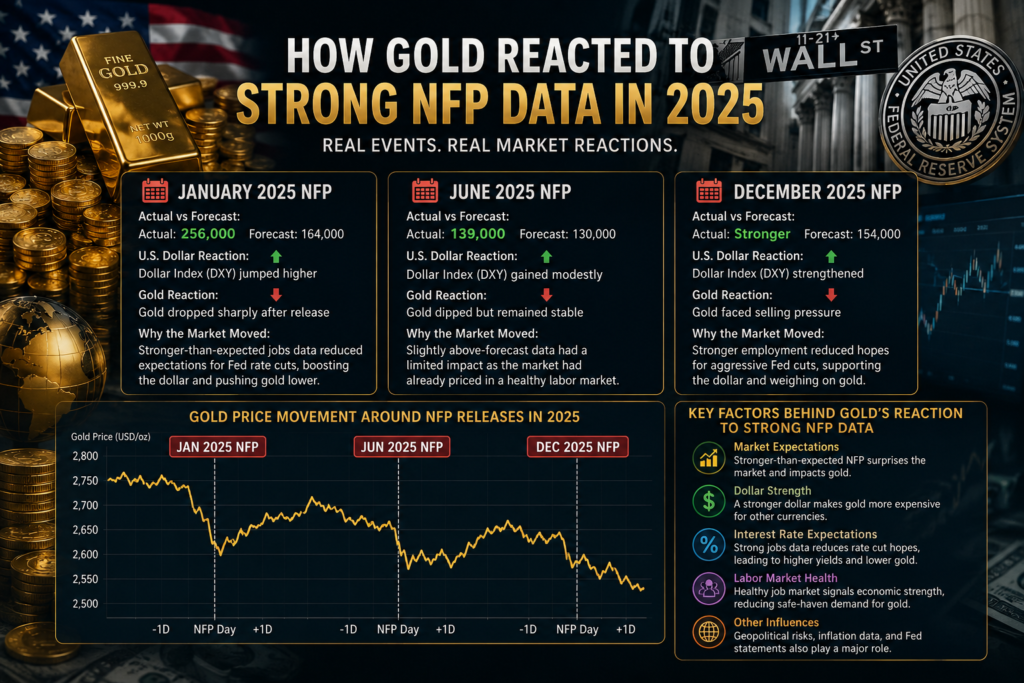
Studying real market events is one of the best ways to understand Why Gold Falls After Strong NFP Data. While strong employment numbers often push gold lower, the size of the move depends on market expectations, Federal Reserve policy expectations, and investor sentiment. Below are three real NFP releases from 2025 that show how gold reacted.
January 2025 NFP Release (Released: January 10, 2025)
Actual vs Forecast
- Forecast: 164,000 jobs
- Actual: 256,000 jobs
- Result: Much stronger than expected.
U.S. Dollar Reaction
The U.S. Dollar Index (DXY) rallied sharply as traders reduced expectations for near-term Federal Reserve rate cuts. Higher Treasury yields also supported the dollar.
June 2025 NFP Release (Released: June 6, 2025)
Actual vs Forecast
- Forecast: Approximately 130,000 jobs
- Actual: Approximately 139,000 jobs
- Result: Slightly stronger than expected.
U.S. Dollar Reaction
The dollar gained modestly following the report as traders viewed the labor market as remaining healthy, but the move was limited because the surprise was relatively small.
June 2025 NFP Release (Released: June 6, 2025)
Actual vs Forecast
- Forecast: Approximately 130,000 jobs
- Actual: Approximately 139,000 jobs
- Result: Slightly stronger than expected.
U.S. Dollar Reaction
The dollar gained modestly following the report as traders viewed the labor market as remaining healthy, but the move was limited because the surprise was relatively small.
How Professional Traders Prepare for NFP
Professional traders know that the Non-Farm Payroll (NFP) report is one of the most volatile economic events in the financial markets. Instead of guessing the market’s direction, they follow a structured trading plan to manage risk and capitalize on opportunities. Understanding Why Gold Falls After Strong NFP Data is only one part of successful trading—the other part is preparing for the event with discipline and proper risk management.
Below are the key steps professional traders take before every NFP release.
1. Check the Economic Calendar
The first thing professional traders do is review the economic calendar well before the NFP announcement. They don’t just look at the release date—they also monitor:
- NFP forecast
- Previous month’s NFP data
- Average Hourly Earnings (Wage Growth)
- Unemployment Rate
- Other high-impact U.S. economic events
2. Follow Strict Risk Management
Professional traders understand that NFP can cause gold prices to move by $20–$50 or more within minutes. Instead of increasing their trade size, they focus on protecting their capital.
Their risk management plan usually includes:
- Risking only 1–2% of account balance per trade
- Always use a stop-loss order
- Avoiding overleveraging
- Accepting that missing a trade is better than taking an unnecessary loss
Since Why Gold Falls After Strong NFP Data depends on several economic factors, experienced traders never assume the market will move in one direction.
3. Identify Key Support and Resistance Levels
Before the NFP report is released, professional traders mark important technical price levels on their charts.
These include:
- Major support levels
- Major resistance levels
- Previous day’s high and low
- Weekly highs and lows
- Psychological price levels
These areas often become the points where gold experiences strong breakouts or reversals after the NFP announcement.
Combining technical analysis with economic data provides a much clearer understanding of Why Gold Falls After Strong NFP Data and where the price may react.
4. Wait for Market Confirmation
One of the biggest mistakes beginners make is entering a trade immediately after the NFP numbers are released.
Professional traders usually wait for:
- The first 5–15 minutes of volatility to settle
- A confirmed breakout or reversal
- Increased trading volume
- Price action confirmation before entering
This approach helps them avoid false breakouts and sudden price spikes that are common during major news events.
Rather than predicting the market, they let the market reveal its direction first.
Frequently Asked Questions (FAQs)
1. Why does gold fall after strong NFP?
Gold often falls after a stronger-than-expected Non-Farm Payroll (NFP) report because it signals a healthy U.S. economy. Strong employment data can increase expectations that the Federal Reserve will keep interest rates higher for longer. Higher interest rates usually strengthen the U.S. dollar and Treasury yields, making non-yielding assets like gold less attractive. This is the primary reason Why Gold Falls After Strong NFP Data in many market situations.
2. Can gold rise after strong NFP?
Yes. Gold can still rise even after a strong NFP report. If the market had already priced in strong job growth, or if other parts of the report—such as weak wage growth or a higher unemployment rate—disappoint investors, gold may recover or even rally. Geopolitical tensions, inflation concerns, or safe-haven demand can also outweigh the impact of strong employment data.
3. What time is NFP released?
The U.S. Non-Farm Payroll (NFP) report is typically released on the first Friday of every month at 8:30 AM Eastern Time (ET) by the U.S. Bureau of Labor Statistics. Traders around the world closely monitor this release because it often causes significant volatility in gold, forex, and stock markets.
4. Is NFP better than CPI for gold traders?
Both NFP and the Consumer Price Index (CPI) are major economic reports, but they influence gold in different ways.
- NFP measures the strength of the U.S. labor market and affects expectations for Federal Reserve interest rate decisions.
- CPI measures inflation and has a direct impact on monetary policy and the value of the U.S. dollar.
5. Should beginners trade NFP?
Beginners should be cautious when trading during the NFP release. Gold prices can move rapidly within seconds, creating wider spreads, slippage, and unpredictable price swings. Instead of trading immediately after the announcement, new traders should consider watching the market reaction and practicing on a demo account until they gain experience.
Gold often falls after a stronger-than-expected Non-Farm Payroll (NFP) report because it signals a healthy U.S. economy. Strong employment data can increase expectations that the Federal Reserve will keep interest rates higher for longer. Higher interest rates usually strengthen the U.S. dollar and Treasury yields, making non-yielding assets like gold less attractive. This is the primary reason Why Gold Falls After Strong NFP Data in many market situations.
Yes. Gold can still rise even after a strong NFP report. If the market had already priced in strong job growth, or if other parts of the report—such as weak wage growth or a higher unemployment rate—disappoint investors, gold may recover or even rally. Geopolitical tensions, inflation concerns, or safe-haven demand can also outweigh the impact of strong employment data.
The U.S. Non-Farm Payroll (NFP) report is typically released on the first Friday of every month at 8:30 AM Eastern Time (ET) by the U.S. Bureau of Labor Statistics. Traders around the world closely monitor this release because it often causes significant volatility in gold, forex, and stock markets.
Both NFP and the Consumer Price Index (CPI) are major economic reports, but they influence gold in different ways.
- NFP measures the strength of the U.S. labor market and affects expectations for Federal Reserve interest rate decisions.
- CPI measures inflation and has a direct impact on monetary policy and the value of the U.S. dollar.
Beginners should be cautious when trading during the NFP release. Gold prices can move rapidly within seconds, creating wider spreads, slippage, and unpredictable price swings. Instead of trading immediately after the announcement, new traders should consider watching the market reaction and practicing on a demo account until they gain experience.