Introduction
The Gold Order Block Strategy has become one of the most effective trading methods for identifying high-probability entry points in the gold market. Instead of relying on lagging indicators, this strategy focuses on institutional buying and selling activity, helping traders understand where major market participants are likely to enter or exit their positions. Whether you are trading XAU/USD as a beginner or an experienced trader, learning the Gold Order Block Strategy can improve your decision-making and overall trading performance.
Gold is one of the most actively traded financial assets, known for its strong price movements and volatility. These characteristics make it an excellent market for Smart Money Concepts (SMC), where banks and institutional traders leave clues through price action. By identifying these institutional footprints, the Gold Order Block Strategy allows traders to anticipate potential reversals, continuation moves, and high-probability trading opportunities before they happen.
Unlike traditional trading strategies that depend on multiple indicators, the Gold Order Block Strategy teaches traders to read market structure, locate order blocks, and combine them with concepts such as Break of Structure (BOS), Fair Value Gaps (FVG), liquidity sweeps, and support and resistance. This approach helps traders enter the market with greater confidence while maintaining better risk management.
In this complete guide, you will learn everything you need to know about the Gold Order Block Strategy, including how order blocks are formed, how to identify bullish and bearish order blocks, the best entry and exit techniques, common mistakes to avoid, and advanced trading setups used by professional traders. By the end of this article, you will have a clear understanding of how to apply the Gold Order Block Strategy effectively to your own gold trading plan and increase your chances of consistent trading success.
What is order block?
The Gold Order Block Strategy is a Smart Money trading technique that helps traders identify areas where large financial institutions and banks have placed significant buy or sell orders. These areas, known as order blocks, often act as strong support or resistance zones where the gold price is likely to react.
Unlike traditional indicator-based methods, the Gold Order Block Strategy focuses on price action and institutional order flow. Instead of chasing the market after a big move, traders wait for the price to return to an order block before looking for a potential trade. This approach allows for more precise entries and better risk management.
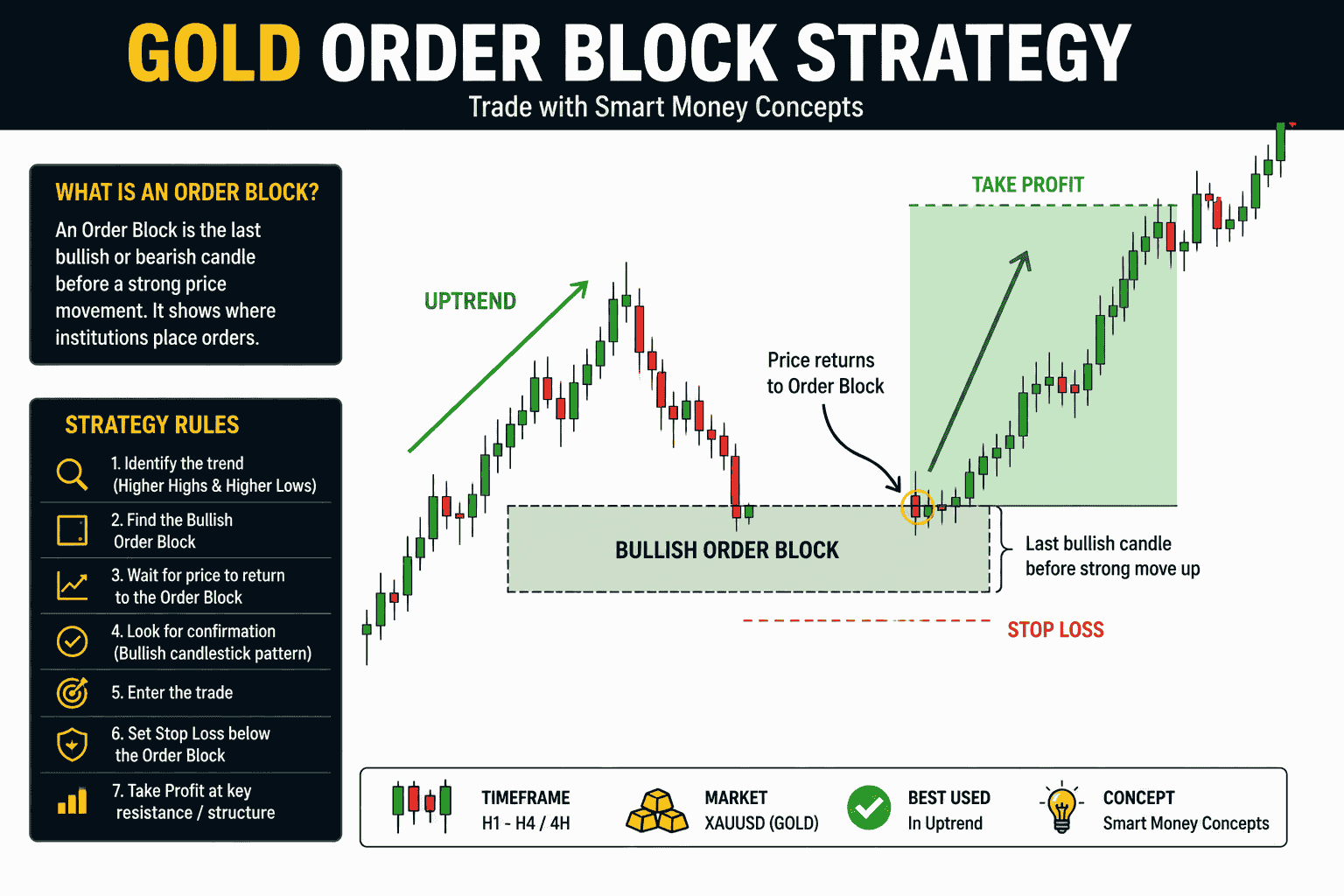
An order block is typically the last bullish or bearish candle before a strong impulsive move in the opposite direction. When the price later revisits this zone, it often finds liquidity left behind by institutional traders, making it a high-probability area for buying or selling.
For example, if the gold price makes a strong bullish move after a bearish candle, that bearish candle becomes a bullish order block. When the price retraces to this level, many traders look for buying opportunities with confirmation from market structure or price action.
Similarly, if the market falls sharply after a bullish candle, that candle becomes a bearish order block. As the price returns to this area, traders monitor for potential selling opportunities.
The Gold Order Block Strategy is widely used alongside Smart Money Concepts (SMC), ICT Order Block Strategy, Break of Structure (BOS), Fair Value Gaps (FVG), and liquidity sweeps. Combining these concepts helps traders filter false signals and identify high-probability trade setups.
One of the biggest advantages of the Gold Order Block Trading approach is that it works across multiple timeframes. Whether you are a scalper, day trader, or swing trader, the Order Block Strategy for Gold can help you identify institutional trading zones and improve your overall trading accuracy.
By learning the Gold Order Block Strategy, traders gain a deeper understanding of how the market moves and where professional traders are most likely to enter or exit positions. This knowledge can lead to better trade entries, improved risk-to-reward ratios, and more consistent results when trading XAU/USD.
Why it is called order block?
The Gold Order Block Strategy gets its name from the concept of institutional orders. Before banks, hedge funds, and other large financial institutions move the market, they often place a large number of buy or sell orders within a specific price range. This area becomes an order block, which is why the strategy is known as the Gold Order Block Strategy.
Unlike retail traders, institutions cannot execute all of their positions with a single click because their order sizes are too large. Instead, they accumulate positions over time, creating a price zone where significant buying or selling activity takes place. These zones are visible on the chart and form the foundation of Gold Order Block Trading.
When the market returns to one of these institutional zones, the price often reacts because there may still be unfilled orders remaining. This is why the Order Block Strategy for Gold focuses on waiting for price to revisit these levels instead of entering trades after a large move has already occurred.
A Bullish Order Block forms when institutional buyers accumulate positions before driving the gold price sharply higher. As the price retraces back to this area, traders watch for buying opportunities supported by strong price action and market structure.
On the other hand, a Bearish Order Block develops when institutional sellers build large short positions before pushing the market lower. If the price later revisits this zone, traders often look for selling opportunities after receiving confirmation.
The Gold Order Block Strategy is a key part of Smart Money Concepts Gold, which focuses on following the footprints left by institutional traders instead of relying on lagging indicators. This approach helps traders understand where professional money is entering the market and where high-probability reversals may occur.
Many traders also combine the ICT Order Block Strategy with concepts such as Fair Value Gaps (FVG), Break of Structure (BOS), and liquidity sweeps. When these tools align with an order block, they can provide stronger confirmation for a potential trade.
Whether you are a beginner or an experienced trader, using the Gold Trading Strategy based on order blocks can improve your market analysis, enhance trade timing, and help you make more informed trading decisions in the XAU/USD market.
Simple Example to Understand an Order Block on the Chart
Imagine you are looking at the XAU/USD (Gold) chart on the 1-hour timeframe.
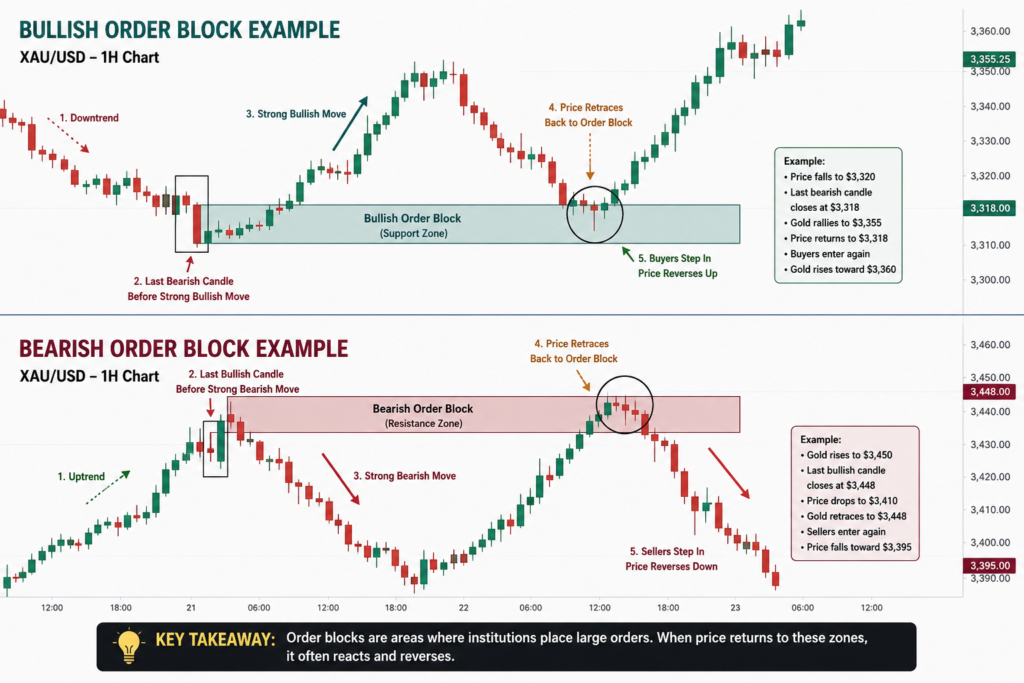
Example of a Bullish Order Block
- Gold is moving downward.
- A large bearish candle forms.
- Immediately after that, several strong bullish candles push the price much higher.
- The last bearish candle before the strong upward move becomes the Bullish Order Block.
A few hours later, the gold price retraces to this bearish candle.
Instead of continuing lower, buyers step in again, and the price starts moving upward.
This happens because institutions previously placed buy orders in that area. The zone acts as a support level.
Example:
- Price falls to $3,320
- Last bearish candle closes at $3,318
- Gold rallies to $3,355
- Price later returns to $3,318
- Buyers enter again
- Gold rises toward $3,360
The candle around $3,318 is the Bullish Order Block.
Example of a Bearish Order Block
Now imagine the opposite situation.
- Gold is moving upward.
- A large bullish candle appears.
- Right after it, several strong bearish candles drive the market sharply lower.
- The last bullish candle before the decline becomes the Bearish Order Block.
When the price later returns to this zone, sellers become active again, causing another downward move.
Example:
- Gold rises to $3,450
- Last bullish candle closes at $3,448
- Price drops to $3,410
- Gold retraces to $3,448
- Sellers enter again
- Price falls toward $3,395
The candle near $3,448 is the Bearish Order Block.
Pro Tip: Don’t trade every order block. The highest-probability setups occur when the Gold Order Block Strategy is combined with Smart Money Concepts Gold, a Break of Structure (BOS), a Fair Value Gap (FVG), or a Liquidity Sweep. These confirmations help filter out weak setups and improve your trade accuracy.
Visual representation of order block
How to Identify Whether an Order Block Is Valid
Not every order block is worth trading. Many beginners make the mistake of marking every bullish or bearish candle as an order block. A valid Gold Order Block Strategy focuses only on institutional order blocks that meet specific conditions.
Here are the key factors to confirm whether an order block is valid.
1. Look for a Strong Impulsive Move
A valid order block should be followed by a powerful price movement. This shows that institutional traders entered the market with enough volume to move the price significantly.
Example:
- Gold trades around $3,320
- After the last bearish candle, the price rallies more than 150 pips
- This strong move suggests that the candle may be a valid Bullish Order Block.
If the price only moves a few candles sideways, the order block is usually weak.
2. It Should Be the Last Opposite-Colored Candle
A valid order block is usually the last opposite-colored candle before the impulsive move.
- Bullish Order Block: The last bearish candle before a strong bullish rally.
- Bearish Order Block: The last bullish candle before a strong bearish decline.
This candle represents the area where institutions likely placed large buy or sell orders.
3. Wait for a Break of Structure (BOS)
One of the strongest confirmations in the Gold Order Block Strategy is a Break of Structure (BOS).
For example:
- Price forms a bullish order block.
- Gold breaks above the previous swing high.
- Later, the price retraces to the order block.
This sequence provides a much higher-probability buying opportunity than trading an order block without a BOS.
4. Price Should Return to the Order Block
A valid order block becomes useful only when the market revisits it.
When gold returns to the zone:
- Watch for rejection candles.
- Look for bullish or bearish engulfing patterns.
- Wait for confirmation before entering the trade.
Avoid entering immediately after the impulsive move because the best entries usually occur on the retracement.
5. Check for High Trading Volume
Large institutional orders often create higher-than-average trading volume.
If your trading platform provides volume data, look for a noticeable increase during the impulsive move. Higher volume adds confidence that the order block was created by institutional activity.
6. Combine It with Smart Money Concepts (SMC)
The Gold Order Block Strategy becomes much more reliable when combined with Smart Money Concepts Gold.
Look for confirmations such as:
- Break of Structure (BOS)
- Change of Character (CHOCH)
- Fair Value Gap (FVG)
- Liquidity Sweep
- Premium and Discount Zones
The more confirmations you have, the stronger the setup.
7. Higher Timeframes Are More Reliable
Order blocks found on higher timeframes usually carry more weight than those on lower timeframes.
A 4-hour or daily order block is generally stronger than a 5-minute order block because it reflects the activity of larger market participants.
Many professional traders identify the main order block on the higher timeframe and then switch to a lower timeframe for precise entries.
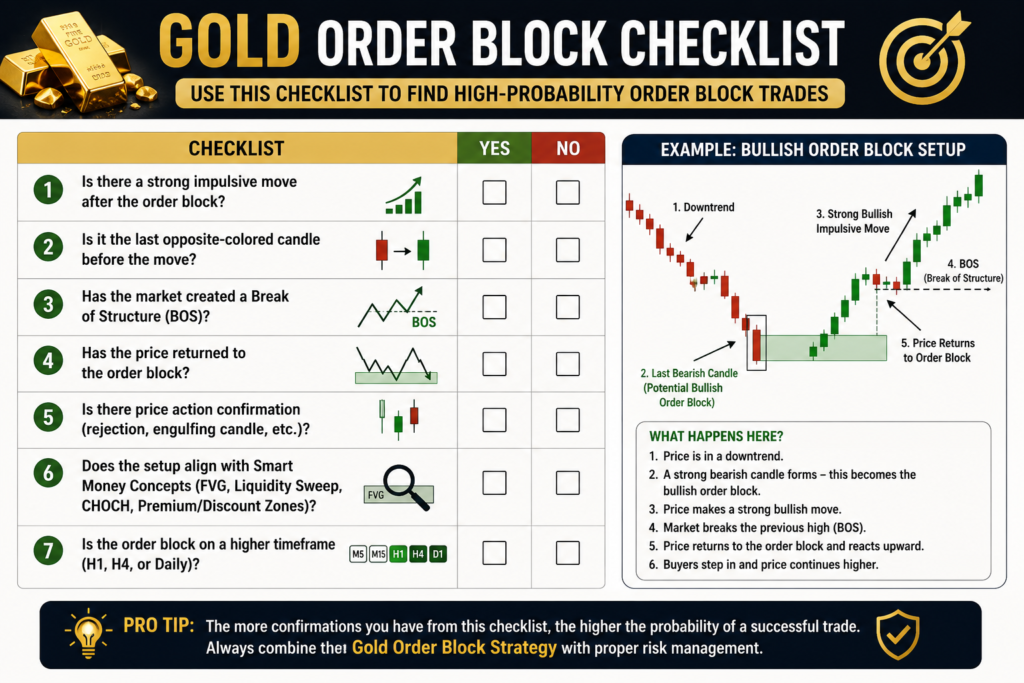
Checklist for a Valid Order Block
Before taking a trade, ask yourself these questions:
- ✅ Is there a strong impulsive move after the order block?
- ✅ Is it the last opposite-colored candle before the move?
- ✅ Has the market created a Break of Structure (BOS)?
- ✅ Has the price returned to the order block?
- ✅ Is there price action confirmation, such as a rejection or engulfing candle?
- ✅ Does the setup align with Smart Money Concepts Gold, such as an FVG or Liquidity Sweep?
- ✅ Is the order block on a higher timeframe (H1, H4, or Daily)?
If the answer is “Yes” to most of these questions, you are likely looking at a valid order block rather than a random price zone.
Pro Tip: The highest-probability trades come from the Gold Order Block Strategy when multiple confirmations align. Don’t rely on the order block alone—combine it with market structure, liquidity, and price action to improve your win rate.