Table of Contents
ToggleWhy I Started Looking for an AI Market Analysis Solution
When I first started trading, I believed that spending more hours in front of charts would automatically make me a better trader. Every day, I switched between multiple indicators, watched countless YouTube videos, and read financial news from different websites. Instead of becoming more confident, I became overwhelmed by conflicting information.
That was the moment I realized I needed a better approach. I wasn’t looking for a tool that could magically predict the market—I was looking for an AI Market Analysis Guide that could help me organize information, identify high-probability setups, and make better trading decisions.
At first, I was skeptical about using AI. Many people online claimed that AI could generate perfect trading signals and guarantee profits. After testing several AI tools myself, I quickly learned that those claims were unrealistic. AI isn’t a crystal ball, and it can’t predict every market move. What it can do is analyze large amounts of data much faster than any human can.
As I continued learning, I discovered that an AI Market Analysis Guide could save me valuable time by summarizing market news, highlighting important technical levels, and identifying trends across multiple financial markets. Instead of spending hours gathering information, I could focus on validating trade setups and managing risk.
Today, AI has become an important part of my trading routine, but I never allow it to make decisions for me. I use it as a research assistant that supports my own analysis, not as a replacement for experience, discipline, or proper risk management.
This AI Market Analysis Guide is based on the lessons I learned while integrating AI into my daily trading workflow. My goal is to help you avoid the mistakes I made, understand what AI can and cannot do, and learn how to use it responsibly to improve your market analysis.
The Trading Mistakes That Made Me Change My Approach
Looking back, I can confidently say that my biggest losses didn’t happen because my trading strategy was bad—they happened because of the mistakes I made while using it. Before I found a structured AI Market Analysis Guide, I relied on emotions, rushed decisions, and information overload instead of following a consistent trading process.
One of my biggest mistakes was entering trades too quickly. Whenever I saw a strong candlestick or a sudden price movement, I felt like I had to jump into the market immediately. Most of the time, those impulsive trades ended with unnecessary losses because I hadn’t analyzed the bigger picture.
Another mistake was depending on too many indicators. My TradingView chart was filled with different tools, and each indicator gave a different signal. Instead of making trading easier, it created confusion. I often found myself waiting for every indicator to agree, only to miss good opportunities or enter trades too late.
I also ignored the importance of market context. I focused only on technical setups without paying enough attention to economic news, market sentiment, or major events that could move prices. Sometimes a perfect chart setup failed simply because I hadn’t considered what was happening in the broader market.
Risk management was another area where I struggled. There were times when I moved my stop-loss because I hoped the market would reverse. Other times, I risked more than I should have because I felt confident after a winning streak. Those emotional decisions taught me that discipline is far more important than confidence.
The turning point came when I realized I needed a smarter way to organize information instead of collecting more information. That’s when I started exploring an AI Market Analysis Guide. Rather than replacing my trading strategy, AI helped me analyze charts, summarize market news, and identify important levels much faster. It reduced the time I spent searching for information and allowed me to focus on confirming high-quality trade setups.
Today, I still make every trading decision myself, but I no longer trade based on emotions or guesswork. Following an AI Market Analysis Guide has helped me create a more structured workflow where analysis comes first, risk management comes second, and trade execution comes last. That simple change has made me a more patient and disciplined trader.
How I First Discovered AI for Market Analysis
My journey with AI began out of frustration rather than curiosity. After months of spending hours analyzing charts, reading financial news, and switching between different indicators, I realized that I was spending more time collecting information than actually understanding the market. I knew there had to be a smarter way to analyze data without feeling overwhelmed.
One day, while researching ways to improve my trading routine, I came across several traders discussing AI-powered market analysis tools. At first, I was skeptical. Many people claimed that AI could predict the market perfectly or generate winning signals every time. Those promises sounded too good to be true, so I decided to test the technology myself instead of believing the hype.
That decision introduced me to the idea of using an AI Market Analysis Guide. Instead of expecting AI to tell me when to buy or sell, I started using it to organize market information, summarize economic news, identify important support and resistance levels, and explain technical setups more clearly. I quickly realized that AI worked best as an assistant, not as an automatic trading system.
The first few weeks were a learning experience. I compared AI-generated analysis with my own chart analysis before placing any trades. Sometimes the AI highlighted trends or risk factors that I had overlooked. Other times, my own analysis was stronger than the AI’s suggestions. Those comparisons helped me understand both the strengths and limitations of artificial intelligence in trading.
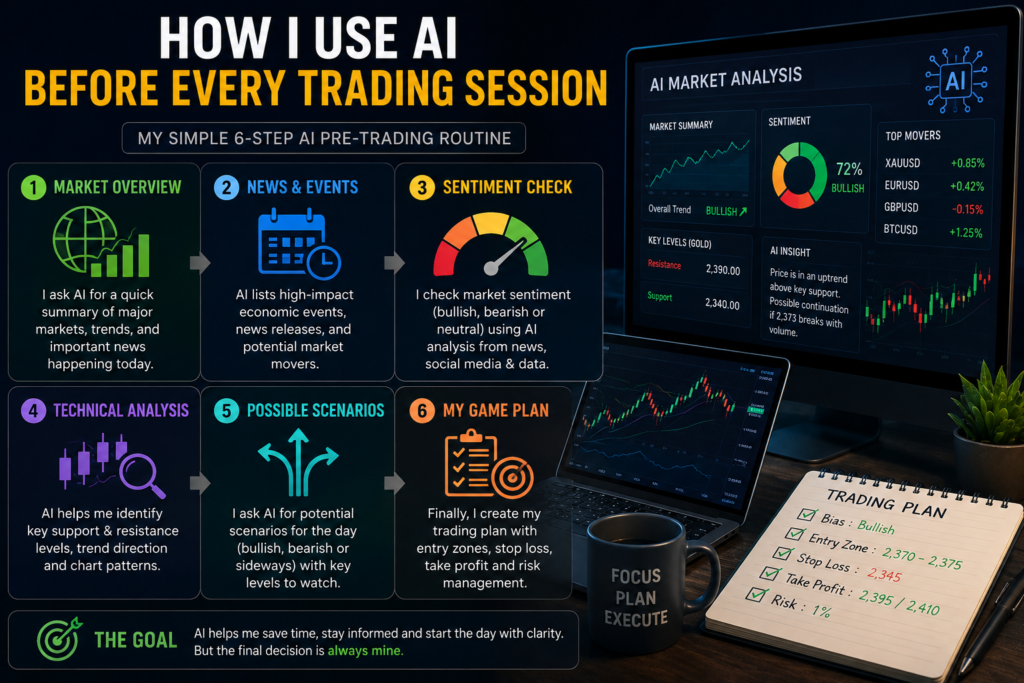
As I gained more experience, the AI Market Analysis Guide became an essential part of my daily routine. Before every trading session, I use AI to review the latest market sentiment, summarize important news, and organize my analysis. After that, I verify everything using price action, technical indicators, and my own trading strategy before making any decision.
Looking back, discovering AI didn’t completely change my trading strategy—it changed the way I prepared for trading. Instead of wasting hours searching through scattered information, I now have a structured process that helps me analyze the market more efficiently. That simple change has saved me time, improved my confidence, and made me a more disciplined trader.

My First Experience Using AI to Analyze the Markets
The first time I used AI to analyze the markets, I expected it to provide perfect buy and sell signals. Like many beginners, I thought artificial intelligence could predict every market move with incredible accuracy. After just a few days of testing, I realized that my expectations were completely wrong.
I decided to use an AI Market Analysis Guide as part of my daily trading routine rather than relying on AI alone. I started by asking AI to summarize the latest market news, explain the current trend, identify key support and resistance levels, and highlight important economic events that could affect prices. Instead of replacing my own analysis, it gave me a clearer starting point.
One of the biggest differences I noticed was the amount of time I saved. Previously, I would spend hours reading articles, checking multiple websites, and comparing different opinions before opening a trade. With an AI Market Analysis Guide, I could quickly organize that information and focus on what mattered most. It helped me spend less time searching for data and more time evaluating trading opportunities.
I also learned an important lesson during my first few weeks. There were times when AI suggested a bullish outlook, but the price action on my chart told a different story. Rather than following the AI blindly, I waited for confirmation from my trading strategy. In several cases, that extra confirmation kept me out of losing trades. It reminded me that AI is an analysis tool—not a replacement for experience or discipline.
As I became more comfortable using AI, I developed a simple workflow. I begin every trading session by using AI to review market sentiment and recent news. Then I open my TradingView charts, check the trend, mark support and resistance levels, and wait for price action to confirm a setup. Only after all those steps do I consider entering a trade.
Today, my experience has taught me that the real value of an AI Market Analysis Guide is not in predicting the future. Its value lies in helping me process information faster, stay organized, and avoid emotional decision-making. AI has become a trusted assistant in my trading routine, but every trade I take is still based on my own analysis, risk management, and patience.
What AI Actually Does (And What It Doesn't)
When I first started using AI for trading, I believed it could predict every market move with incredible accuracy. After months of testing different tools and comparing their analysis with real market behavior, I realized that AI is powerful—but it has clear limitations. Understanding what AI can and cannot do completely changed the way I use it.
One of the biggest lessons I learned from following an AI Market Analysis Guide is that AI is designed to analyze information, not guarantee profits. It processes large amounts of market data in seconds, helping me understand trends and organize my research more efficiently. However, the final trading decision is always mine.
What AI Actually Does
AI has become an important part of my daily trading routine because it helps me in several ways:
- Summarizes financial news from multiple sources.
- Identifies the overall market trend.
- Highlights important support and resistance levels.
- Analyzes technical indicators and price action.
- Detects potential chart patterns like breakouts, flags, and double tops.
- Monitors market sentiment and economic events.
- Saves hours of manual research by organizing information into a simple summary.
Using an AI Market Analysis Guide, I can prepare for the trading day much faster than I could by doing everything manually.
What AI Doesn’t Do
While AI is a powerful assistant, it cannot do everything. These are some of the biggest misconceptions I had when I started:
- AI cannot predict the future with 100% accuracy.
- AI cannot eliminate trading losses.
- AI cannot understand unexpected geopolitical events before they happen.
- AI cannot replace proper risk management.
- AI cannot control your emotions when you’re in a losing trade.
- AI cannot make you a profitable trader without a proven strategy.
These limitations reminded me that successful trading still depends on discipline, patience, and consistent execution.
My Biggest Realization
The biggest mistake I made was expecting AI to think like an experienced trader. Instead, I learned that AI works best when it supports my own analysis. Before taking any trade, I still review the chart, check the market structure, confirm the trend, and follow my trading rules.
Today, I use an AI Market Analysis Guide as my research assistant rather than my decision-maker. AI helps me gather information quickly, spot opportunities I might have missed, and stay organized, but it never replaces my judgment. That balanced approach has made me a more confident and disciplined trader, and it has helped me trust my process instead of chasing unrealistic expectations.
My Step-by-Step AI Market Analysis Routine
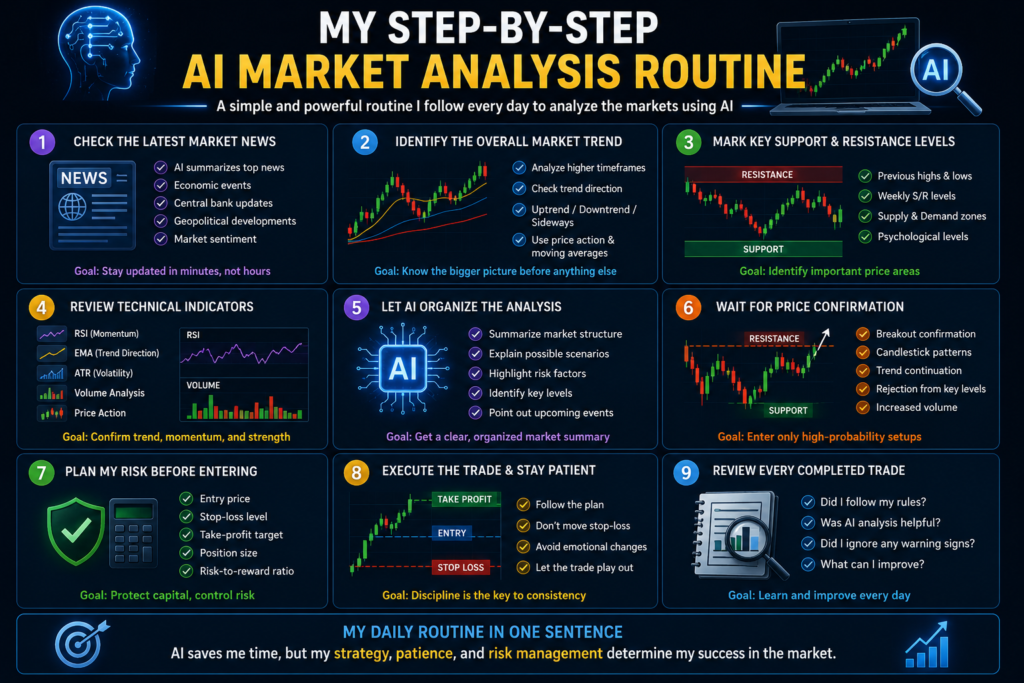
After months of trial and error, I finally developed a routine that works for me. Instead of opening random charts and searching for trade ideas, I now follow the same process every trading day. This AI Market Analysis Guide has helped me stay organized, reduce emotional decisions, and focus only on high-quality trading opportunities.
Here’s the exact routine I follow before placing a trade.
Step 1: Check the Latest Market News
The first thing I do every morning is review the latest financial news. Instead of reading dozens of websites, I use AI to summarize the most important updates.
I focus on:
- Major economic events
- Central bank announcements
- Inflation and employment reports
- Geopolitical developments
- Market sentiment
This gives me a quick overview of what could influence the markets during the day.
Step 2: Identify the Overall Market Trend
Next, I open my TradingView charts to determine the bigger picture. Before looking for an entry, I always ask:
- Is the market trending up?
- Is it trending down?
- Is it moving sideways?
The AI Market Analysis Guide helps me compare multiple timeframes, but I always verify the trend myself using price action and moving averages.
Step 3: Mark Key Support and Resistance Levels
Once I know the trend, I manually draw important support and resistance zones.
These include:
- Previous daily highs and lows
- Weekly support and resistance
- Supply and demand zones
- Psychological price levels
AI often highlights these areas, but I prefer to confirm them on my own chart before planning a trade.
Step 4: Review Technical Indicators
Now I check the indicators that are part of my trading strategy.
I usually review:
- RSI for momentum
- EMA for trend direction
- ATR for volatility
- Volume analysis
- Price action confirmation
I avoid adding too many indicators because simplicity helps me make better decisions.
Step 5: Let AI Organize the Analysis
This is where the AI Market Analysis Guide saves me the most time.
I ask AI to:
- Summarize the current market structure
- Explain possible bullish and bearish scenarios
- Highlight important risk factors
- Identify major support and resistance levels
- Point out upcoming economic events
Instead of making trading decisions for me, AI helps me organize all the available information into a clear and easy-to-understand summary.
Step 6: Wait for Price Confirmation
One lesson I learned the hard way is never to enter a trade simply because AI suggests a direction.
I always wait for confirmation such as:
- Breakout confirmation
- Candlestick patterns
- Trend continuation
- Rejection from key levels
- Increased trading volume
If my strategy doesn’t confirm the setup, I simply skip the trade.
Step 7: Plan My Risk Before Entering
Before clicking the Buy or Sell button, I calculate my risk.
I decide:
- Entry price
- Stop-loss level
- Take-profit target
- Position size
- Risk-to-reward ratio
No matter how strong a setup looks, I never trade without a predefined risk management plan.
Step 8: Execute the Trade and Stay Patient
Once everything aligns, I place the trade and avoid making emotional changes.
I don’t move my stop-loss because of fear, and I don’t close trades early because of excitement. Following my trading plan has been one of the biggest improvements in my journey.
Step 9: Review Every Completed Trade
At the end of the trading session, I review every trade, whether it was a win or a loss.
I ask myself:
- Did I follow my trading rules?
- Did AI provide useful insights?
- Did I ignore any warning signs?
- What can I improve next time?
Keeping a trading journal helps me learn from every experience and continuously refine my strategy.
My Daily Routine in One Sentence
Today, my AI Market Analysis Guide is not a system that tells me what to trade. It is a structured workflow that helps me gather information faster, stay disciplined, and make informed trading decisions based on my own analysis. AI saves me time, but my strategy, patience, and risk management determine whether I succeed in the market.
Frequently Asked Questions
1. Can AI accurately predict the financial markets?
No. AI cannot predict the market with 100% accuracy. It analyzes historical data, market sentiment, technical indicators, and current trends to estimate the most likely outcomes. I use AI as a decision-support tool, but I always confirm every trade with my own technical analysis and risk management.
2. Which markets can I analyze using AI?
AI can be used across almost every major financial market, including:
- Gold (XAU/USD)
- Forex
- Stocks
- Cryptocurrency
- Indices
- Commodities
The same AI market analysis process can be adapted to different asset classes by using relevant market data and trading strategies.
3. What AI tools do I use before every trading session?
Before I place any trade, I use AI to:
- Summarize the latest market news
- Analyze market sentiment
- Identify key support and resistance levels
- Review technical indicators
- Explore possible market scenarios
- Create a structured trading plan
This routine saves time and helps me start each trading session with greater clarity.
4. Should beginners rely completely on AI for trading?
No. Beginners should never rely entirely on AI-generated signals. AI is most effective when combined with an understanding of price action, technical analysis, and proper risk management. Think of AI as your trading assistant—not your replacement.