Table of Contents
ToggleIntroduction
Scalping gold on a 5-minute chart is not about entering every small price movement. Gold can move aggressively within a few candles, and without a clear process, a promising setup can quickly turn into a poorly timed trade.
The 5-minute gold scalping strategy explained in this guide focuses on what matters most when trading short-term XAUUSD setups: identifying the market direction, waiting for a controlled pullback, confirming the entry, and defining the risk before taking the trade. The idea is to remove unnecessary decisions from the process and give each setup a clear reason for entering or staying out.
I have kept this approach deliberately simple because a scalping strategy needs to be practical when the market is moving quickly. Instead of filling the chart with multiple indicators, the setup uses a small number of tools alongside price structure to determine whether a trade is actually worth taking.
If you are looking for a method that tells you when to enter, where to place the stop loss, how to set a target, and when to avoid a trade, the seven rules below will give you a clear framework to test on the 5-minute XAUUSD chart.
How My 5-Minute Gold Scalping Strategy Works
My 5-minute gold scalping strategy is built around finding short-term opportunities when XAUUSD shows a clear reaction at an important price area. Rather than entering every time gold moves quickly, I wait for a combination of market direction, key levels, and price action to give me a reason to enter.
The goal is not to predict every move in gold. I use a structured approach to identify situations where the potential reward justifies the risk, while accepting that some setups will fail.
What the Strategy Is Designed to Capture
The strategy is designed to capture short-term price movements in gold that can develop within a few candles on the 5-minute chart. I mainly look for situations where price reaches a significant support or resistance area and then shows signs that buyers or sellers are stepping in.
For a buy setup, I want to see evidence that selling pressure is weakening and buyers are gaining control. For a sell setup, I look for the opposite, where price struggles to move higher and sellers begin pushing the market lower.
This keeps the strategy focused on high-probability setups rather than constant trading. If the market does not provide the conditions I am looking for, I prefer to stay out rather than force an entry.
Why I Use the 5-Minute Chart for XAUUSD
I use the 5-minute chart because it provides a useful balance between market detail and trading speed. A 1-minute chart can produce a lot of noise and false signals, while a much higher timeframe may not provide enough entry opportunities for a scalping approach.
Each candle represents five minutes of price movement, allowing me to see short-term structure, momentum, breakouts, and reactions around important levels. This makes it easier for me to define an entry, stop loss, and potential target without relying entirely on very small price fluctuations.
However, the 5-minute timeframe is not automatically better for every trader. Gold can move rapidly, so I treat the chart as an execution timeframe and pay attention to the broader market context before taking a position.
The Basic Idea Behind My Approach
The process is simple: identify the direction, mark an important level, wait for price to reach it, and look for confirmation before entering. I do not want to buy simply because gold has fallen or sell simply because it has risen.
That patience is what makes my 5-minute gold scalping strategy different from simply reacting to every candle. The setup has to make sense from both a technical and risk-management perspective before I consider taking the trade.
Note: This is an educational trading framework, not a guarantee of profitable results. Scalping gold carries significant risk, particularly during volatile market conditions.
Why Gold Is Suitable for 5-Minute Scalping
Gold is one of the markets I find interesting for short-term trading because its price can move significantly within a relatively short period. That movement creates opportunities for traders who know how to wait for clear setups instead of reacting to every candle.
Gold’s Volatility and Liquidity
Gold, particularly XAUUSD, often attracts a large amount of trading activity during major market sessions. Its liquidity and frequent price movements make it possible to look for short-term setups without needing to hold a position for hours or days.
For my 5-minute gold scalping strategy, volatility is important because I need enough movement for a trade to reach its target after accounting for the spread and trading costs. At the same time, excessive volatility can make entries and stop-loss placement more difficult, so I do not treat every fast move as an opportunity.
How Fast Price Movements Create Opportunities
Gold can move quickly when buyers or sellers become active around important price levels. A strong breakout, rejection from resistance, or bounce from support can sometimes create a short-term movement that is visible clearly on the 5-minute chart.
I use these movements as opportunities only when they fit my trading conditions. Instead of entering simply because a large candle appears, I wait for price action to provide confirmation that the move has enough structure behind it.
This approach helps keep my 5-minute gold scalping strategy focused on planned entries rather than emotional decisions. Missing a move is not a problem for me because another setup can appear later.
The Risks of Scalping XAUUSD
The same volatility that creates opportunities can also make gold dangerous for inexperienced scalpers. XAUUSD can move sharply against a position, especially around major economic announcements, unexpected market events, or periods of increased volatility.
Another challenge is overtrading. Because the 5-minute chart produces many candles throughout the trading session, it can be tempting to enter repeatedly even when there is no high-quality setup.
For this reason, risk management is a major part of my 5-minute gold scalping strategy. I define my stop loss before entering, keep my position size under control, and accept that a losing trade is part of the process rather than trying to immediately recover a loss with another trade.
The Tools I Use for My 5-Minute Gold Scalping Strategy
A good scalping setup does not need a screen full of indicators. For my 5-minute gold scalping strategy, I keep the chart simple and focus on tools that help me read price movement, identify important levels, and confirm whether a trade has enough momentum to continue.
TradingView or MT5
I use TradingView or MetaTrader 5 (MT5) as the main platforms for analyzing XAUUSD. TradingView is useful for clean chart analysis and marking support, resistance, and market structure, while MT5 is practical for monitoring prices and managing trades.
The important point is consistency rather than using multiple platforms at once. I want my charts to provide the information I need quickly because a five-minute setup can develop and disappear within a few candles.
Candlestick Price Action
Candlesticks are at the center of my 5-minute gold scalping strategy because they show what buyers and sellers are actually doing at a specific price level. Instead of relying on an indicator to tell me when to enter, I first look for patterns such as strong rejection candles, engulfing candles, and decisive breakout candles.
For example, if gold reaches a major support level and forms a strong bullish rejection candle, I take that as evidence that buyers are defending the area. I then look for additional confirmation before entering rather than treating a single candle as an automatic trade signal.
Support and Resistance
Support and resistance help me determine where a trade has a reasonable chance of reacting. I mark important levels before looking for an entry, especially previous highs, previous lows, and areas where price has repeatedly reversed.
These levels also help me avoid entering in the middle of a range where the risk-to-reward ratio may be poor. In my 5-minute gold scalping strategy, the level comes first and the entry signal comes second.
Moving Averages
Moving averages give me a quick view of the short-term trend and help filter trades that go against the current direction. I prefer using them as a trend-confirmation tool rather than allowing them to generate every entry.
When price is consistently holding above a rising moving average, I generally look for bullish setups, while sustained movement below a falling average can support bearish opportunities. This simple approach keeps the chart cleaner and makes it easier to combine trend direction with price action.
RSI or Momentum Confirmation
RSI can provide another layer of confirmation when price reaches an important level. I mainly use it to understand whether momentum supports the potential trade instead of entering simply because RSI reaches an overbought or oversold zone.
For instance, a bullish setup becomes more interesting when price reacts from support while momentum begins strengthening. Combining this information with candlestick behavior and market structure makes my 5-minute gold scalping strategy more selective and helps reduce trades based on weak signals.
Keeping the Setup Simple
The goal is not to use as many indicators as possible. My 5-minute gold scalping strategy works best when each tool has a specific job: the platform provides the chart, price action shows the immediate reaction, support and resistance identify key areas, moving averages help with direction, and RSI provides momentum confirmation.
This keeps the decision-making process focused and prevents conflicting indicators from making a simple setup unnecessarily complicated.
Step 1: Identify the Overall Gold Market Trend
Before I look for an entry, I first determine what the gold market is doing on the 5-minute chart. This is an important part of my 5-minute gold scalping strategy because I do not want to take a bullish trade in a clearly bearish market or sell when buyers are firmly in control.
Bullish, Bearish, and Ranging Conditions
I classify the market into three basic conditions: bullish, bearish, or ranging. A bullish market generally shows sustained upward movement, a bearish market moves progressively lower, while a ranging market stays between recognizable support and resistance areas.
When the market is trending strongly, I prefer setups that follow the existing direction instead of trying to predict a reversal. During a range, I become more selective because gold can quickly move from one side of the range to the other and create false breakout signals.
Higher Highs and Higher Lows
A simple way I identify a bullish trend is by watching for higher highs and higher lows. If each meaningful swing pushes above the previous high and pullbacks continue to hold above previous lows, buyers are showing control.
This structure gives me a clear framework for finding potential long setups. Rather than buying simply because gold is moving upward, I wait for price to pull back toward a useful level and then look for confirmation before entering.
Lower Highs and Lower Lows
For a bearish market, I look for lower highs and lower lows. When sellers repeatedly push price below previous lows and rallies fail to reach the previous swing high, the overall structure suggests that selling pressure remains dominant.
In this situation, I focus more on short opportunities and avoid forcing bullish trades against the trend. This keeps my 5-minute gold scalping strategy aligned with the current market structure instead of trying to catch every reversal.
What I Do When the Market Is Ranging
Not every session produces a clean trend, and I do not treat sideways movement as a trend. When gold repeatedly moves between support and resistance without establishing new highs or lows, I consider the market to be ranging.
My approach during these conditions is to wait for price to reach an important boundary rather than entering in the middle of the range. If gold eventually breaks out with strong price action and confirmation, I can then reassess the market structure and look for a new setup.
My Main Rule for Step 1
The purpose of this step is simply to answer one question: Who is currently controlling the market, buyers or sellers? Once I understand the structure, I can move to the next part of my 5-minute gold scalping strategy and search for a high-probability setup in the appropriate direction.
Step 2: Mark Key Support and Resistance Levels
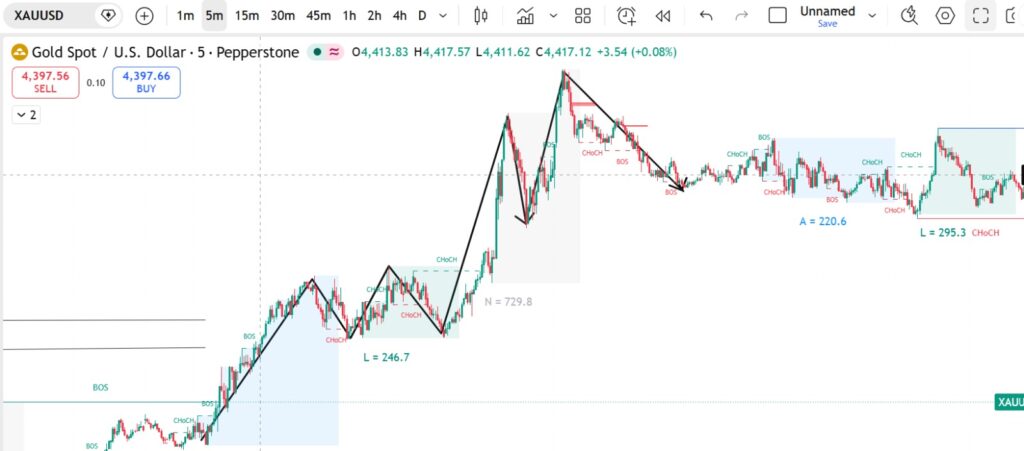
Once I know the overall direction of gold, the next step in my 5-minute gold scalping strategy is to mark the price levels where the market is most likely to react. I do this before looking for an entry because a good setup means very little if it forms directly into a strong support or resistance area.
Instead of drawing dozens of lines across the chart, I focus on levels that have a clear reason behind them. The stronger and more obvious a level is, the more attention I give to the price action when gold approaches it.
Previous Highs and Lows
Previous highs and lows are some of the first levels I mark because they show where price has already encountered strong buying or selling pressure. A previous swing high can become resistance, while a previous swing low can act as support when price returns to the area.
I pay particular attention to levels that have produced a sharp reaction in the past. If gold approaches one of these areas again, I wait to see whether buyers or sellers defend the level rather than assuming that price will automatically reverse.
Intraday Support and Resistance
After marking the larger swing points, I look at the current trading session and identify intraday support and resistance. These levels are useful for scalping because they are closer to the current price and can influence short-term movements on the 5-minute chart.
For example, if gold repeatedly rejects the same area during the session, I treat that zone as important rather than relying on a single exact price. In my 5-minute gold scalping strategy, I prefer waiting for price to reach these areas and then watching the candles for evidence of rejection, breakout, or continuation.
London and New York Session Levels
Gold often becomes more active when major trading sessions overlap or open, so I also mark important levels created during the London and New York sessions. The London session can establish significant highs and lows that later become reference points when the New York session begins.
I also watch the high and low of the earlier session because these levels can attract attention when liquidity increases. A break above a session high or below a session low does not automatically mean I enter the trade, since I first want to see whether the breakout holds or turns into a false move.
Liquidity Zones
Liquidity zones are areas where many orders may be concentrated, often around obvious highs, lows, equal highs, equal lows, and well-known support or resistance levels. Gold can briefly move beyond these areas before reversing, which is why I avoid placing trades solely because price has touched or broken a marked level.
One pattern I watch for is a quick move through a previous high or low followed by a strong rejection back into the range. When this happens near an important level, it can provide useful information about where short-term buying or selling pressure is entering the market.
How I Combine These Levels
I do not treat every level as an automatic buy or sell signal. The purpose of marking support, resistance, session highs and lows, and liquidity zones is to create a map of important price areas before the trade develops.
When several factors meet around the same zone, I pay closer attention to the price action there. This makes my 5-minute gold scalping strategy more selective because I am waiting for price to come to me instead of chasing every movement on the chart.
The key rule I follow is simple: mark the level first, then wait for price to prove what it wants to do there.
Step 3: Wait for Gold to Reach a Key Level
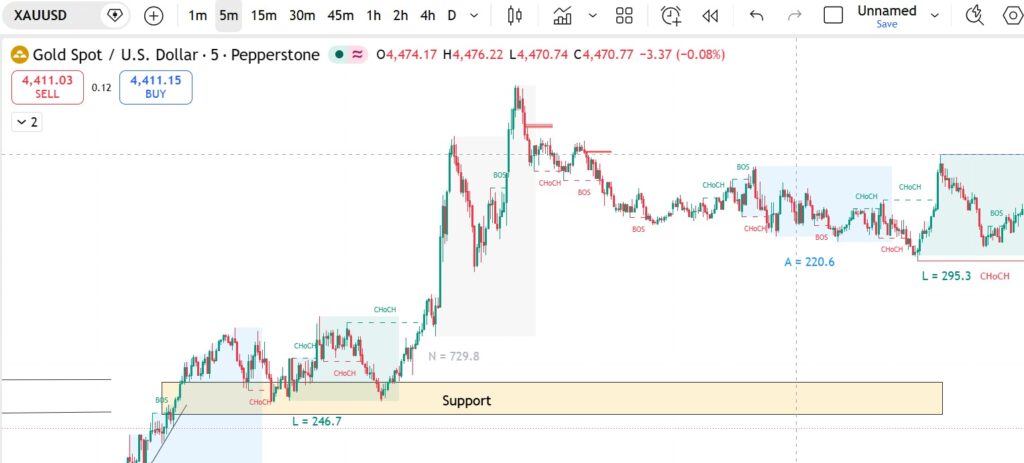
Once I have identified the trend and marked the important areas on my chart, I do not immediately enter a trade. The next part of my 5-minute gold scalping strategy is waiting patiently for price to reach one of the zones I have already identified.
This step is important because the best opportunities usually come from planned reactions at meaningful levels, not from entering simply because gold is moving quickly. I want the market to come into my area first, then I decide whether the price action gives me a reason to trade.
Why I Avoid Chasing Price
Gold can move several points in a short period, especially during active trading sessions. When I see a large bullish or bearish candle, it can be tempting to enter immediately because I feel that the move might continue without me.
I avoid this because entering after a sharp move can mean buying near a temporary high or selling near a temporary low. In my 5-minute gold scalping strategy, I would rather miss a trade than enter late with poor risk-to-reward conditions.
Instead, I let the initial move happen and wait for price to return to an area where I already have a trading idea. This gives me time to assess the market instead of making a decision based on emotion or fear of missing out.
What I Look for When Price Enters My Zone
When gold reaches my marked zone, I stop looking at the market as simply bullish or bearish and start watching the reaction around that specific level. I want to see whether buyers or sellers are actually defending the area.
I look for things such as a strong rejection wick, an engulfing candle, a change in short-term structure, or a decisive candle closing away from the level. I also compare the reaction with the overall trend and momentum rather than treating one candlestick pattern as sufficient confirmation.
For example, if the market is bullish and price pulls back into a strong support zone, I want to see buyers step in before considering a long position. If sellers continue pushing through the zone without meaningful rejection, I do not force the setup simply because the level was marked earlier.
Strong Versus Weak Reactions
Not every reaction from support or resistance is worth trading. A strong reaction usually shows clear rejection, strong candle bodies, follow-through, and evidence that the opposing side is losing control.
A weak reaction can look very different, with small candles, long wicks on both sides, limited follow-through, or price repeatedly testing the same area without moving away. These conditions tell me that the market may still be undecided, so I prefer to remain patient.
The difference matters because my 5-minute gold scalping strategy depends on confirmation rather than prediction. A level tells me where to pay attention, but the reaction tells me whether there is actually a trade worth taking.
My Patience Rule
I do not consider a level an entry signal by itself. I treat it as a decision zone where I wait for price action, momentum, and market structure to give me enough evidence to act.
This approach keeps me from chasing fast gold moves and helps me focus on setups that fit my plan. In my 5-minute gold scalping strategy, patience is not about avoiding trades; it is about waiting until the market reaches the right place and gives me the right reaction.
Step 4: Look for a 5-Minute Entry Signal
Once gold reaches one of the key zones I marked in the previous step, I do not enter simply because price has touched support or resistance. This is where my 5-minute gold scalping strategy becomes more precise, because I want to see actual evidence that buyers or sellers are taking control.
The entry signal is not just a candlestick pattern by itself. I consider the location of the setup, the current market structure, the strength of the reaction, and whether the move makes sense within the broader trend.
Rejection Candles
A rejection candle is one of the first signals I watch for when gold reaches an important level. A long wick combined with a strong close can show that price moved into an area but was pushed back by the opposite side.
For example, if gold falls into support and leaves a long lower wick before closing higher, I see that as a possible sign that sellers were unable to maintain control. I still wait for confirmation because a single rejection candle can fail, particularly when the market is moving aggressively.
Engulfing Candles
Engulfing candles can provide stronger evidence when they appear at the right location. A bullish engulfing candle after a reaction from support can show that buyers have taken control of the short-term movement, while a bearish engulfing candle near resistance can indicate increasing selling pressure.
I pay more attention to the context than the shape of the candle. An engulfing pattern in the middle of a random price movement does not carry the same meaning as one forming directly at a well-defined support or resistance zone.
Breakout and Retest
Another setup I look for is a breakout followed by a retest. Instead of entering immediately when gold breaks through resistance or support, I wait to see whether price returns to the broken level and respects it from the opposite side.
For instance, after a convincing break above resistance, price may pull back toward that area and hold it as new support. If the retest produces a strong bullish reaction, it can offer a more controlled entry than chasing the original breakout.
This is particularly useful in my 5-minute gold scalping strategy because gold can produce false breakouts that look convincing for only a few minutes. Waiting for the retest gives me additional information about whether the market is actually accepting the new price area.
Change of Market Structure
Sometimes the best signal is a shift in short-term market structure. If gold has been making lower highs and lower lows but then breaks above a meaningful previous lower high, I pay attention because the sellers may be losing control.
I do not automatically treat a structure break as a reversal. I want to see where the break occurs, whether the candle closes convincingly, and whether subsequent price action supports the change.
How I Choose the Final Entry
I look for several pieces of information to agree rather than relying on one pattern. A strong level, favorable market direction, clear price action, and supportive momentum create a much stronger setup than any individual signal working alone.
This filtering process is an important part of my 5-minute gold scalping strategy because it keeps me from taking every candle pattern that appears on the chart. The objective is not to predict every gold move, but to wait for a setup where the market gives me enough evidence to justify taking the risk.
Step 5: Confirm the Trade Before Entering
Reaching a strong support or resistance level does not automatically mean I take a trade. In my 5-minute gold scalping strategy, I want three things to agree before entering: the overall trend, the key price level, and a clear price-action signal. This final confirmation helps me avoid entering simply because gold has moved quickly or touched an area that looks interesting on the chart.
Combining Trend, Level, and Price Action
The first thing I check is whether the trade agrees with the broader market direction. If gold is forming higher highs and higher lows, I give more attention to buying opportunities near support, while a sequence of lower highs and lower lows makes me more interested in selling near resistance.
Next, I want price to reach a level that I have already marked on the chart. This could be a previous high or low, an important intraday support or resistance area, or a level formed during the London or New York session. A price-action signal becomes much more meaningful when it appears at a level that already has a reason behind it.
The final piece is the entry signal itself. I look for rejection candles, engulfing candles, a breakout and retest, or a clear change in market structure before committing to the trade. When all three factors point in the same direction, the setup fits my 5-minute gold scalping strategy much better than a signal based on one indicator alone.
Avoiding Weak Setups
One of the biggest improvements I made was learning that skipping a trade can be just as important as taking one. I avoid setups where price is sitting in the middle of a range, the trend is unclear, or the reaction from a key level is weak and inconsistent.
I also avoid entering after a large candle has already made most of the move. Chasing an extended candle can leave little room for a logical stop loss and may result in entering just before a short-term pullback.
Another warning sign is conflicting information. For example, if the higher-timeframe direction is bearish but a small bullish candle appears at a weak level, I do not treat that candle as enough confirmation. My 5-minute gold scalping strategy is based on confluence, so I would rather miss a questionable move than force an entry without a clear setup.
My Trade-Entry Checklist
Before clicking the buy or sell button, I quickly run through the following checklist:
- Trend: Is gold clearly bullish, bearish, or ranging?
- Level: Is price reacting at a meaningful support or resistance area?
- Location: Am I entering at a logical area rather than in the middle of a move?
- Price action: Is there a clear rejection, engulfing candle, breakout and retest, or market-structure shift?
- Confirmation: Does the entry agree with the overall direction?
- Stop loss: Is there a logical invalidation point?
- Risk: Is the potential trade worth taking based on my predefined risk?
- Target: Is there enough room for price to reach the target before major opposing levels?
If several boxes are missing, I simply leave the setup alone. This checklist keeps emotions out of the final decision and makes my 5-minute gold scalping strategy more systematic rather than dependent on impulse. The goal is not to trade every movement in gold, but to wait for the small number of setups that meet the conditions I have defined.