Table of Contents
ToggleWhat Is the Spot Price of Gold?
If you have ever opened a gold chart and wondered what the number next to XAU/USD actually means, the answer starts with the spot price of gold.
In simple terms, the spot price is the current market reference price for gold for near-term settlement. Gold is normally quoted in U.S. dollars per fine troy ounce, which is different from the regular ounce used for everyday goods. One troy ounce is approximately 31.1 grams.
For example, if gold is trading at $4,400 per troy ounce, that figure represents the market’s current spot reference for one troy ounce of gold. The price can change constantly as buyers and sellers react to economic data, interest rates, currency movements, geopolitical developments, and changes in market sentiment.
Why Is the Spot Price Important?
The spot price of gold acts as a starting point for much of the global gold market. Banks, dealers, traders, investors, and other market participants use spot prices as a reference when buying, selling, or valuing gold.
However, the spot price is not always the same as the price you pay for physical gold. A gold coin, jewellery item, or small bar can cost more because of manufacturing, distribution, insurance, dealer margins, and other premiums.
This is why seeing a gold price on a financial website does not necessarily mean you can walk into a local dealer and purchase gold at exactly that price.
Spot Gold and XAU/USD
For online traders, the spot market is especially important because gold is commonly represented by the symbol XAU/USD.
Here, XAU represents one troy ounce of gold, while USD represents the U.S. dollar. Therefore, an XAU/USD quote tells you how many U.S. dollars are being used to value a troy ounce of gold.
This is the price that many forex and CFD traders monitor when analysing gold on platforms such as TradingView or MetaTrader.
Spot Price vs. LBMA Gold Price
It is also important not to confuse the continuously changing spot market with the LBMA Gold Price benchmark.
The LBMA Gold Price is an internationally recognised benchmark produced through electronic auctions administered by ICE Benchmark Administration. The benchmark is set twice daily, at 10:30 and 15:00 London time, in U.S. dollars.
The broader spot market, meanwhile, reflects ongoing market activity and changing buying and selling interest.
Understanding this difference can make gold charts and market reports much easier to interpret.
How Does the Gold Spot Price Work?
Understanding what the spot price of gold is only the first step. To understand the gold market properly, you also need to know how that price is created and why it keeps changing throughout the trading day.
The gold spot market is part of a global over-the-counter (OTC) market where buyers and sellers trade gold directly with each other rather than through a single centralised exchange. London is one of the major centres of this market, with transactions taking place between banks, dealers, investors, refiners, central banks, and other participants.
Supply and Demand Drive the Price
At its core, what is the spot price of gold comes down to the interaction between buying and selling interest.
When more market participants want to buy gold at available prices, buyers can push the price higher. When selling pressure becomes stronger, sellers may push the price lower. This constant interaction creates the changing market price that traders see on their screens.
Gold is normally quoted in U.S. dollars per fine troy ounce. The international market convention uses the troy ounce rather than the standard ounce used for everyday products.
Gold Prices Are Quoted by Market Makers
Large financial institutions and bullion market makers provide two-way prices, meaning they quote both a price at which they are prepared to buy and a price at which they are prepared to sell.
This creates the bid and ask prices that traders see when monitoring gold. The difference between these two prices is known as the spread.
As market conditions change, these quotes can change rapidly. During periods of high volatility, the spread and available liquidity can also change.
What Is the Current Spot Price of Gold?
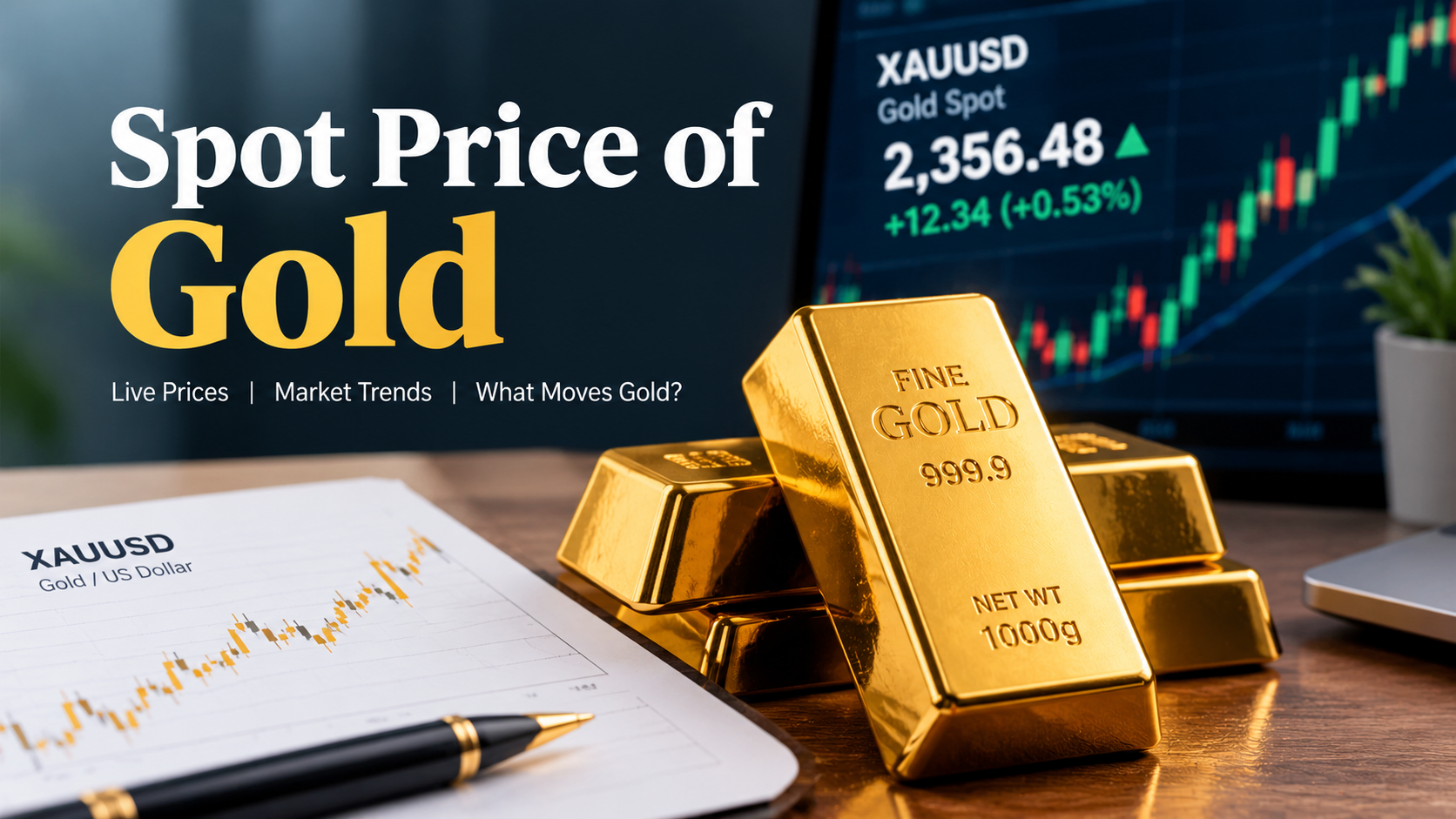
The spot price of gold is the live market price at which gold is currently quoted for immediate settlement. Unlike a fixed retail price, it changes throughout the trading day as buyers and sellers react to economic data, currency movements, interest rates, and global events.
As of September 10, 2026, spot gold was trading around $4,355 per troy ounce, although the price moved significantly during the session. Reuters reported an intraday low of about $4,324 before spot gold recovered toward $4,356.
When checking the current spot price of gold, it is important to look at a live market quote rather than relying on an old price from an article or search result. This is particularly important for traders because even a small movement in XAUUSD can change an entry, stop-loss, or take-profit level.
The spot price of gold is generally quoted in US dollars per troy ounce, which is why traders commonly see gold represented as XAU/USD or XAUUSD on trading platforms. The first part, XAU, represents one troy ounce of gold, while USD represents its value in US dollars.
For traders, the spot price of gold is more than just a number. It provides the starting point for analyzing price action, identifying important support and resistance levels, and understanding how gold is reacting to major economic events.
Important: The price shown in this section should be updated regularly or replaced with a live gold-price widget. That way, the article can satisfy people searching for the current gold price without becoming outdated.
How Is the Spot Price of Gold Determined?
The spot price of gold is not set by a single buyer, seller, or government. It is formed through global market activity, where buyers and sellers continuously negotiate prices based on current supply, demand, liquidity, and expectations about the economy.
A major part of this price discovery takes place in the global over-the-counter (OTC) gold market. Large financial institutions, dealers, producers, refiners, and other market participants trade gold through this network, while prices from major exchanges and futures markets also contribute to the information traders use to value gold.
Several factors can move the spot price of gold within minutes. The US dollar is particularly important because gold is commonly quoted in dollars, so a stronger dollar can put pressure on gold while a weaker dollar can make it more attractive to buyers using other currencies.
Interest rates and expectations about central-bank policy also play a major role. When markets expect interest rates to fall, gold can become more appealing because it does not pay interest, while changing expectations about inflation, economic growth, or monetary policy can quickly influence demand.
Global events can create another layer of movement in the spot price of gold. Geopolitical tensions, financial-market uncertainty, inflation concerns, and strong economic data can all change investor demand, sometimes causing sharp moves in XAUUSD.
For traders, understanding these drivers is more useful than simply watching the price move up or down. When you know why gold is moving, you can better evaluate whether a breakout, pullback, or reversal has meaningful market pressure behind it.
What Factors Affect the Spot Price of Gold?
The spot price of gold can change quickly because gold responds to several forces at the same time. Understanding these drivers helps traders make sense of sudden moves instead of treating every price change as a random market reaction.
1. The US Dollar
Gold is mainly quoted in US dollars, so movements in the dollar can have a strong influence on gold. When the dollar strengthens, gold can become more expensive for buyers using other currencies, which may put downward pressure on demand.
When the dollar weakens, gold can become relatively cheaper for international buyers. This is one reason traders often keep an eye on the DXY index when analyzing XAUUSD.
2. Interest Rates
Interest rates are another major influence on gold. When interest rates or bond yields rise, interest-bearing assets can become more attractive compared with an asset such as gold that does not pay interest.
On the other hand, expectations of lower rates can increase interest in gold. Traders therefore pay close attention to central-bank decisions and changes in expectations before major policy announcements.
3. Inflation
Gold is often viewed as a store of value during periods of rising inflation. If investors become concerned that purchasing power is falling, demand for gold can increase as they look for assets that may help protect their wealth.
However, inflation does not automatically mean gold will rise. The market also considers interest rates, the dollar, economic growth, and whether inflation is higher or lower than expected.
4. Economic Data
Major economic reports can create sharp movements in gold. Data such as CPI, Nonfarm Payrolls, unemployment figures, GDP, and retail sales can change expectations about the economy and future interest-rate decisions.
For an XAUUSD trader, these releases are particularly important because price can move rapidly within seconds or minutes. This is why checking the economic calendar before entering a trade can be just as important as analyzing the chart.
5. Geopolitical Uncertainty
Wars, political tensions, financial instability, and other major global events can increase demand for safe-haven assets. When uncertainty rises, some investors turn toward gold because it is viewed as a defensive asset.
The reaction is not always straightforward, though. Gold can initially rise during a crisis and later reverse if the dollar or Treasury yields move strongly in the opposite direction.
6. Central Bank Gold Purchases
Central banks are significant participants in the global gold market. When central banks increase their gold reserves, it can contribute to overall demand and influence long-term sentiment toward the metal.
This factor usually matters more for the broader trend than for a single short-term candle. Traders should therefore combine central-bank activity with technical and macroeconomic analysis.
7. Supply and Demand
Like other markets, gold is influenced by supply and demand. Mine production, recycling, jewelry demand, investment demand, and institutional buying can all contribute to changes in the market balance.
For short-term traders, however, expectations and market sentiment can sometimes have a greater immediate effect than changes in physical supply. This is why the spot price of gold can move sharply even when there has been no sudden change in mine production.
What Traders Should Watch
Rather than focusing on one factor, I recommend looking at several signals together. The US dollar, Treasury yields, major economic releases, central-bank expectations, and price action on XAUUSD can provide a much clearer picture of what is driving gold.
This approach is especially useful when trading around high-impact news. A strong setup on the chart can behave very differently when an important economic announcement is about to hit the market.
Spot Gold vs. Gold Futures: What Is the Difference?
If you are learning about gold trading, you will often come across two terms: spot gold and gold futures. Although both are connected to the price of gold, they are traded differently and serve different purposes.
Understanding the difference is important because the price you see on a trading platform may represent a spot market instrument, while futures prices come from standardized contracts traded on an exchange. Knowing how each market works can help you choose the instrument that fits your trading style.
What Is Spot Gold?
Spot gold refers to gold traded for delivery at the current market price, with settlement typically occurring shortly after the trade. In online trading, however, traders usually do not take physical possession of gold when trading instruments such as XAU/USD.
Instead, traders speculate on movements in the price of gold against the US dollar. If gold rises after you enter a buy position, you may profit from the price difference, while a falling market can create an opportunity for a short position.
Spot gold is popular among forex and CFD traders because it can be traded during the market’s available trading hours and allows traders to focus directly on gold price movements.
What Are Gold Futures?
Gold futures are standardized contracts to buy or sell a specific amount of gold at a predetermined price for settlement at a future date. These contracts are traded on regulated futures exchanges, with the most well-known gold futures contracts traded through CME Group’s COMEX market.
Unlike a typical spot gold position, a futures contract has an expiration date and standardized contract specifications. Traders can close their positions before expiration, so they do not necessarily need to take physical delivery of the gold.
Gold futures are widely used by professional traders, institutions, producers, and investors for speculation and hedging against changes in gold prices.
Spot Gold vs. Gold Futures: Key Differences
| Feature | Spot Gold | Gold Futures |
|---|---|---|
| Pricing | Current market price | Price for a specific future contract |
| Expiration | Usually no fixed expiration for the trading instrument | Has an expiration date |
| Trading | Common through brokers and CFD/forex platforms | Traded on futures exchanges |
| Contract size | Depends on the broker/instrument | Standardized by the exchange |
| Leverage | Often available | Margin-based |
| Physical delivery | Usually not involved for retail trading instruments | Possible under contract terms |
| Main users | Retail traders, forex traders | Traders, institutions, hedgers, investors |
Why Is the Price Sometimes Different?
You may notice that the spot gold price and a gold futures price are not exactly the same. This does not necessarily mean that one price is incorrect.
Futures prices can reflect factors such as interest rates, financing costs, market expectations, and the time remaining until the contract expires. As a result, a futures contract can trade at a premium or discount to the spot price.
For example, suppose spot gold is trading around $3,500 per ounce while a futures contract expiring several months later is trading slightly higher. The difference can reflect the cost of carrying gold and other market factors rather than a simple disagreement about gold’s value.
Which One Is Better for Traders?
There is no universal winner between spot gold and gold futures. The better choice depends on what you are trying to achieve.
For a retail trader who mainly wants to speculate on short-term XAU/USD price movements, spot gold may be more familiar and accessible through a forex or CFD broker. Traders can analyze price action, support and resistance, liquidity, moving averages, and other technical tools without dealing with futures contract expiration.
Gold futures may be more suitable for traders who specifically want access to an exchange-traded, standardized futures market. They can also be useful for understanding institutional gold-market activity and for hedging.
Spot Gold vs. Gold Futures for Day Trading
For day traders, both markets can provide opportunities, but the trading experience can be different.
Spot gold is commonly used for intraday XAU/USD strategies because traders can focus on the immediate movement of gold against the dollar. Gold futures provide another way to trade gold and can offer detailed exchange-based information such as volume and open interest.
However, leverage makes risk management particularly important in either market. A small movement in gold can produce a relatively large gain or loss when a position is highly leveraged.
Conclusion
Understanding spot gold vs. gold futures makes it easier to see why gold prices can look slightly different across trading platforms and markets. Spot gold is generally focused on the current market price, while gold futures are standardized contracts with specific expiration dates and exchange-based trading.
For traders focused on short-term XAU/USD movements, spot gold can be a practical choice, while futures may be more suitable for those who want to trade standardized exchange contracts or analyze broader market activity. The important thing is to understand how each instrument works, including its costs, leverage, contract structure, and risks, before choosing one for your trading approach.