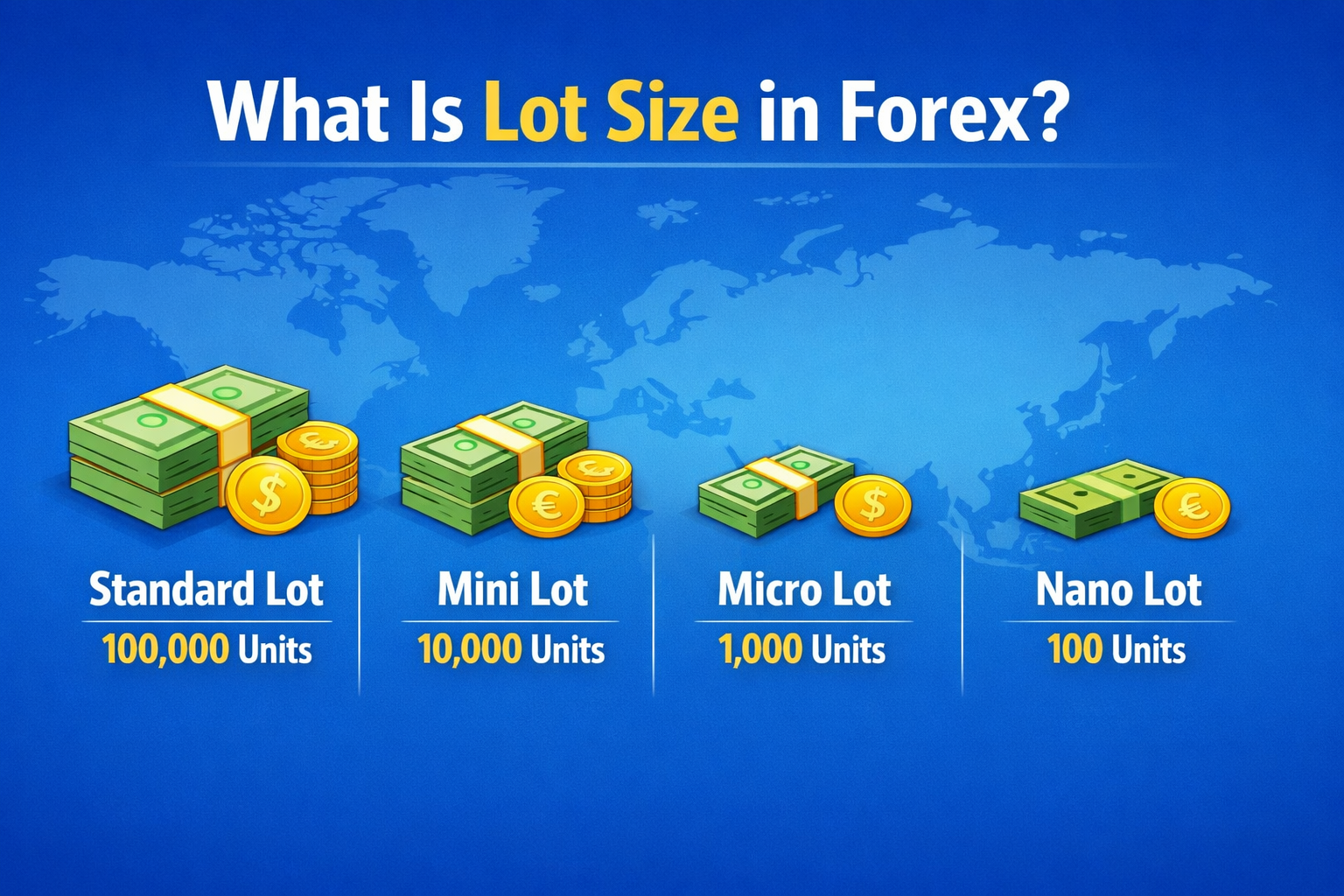
What Is Lot Size in Forex
In forex trading, understanding position sizing is essential for managing risk and profits. One of the most important concepts every beginner must learn is lot size in forex, as it determines how much currency you are buying or selling in a trade.
Definition of Lot Size
A lot refers to the standardized unit of measurement used in forex trading. The lot size in forex tells you the volume of your trade—basically, how big your position is in the market. Instead of buying “1 dollar” or “1 euro,” traders buy or sell in lots.
Why Lot Size Matters in Trading
When it comes to forex trading, many beginners focus only on entry and exit points. However, one of the most critical factors for long-term success is understanding why lot size matters in trading. Your lot size determines how much you risk on each trade and directly affects your profits and losses.
Controls Your Risk
The main reason why lot size matters in trading is risk management. A larger lot size means you are putting more money at risk, while a smaller lot size helps protect your capital. Professional traders always adjust their lot size based on how much they are willing to lose on a single trade.
For example, risking 1–2% of your account per trade is a common rule. Without controlling lot size, even a few losing trades can wipe out your account.
Impacts Profit and Loss
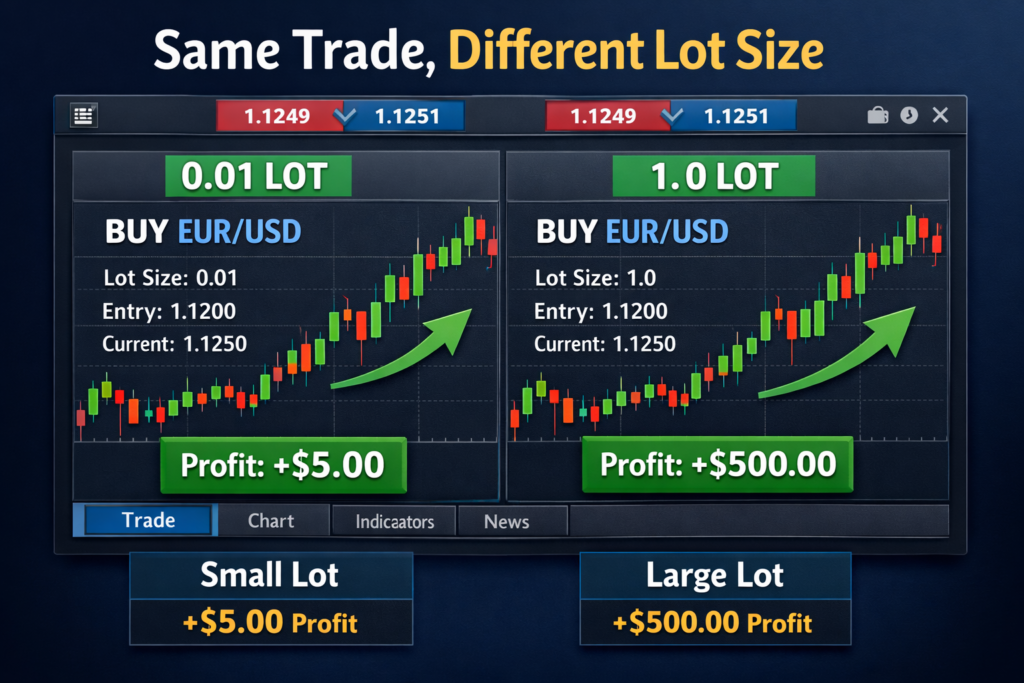
Another key reason why lot size matters in trading is its direct impact on your earnings. The bigger your lot size, the more money you make per pip—but losses also increase at the same rate.
- Large lot size = Higher profit potential + Higher risk
- Small lot size = Lower profit potential + Lower risk
This balance is crucial for consistent trading success.
Affects Trading Psychology
Trading is not just technical—it’s emotional too. Understanding why lot size matters in trading helps you stay calm and disciplined. If your lot size is too big, even small market movements can cause stress and panic.
On the other hand, using a proper lot size allows you to think clearly and follow your strategy without emotional pressure.
Types of Lot Sizes in Forex
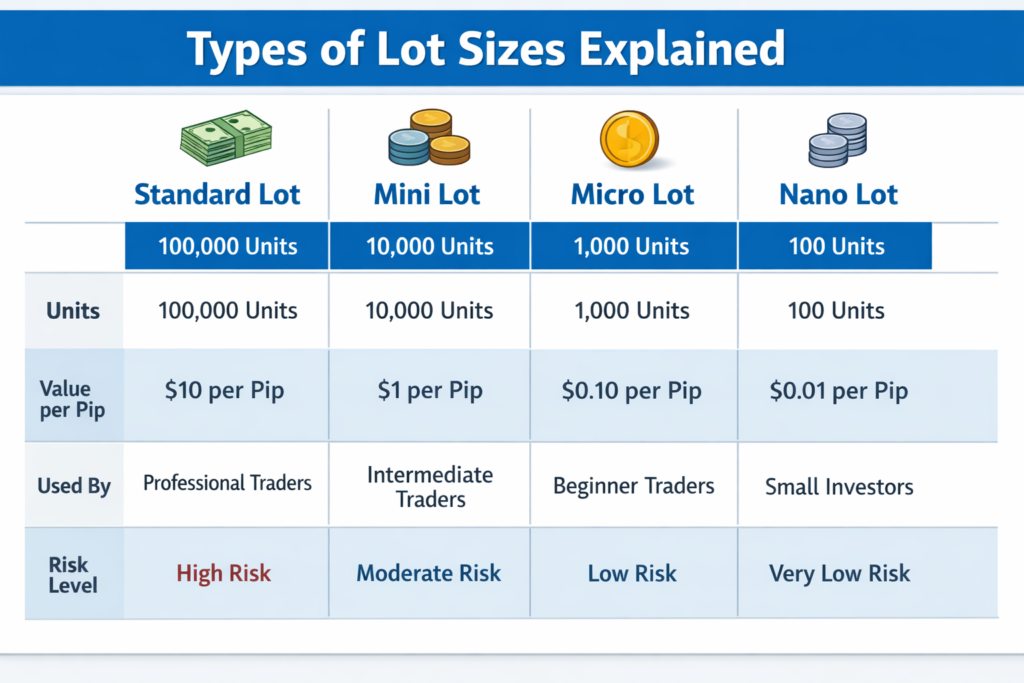
Understanding the different types of lot sizes is essential for every trader. The concept of lot size in forex helps traders control their trade volume, risk level, and potential profit. In simple terms, lot size defines how much currency you are trading in the market.
Let’s explore the main types of lot sizes used in forex trading.
Standard Lot Explained
A standard lot is the largest commonly used unit in forex trading.
- 1 Standard Lot = 100,000 units of currency
Step-by-step:
- When you open a trade with a standard lot, you are buying or selling 100,000 units of a currency pair.
- Each pip movement is usually worth $10.
- This means even small market movements can result in large profits or losses.
This type of lot size in forex is best suited for experienced traders with larger account balances and strong risk management.
Mini Lot Explained
A mini lot is smaller than a standard lot and more suitable for traders who want moderate risk.
- 1 Mini Lot = 10,000 units of currency
Step-by-step:
- You trade 10,000 units instead of 100,000.
- Each pip movement is typically worth $1.
- Risk is lower compared to a standard lot, making it easier to manage trades.
This lot size in forex is ideal for intermediate traders who want a balance between risk and reward.
Micro Lot Explained
A micro lot is one of the safest options for beginners.
- 1 Micro Lot = 1,000 units of currency
Step-by-step:
- You trade only 1,000 units of a currency pair.
- Each pip movement is worth about $0.10.
- Losses and profits are very small, which helps protect your account.
This lot size in forex is perfect for beginners who are still learning and practicing trading strategies.
Nano Lot Explained
A nano lot is the smallest trading size available with some brokers.
- 1 Nano Lot = 100 units of currency
Step-by-step:
- You trade just 100 units of a currency pair.
- Each pip movement is worth around $0.01.
- Risk is extremely low, making it ideal for testing strategies in live markets.
This lot size in forex is best for absolute beginners or traders who want to trade with minimal risk.
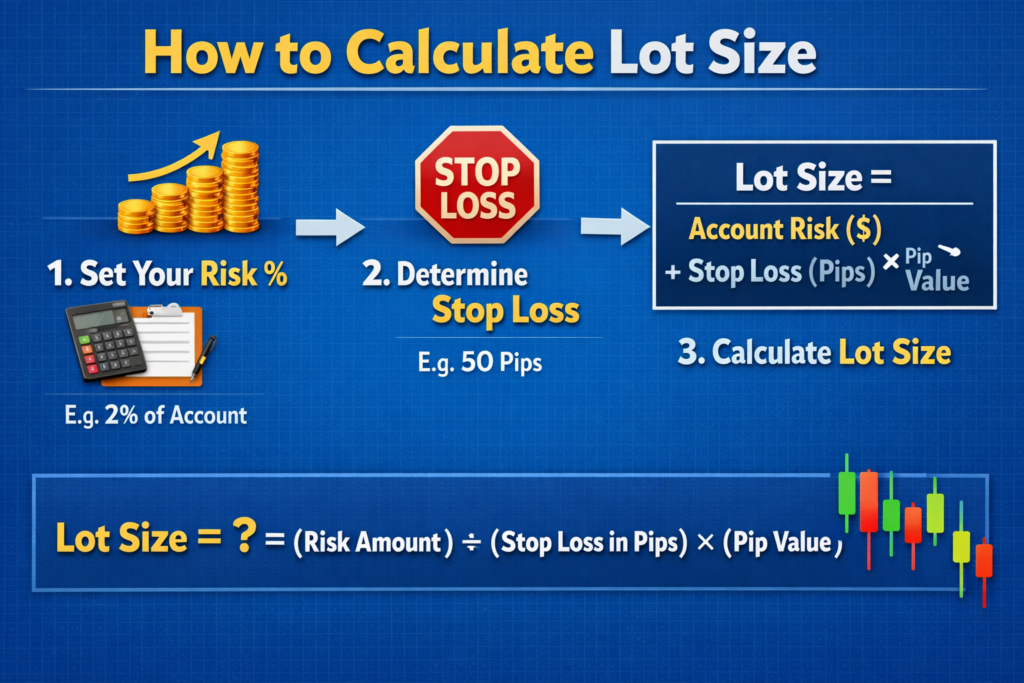
How Lot Size Affects Profit and Loss
In forex trading, your earnings and losses are directly linked to your position size. Understanding how lot size affects profit and loss is essential if you want to manage risk and grow your account consistently.
The Basic Idea
Lot size determines how much currency you are trading. The bigger your lot size, the more money you gain or lose per pip movement.
- Bigger lot size → Bigger profits and bigger losses
- Smaller lot size → Smaller profits and smaller losses
This is the core reason why lot size affects profit and loss in every trade.
Example of Profit and Loss
Let’s take a simple example:
If the market moves 10 pips:
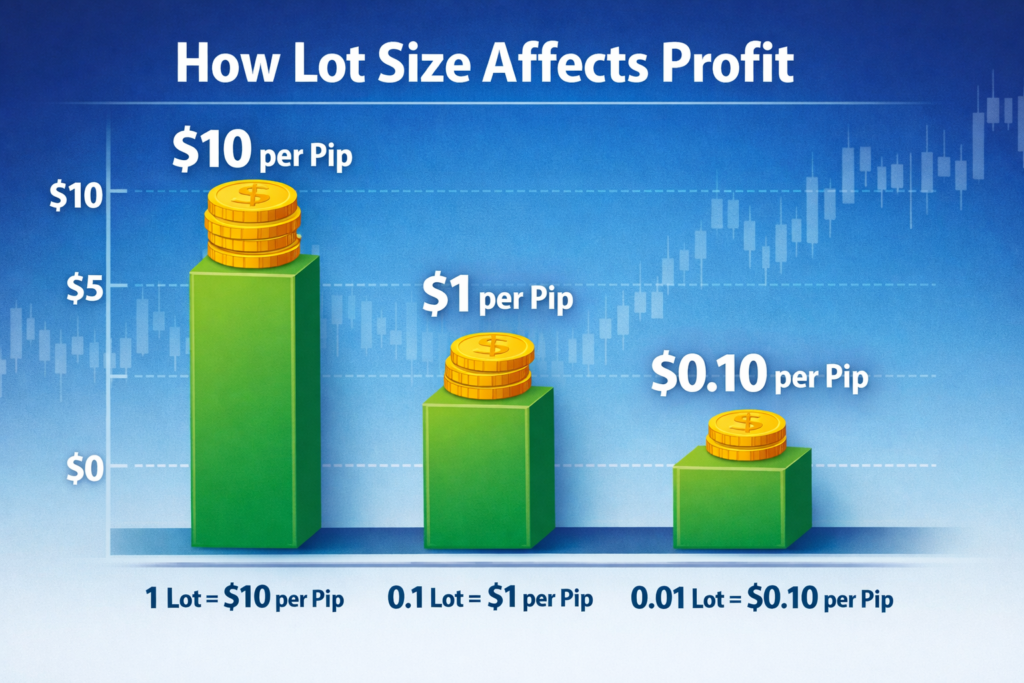
- Standard Lot (100,000 units) → $10 per pip → $100 profit/loss
- Mini Lot (10,000 units) → $1 per pip → $10 profit/loss
- Micro Lot (1,000 units) → $0.10 per pip → $1 profit/loss
This clearly shows how lot size affects profit and loss—the same market movement gives completely different results depending on your lot size.
Risk Increases with Lot Size
One of the most important things to understand about how lot size affects profit and loss is risk.
If you use a large lot size:
- You can make money quickly
- But you can also lose your account quickly
If you use a small lot size:
- Your growth is slower
- But your account is safer
That’s why professional traders always focus on controlling lot size.
Best Lot Size for Beginners
Choosing the right lot size is one of the most important decisions for new traders. The best lot size for beginners is not about making quick profits—it’s about protecting your capital while learning how the market works.
Start with Small Lot Sizes
For beginners, the safest approach is to use smaller position sizes:
- Micro Lot (1,000 units) → Best for learning with low risk
- Nano Lot (100 units) → Ideal for absolute beginners
The best lot size for beginners is usually a micro lot because it allows you to trade in real market conditions without risking too much money.
Why Small Lot Sizes Are Better
Using a small lot size helps you:
- Reduce risk – Losses are small and manageable
- Stay in the game longer – You won’t blow your account quickly
- Learn without pressure – Less emotional stress while trading
This is why the best lot size for beginners is always a smaller one, rather than jumping into large trades.
Risk Management Rule
A simple rule used by professional traders:
- Risk only 1% to 2% of your account per trade
For example:
- If your account is $100
- You should risk only $1–$2 per trade
To follow this rule, choosing the best lot size for beginners becomes essential.
How Brokers Display Lot Sizes
When you start trading, one thing that may confuse beginners is how trading platforms show position sizes. Understanding how brokers display volumes is important because it directly affects your trades. This is where knowing lot size in forex becomes essential.
Lot Size Format on Trading Platforms
Most forex brokers display trade size in decimal format rather than writing full numbers like 100,000 units. This makes it easier to place trades quickly.
Here’s how lot size in forex is commonly displayed:
- 1.00 = Standard Lot (100,000 units)
- 0.10 = Mini Lot (10,000 units)
- 0.01 = Micro Lot (1,000 units)
- 0.001 = Nano Lot (100 units)
Example in a Trading Platform
On platforms like MetaTrader (MT4 or MT5):
- You open the “New Order” window
- You see a field called Volume
- You enter a value like 0.01 or 0.10
- This value represents your lot size in forex
This simple format helps traders quickly adjust their position size before placing a trade.
Fractional Lot Sizes
Many brokers allow flexible trading by offering fractional lot sizes.
For example:
- 0.05 = Half of a mini lot
- 0.25 = Quarter of a standard lot
This flexibility allows better risk control and shows why understanding lot size in forex is so important for managing trades effectively.
Why Brokers Use This System
Brokers use decimal-based lot sizes because:
- It simplifies trading
- It allows precise position sizing
- It supports beginners and advanced traders alike
By learning how lot size in forex is displayed, traders can avoid mistakes like placing trades that are too large or too small.
Common Mistakes Beginners Make
- Confusing 0.01 with 1 lot
- Entering a large lot size by accident
- Not understanding how much money is at risk
These mistakes happen when traders don’t fully understand how lot size in forex works on their platform.
Final Thoughts
Knowing how brokers display lot sizes is a basic but crucial skill in forex trading. Always double-check your volume before placing a trade. A clear understanding of lot size in forex will help you manage risk, avoid costly errors, and trade with confidence.
How Brokers Display Lot Sizes
When you start trading, one thing that may confuse beginners is how trading platforms show position sizes. Understanding how brokers display volumes is important because it directly affects your trades. This is where knowing lot size in forex becomes essential.
Lot Size Format on Trading Platforms
Most forex brokers display trade size in decimal format rather than writing full numbers like 100,000 units. This makes it easier to place trades quickly.
Here’s how lot size in forex is commonly displayed:
- 1.00 = Standard Lot (100,000 units)
- 0.10 = Mini Lot (10,000 units)
- 0.01 = Micro Lot (1,000 units)
- 0.001 = Nano Lot (100 units)
So, when you enter a trade, you are selecting a number like 0.01 or 0.10 instead of typing the full currency amount.
Example in a Trading Platform
On platforms like MetaTrader (MT4 or MT5):
- You open the “New Order” window
- You see a field called Volume
- You enter a value like 0.01 or 0.10
- This value represents your lot size in forex
This simple format helps traders quickly adjust their position size before placing a trade.
Fractional Lot Sizes
Many brokers allow flexible trading by offering fractional lot sizes.
For example:
- 0.05 = Half of a mini lot
- 0.25 = Quarter of a standard lot
This flexibility allows better risk control and shows why understanding lot size in forex is so important for managing trades effectively.