Introduction to Forex Trading
Forex trading, also known as foreign exchange trading, is the process of buying and selling currencies in the global market. It is one of the largest financial markets in the world, with trillions of dollars traded daily by banks, institutions, and individual traders. The main goal in forex trading is to profit from changes in currency prices by predicting whether one currency will rise or fall against another.
To understand forex trading effectively, beginners must first learn basic concepts like currency pairs, spreads, and especially what is pip. A pip is the smallest price movement in a currency pair, and it plays a crucial role in measuring profit and loss. Without understanding what is pip, traders cannot accurately calculate their gains or risks in the market.
Forex trading works through currency pairs such as EUR/USD or GBP/JPY, where one currency is exchanged for another. When you trade, you are speculating on the price movement of these pairs. For example, if you believe the Euro will strengthen against the US Dollar, you buy EUR/USD. Here again, knowing what is pip helps you understand how much the price has moved and how much profit or loss you have made.
Another important aspect of forex trading is leverage, which allows traders to control larger positions with smaller amounts of capital. While leverage can increase profits, it also increases risk. This is why understanding key concepts like what is pip is essential for managing trades wisely.
What is a Pip in Forex Trading?
A pip is one of the most important concepts in forex trading, and every beginner must clearly understand it. If you are wondering what is pip, it simply stands for “Percentage in Point” and represents the smallest price movement in a currency pair.
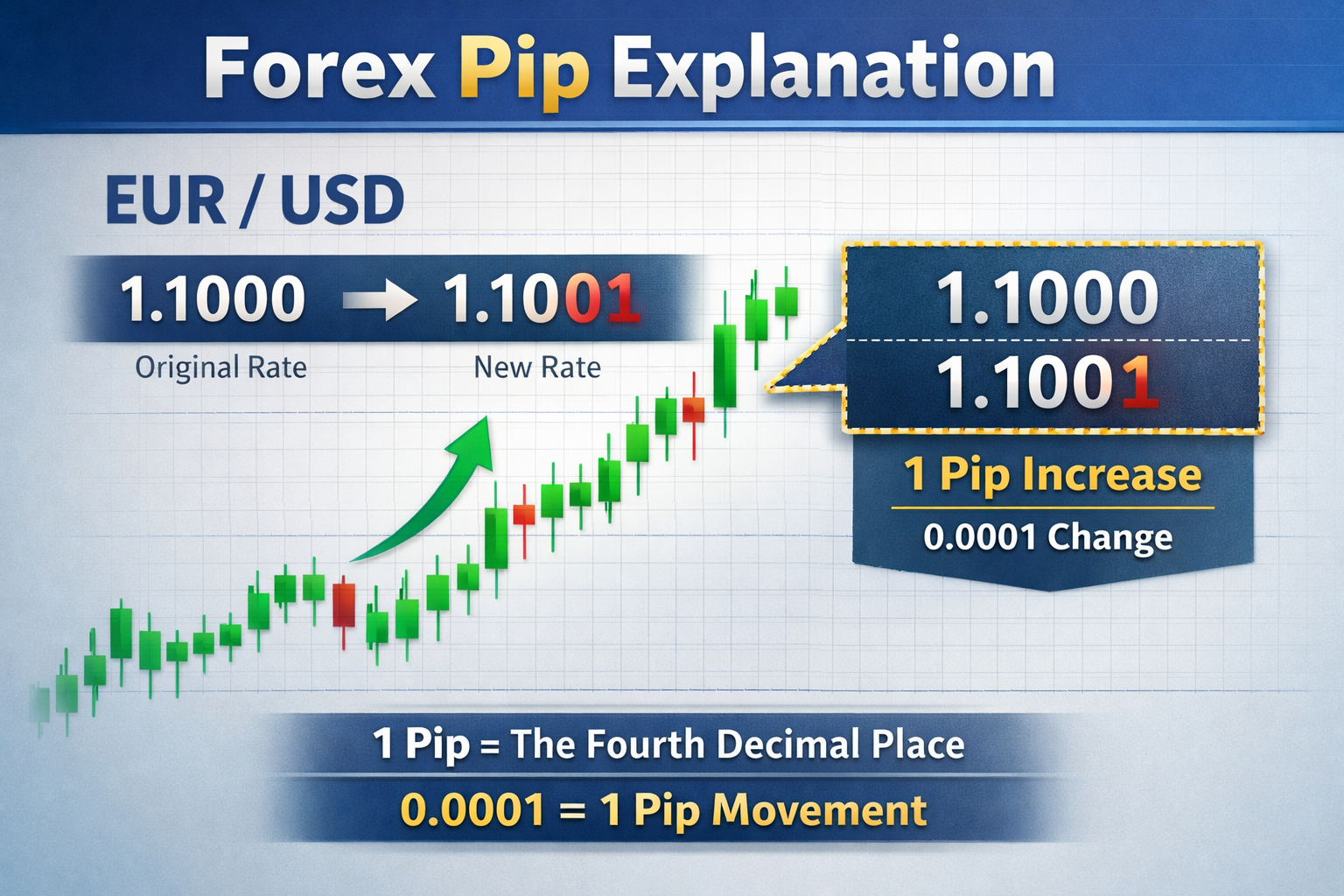
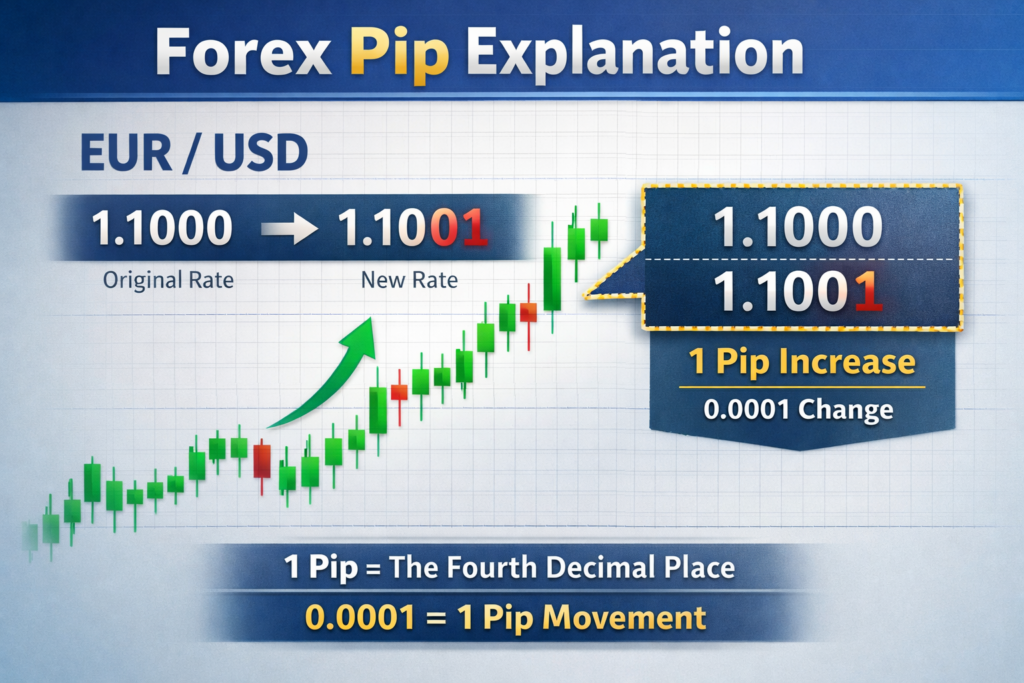
In most currency pairs, a pip is the fourth decimal place. For example, if EUR/USD moves from 1.1000 to 1.1001, that change of 0.0001 is one pip. Understanding what is pip helps traders measure how much the market has moved and calculate their potential profit or loss accurately.
To make it easier, let’s break it down with an example. Suppose you buy a currency pair and the price moves up by 10 pips. This means the price has increased by 0.0010. The actual profit depends on your trade size, but without knowing what is pip, you cannot determine how much you earned or lost in a trade.
It’s also important to note that some currency pairs, especially those involving the Japanese Yen, use two decimal places instead of four. In such cases, a pip is the second decimal place. This is another reason why understanding what is pip is essential for avoiding confusion while trading different pairs.
In conclusion, a pip is the basic unit used to measure price changes in forex trading. It plays a key role in risk management, trade analysis, and profit calculation. For any trader who wants to succeed, mastering what is pip is a fundamental step in building a strong foundation in the forex market.
Why Pips are Important in Forex?
Pips are extremely important in forex trading because they are the standard unit used to measure price movements in the market. If you truly understand what is pip, you can track how much a currency pair has moved and evaluate your trading performance more accurately.
One of the main reasons pips matter is that they help traders calculate profit and loss. Every trade you open will either gain or lose a certain number of pips. Without knowing what is pip, it becomes almost impossible to determine how much money you are making or losing in each trade.
Pips also play a key role in risk management. Traders use pips to set stop-loss and take-profit levels. For example, you might risk 20 pips to gain 40 pips in a trade. This risk-to-reward ratio is essential for long-term success, and it all depends on understanding what is pip properly.
Another important reason pips are valuable is that they allow traders to compare different trades and strategies. Whether you are trading EUR/USD or GBP/JPY, results are often measured in pips. This makes it easier to analyze performance consistently, which is why learning what is pip is a must for every trader.
Finally, pips help in position sizing. Traders decide how big or small their trades should be based on how many pips they are willing to risk. This ensures better control over their capital and prevents unnecessary losses. Once again, this highlights why understanding what is pip is essential for both beginners and experienced traders.
In conclusion, pips are the foundation of forex trading calculations. From measuring price movements to managing risk and profits, everything revolves around pips. That’s why mastering what is pip is a critical step toward becoming a successful forex trader.
How a Pip Works (Simple Explanation)
A pip works as a simple way to measure how much the price of a currency pair moves in forex trading. It helps traders understand small changes in price without dealing with long decimal numbers.
In most currency pairs, a pip is the fourth decimal place. For example, if EUR/USD moves from 1.1000 to 1.1001, that change is 1 pip. If it moves from 1.1000 to 1.1010, that means the price has moved 10 pips. This makes it easy to track price movements in a clear and standardized way.
Let’s understand it in a simple step-by-step example:
- You buy EUR/USD at 1.1000
- The price moves to 1.1005
- The difference is 5 pips
This means you gained 5 pips in the trade. If the price had gone down instead, you would have lost 5 pips.
The value of each pip depends on your trade size (lot size). For example:
- In a standard lot, 1 pip ≈ $10
- In a mini lot, 1 pip ≈ $1
- In a micro lot, 1 pip ≈ $0.10
So, if you gain 10 pips on a standard lot, you make about $100. This is how traders calculate profits and losses quickly.
In simple terms, a pip works like a “point system” in forex trading. It shows how much the market has moved and helps traders measure their gains, losses, and risk easily.
Examples of Pip Movement.
Understanding pip movement becomes much easier when you look at real examples. Before diving in, remember that what is pip refers to the smallest price change in a currency pair, usually the fourth decimal place.
Example 1: Basic Pip Movement
Suppose EUR/USD moves from 1.1000 to 1.1001.
This is a movement of 1 pip.
If the price moves from 1.1000 to 1.1010, that equals 10 pips.
These small changes show exactly what is pip and how price movement is measured in forex trading.
xample 2: Profit Calculation
Let’s say you buy EUR/USD at 1.2000 and sell at 1.2015.
The price moved 15 pips in your favor.
- If you traded a standard lot, you earn about $150
- If you traded a mini lot, you earn about $15
This example clearly shows why understanding what is pip is important for calculating profits.
Example 3: Loss Scenario
You buy GBP/USD at 1.3000, but the price drops to 1.2985.
That’s a 15 pip loss.
This helps you see how what is pip is used not only for profits but also for tracking losses in trading.
Example 4: Japanese Yen Pair
For pairs like USD/JPY, pips are counted differently.
If USD/JPY moves from 110.00 to 110.01, that is 1 pip.
So, if it moves to 110.50, that means a 50 pip move.
This variation is another reason why traders must fully understand what is pip.
Example 5: Daily Market Movement
In a typical trading day, a currency pair might move 50–100 pips.
For example, EUR/USD could go from 1.1050 to 1.1100, which is a 50 pip movement.
This shows how traders use daily pip movements to find trading opportunities and why learning what is pip is essential for success.
What is Pip Value?
Pip value refers to the amount of money you gain or lose for each pip movement in a forex trade. While a pip measures the price change, pip value tells you how much that change is worth in real money.
In simple terms, pip value depends on three main factors: the currency pair you are trading, the size of your trade (lot size), and sometimes the exchange rate. This means the same pip movement can result in different profits or losses depending on your position size.
For most currency pairs where the US Dollar is the quote currency (like EUR/USD), pip value is fixed based on lot size:
- Standard lot (100,000 units): 1 pip ≈ $10
- Mini lot (10,000 units): 1 pip ≈ $1
- Micro lot (1,000 units): 1 pip ≈ $0.10
For example, if you trade a standard lot and the market moves 10 pips in your favor, you earn about $100. If it moves against you by 10 pips, you lose $100.
However, when trading pairs where USD is not the quote currency (like GBP/JPY), pip value can vary slightly depending on the current exchange rate. That’s why traders often use pip value calculators to get accurate numbers.
Understanding pip value is very important because it helps you manage risk. Before entering a trade, you can calculate how much money you are risking per pip and decide the appropriate position size.
How to Calculate Pip Value?
Calculating pip value is an essential skill in forex trading because it helps you understand how much money you can gain or lose per pip movement. Once you know how to calculate it, you can manage your risk much more effectively.
Simple Pip Value Formula
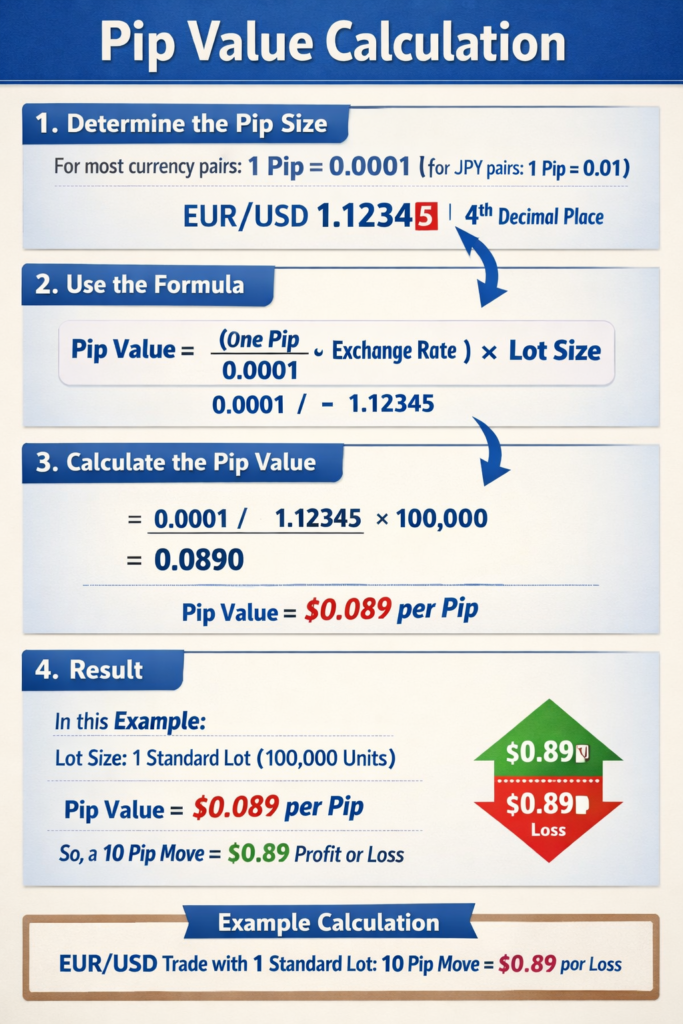
The basic formula to calculate pip value is:
Pip Value = (Pip Size × Lot Size) ÷ Exchange Rate
Step-by-Step Explanation
- Pip Size
- For most currency pairs: 0.0001
- For JPY pairs: 0.01
- Lot Size
- Standard lot = 100,000 units
- Mini lot = 10,000 units
- Micro lot = 1,000 units
Exchange Rate
- The current price of the currency pair
Example 1 (USD as Quote Currency)
Let’s calculate pip value for EUR/USD:
- Pip Size = 0.0001
- Lot Size = 100,000
- No need to divide by exchange rate (since USD is the quote currency)
Calculation:
Pip Value = 0.0001 × 100,000 = $10 per pip
Example 2 (JPY Pair)
For USD/JPY:
- Pip Size = 0.01
- Lot Size = 100,000
- Exchange Rate = 110.00
Calculation:
Pip Value = (0.01 × 100,000) ÷ 110 = ≈ $9.09 per pip
Example 3 (Mini Lot)
If you trade a mini lot (10,000 units) on EUR/USD:
Calculation:
Pip Value = 0.0001 × 10,000 = $1 per pip
Why This Matters
Knowing how to calculate pip value allows you to:
- Control your risk before entering a trade
- Set proper stop-loss levels
- Choose the right lot size
- Understand your exact profit and loss
How Brokers Display Pips?
Brokers display pips in a way that helps traders easily see even the smallest price movements in the forex market. Understanding how this works is important because it allows you to read charts correctly and make better trading decisions.
Standard Pip Display
Most forex brokers show currency prices with 4 decimal places for standard pairs like EUR/USD.
Example:
- EUR/USD = 1.1050 → 1.1051 = 1 pip movement
Here, the last digit (4th decimal place) represents the pip. This is the basic format used to understand price changes.
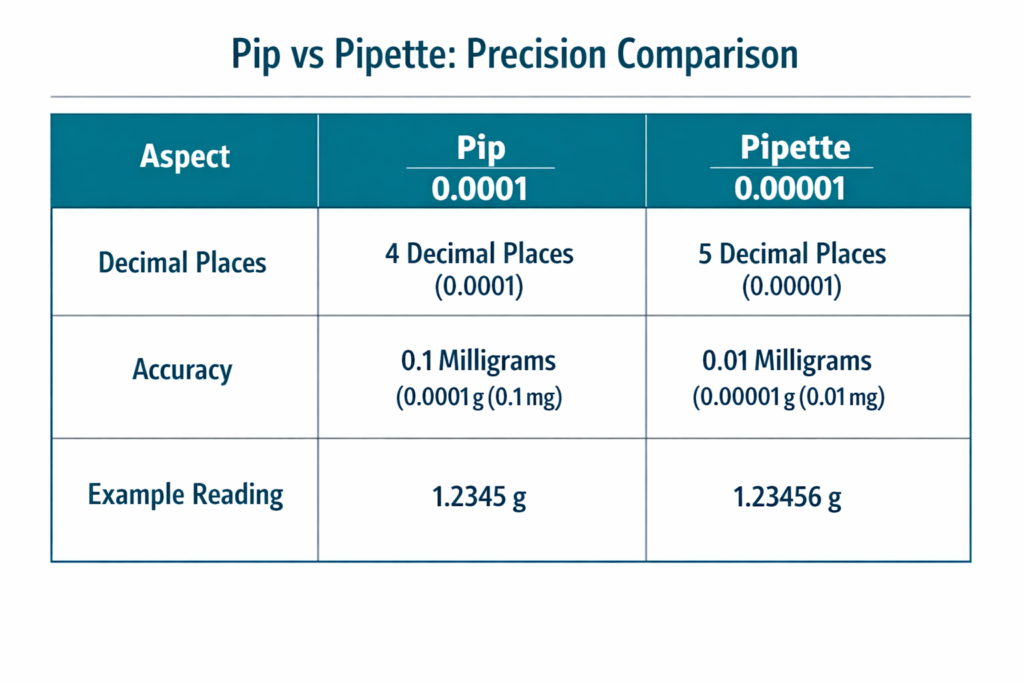
Fractional Pips (Pipettes)
Many modern brokers use 5 decimal places instead of 4. The extra digit is called a pipette (or fractional pip).
Example:
- EUR/USD = 1.10508 → 1.10518
Here:
- The 4th decimal place = pip
- The 5th decimal place = pipette (1/10 of a pip)
This allows for more precise pricing and tighter spreads.
JPY Pair Display
Currency pairs involving Japanese Yen are displayed differently:
- Standard format: 2 decimal places
- With pipettes: 3 decimal places
Example:
- USD/JPY = 110.25 → 110.26 = 1 pip
- USD/JPY = 110.253 → last digit is a pipette
Why Brokers Use Extra Digits
Brokers include fractional pips to:
- Show more accurate price movements
- Offer tighter spreads
- Improve trade execution precision
Reading Pips on Trading Platforms
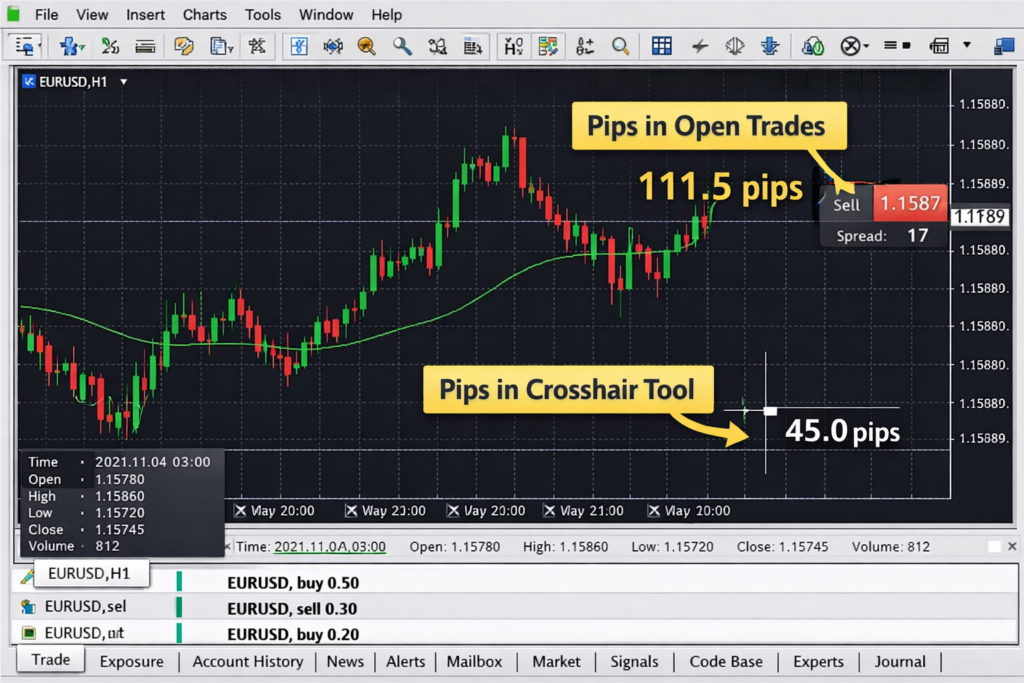
On platforms like MetaTrader 4 (MT4) or MetaTrader 5 (MT5), you will see prices constantly changing. To read pips:
- Focus on the main pip digit (not the smallest one)
- Count how many positions the price moves
- Ignore the last digit if you only want full pips
Simple Tip
If a broker shows 5 digits, just ignore the last digit to find the pip value. That last digit is only for extra precision.
FAQs
What is a pip in forex trading?
A pip stands for “price in percentage” or “price interest point” and is the smallest value of change within a currency pair in forex trading. Most currency pairs are priced to four decimal places — for example, if GBP/USD moves from 1.4000 to 1.4001, the price has moved by one pip
What does pip stand for?
PIP stands for “Percentage In Point” and is considered the smallest price move that a currency pair can make. It is the fundamental unit of measurement in the forex market that helps traders express the change in value between two currencies.
How much is 1 pip worth in dollars?
On USD-quoted major currency pairs, one pip is worth approximately $10 on a standard lot, $1 on a mini lot, and $0.10 on a micro lot. Pip values for JPY pairs and crosses vary slightly depending on the current exchange rate.
How do you calculate pips in forex?
You can calculate pips by looking at the fourth decimal place of major currency pairs. For example, if you enter a trade at 1.0111 and exit that trade at 1.0119, that pair has moved eight pips.
A pip stands for “price in percentage” or “price interest point” and is the smallest value of change within a currency pair in forex trading. Most currency pairs are priced to four decimal places — for example, if GBP/USD moves from 1.4000 to 1.4001, the price has moved by one pip
PIP stands for “Percentage In Point” and is considered the smallest price move that a currency pair can make. It is the fundamental unit of measurement in the forex market that helps traders express the change in value between two currencies.
On USD-quoted major currency pairs, one pip is worth approximately $10 on a standard lot, $1 on a mini lot, and $0.10 on a micro lot. Pip values for JPY pairs and crosses vary slightly depending on the current exchange rate.
You can calculate pips by looking at the fourth decimal place of major currency pairs. For example, if you enter a trade at 1.0111 and exit that trade at 1.0119, that pair has moved eight pips.