Table of Contents
ToggleIntroduction
Understanding how CPI affects gold prices is essential for anyone who trades XAU/USD. Every month, the release of the Consumer Price Index (CPI) can create significant volatility in the gold market, causing prices to rise or fall within minutes. For traders, these movements can present valuable opportunities, but they also increase the risk of unexpected losses if the market is not properly understood.
Many beginner traders believe that higher inflation always pushes gold prices higher. In reality, the relationship between CPI and gold is much more complex. Gold’s price reaction depends on several factors, including inflation expectations, the US dollar, Treasury yields, and the market’s expectations of future Federal Reserve interest rate decisions. This is why gold sometimes falls even after a high CPI reading, leaving many traders confused.
In this comprehensive guide, you’ll learn how CPI affects gold prices, why the market reacts differently to various CPI outcomes, and how experienced traders prepare for one of the most important economic events on the financial calendar. By the end of this article, you’ll have a clear understanding of the relationship between inflation and gold, helping you make more informed trading decisions.
What Is the Consumer Price Index (CPI)?
Before understanding how CPI affects gold prices, it’s important to know what the Consumer Price Index (CPI) actually measures and why it is one of the most closely watched economic indicators in the world.
The Consumer Price Index (CPI) is a monthly economic report that measures the average change in the prices consumers pay for everyday goods and services over time. These goods include food, housing, transportation, healthcare, education, clothing, and many other essential expenses. In simple terms, CPI helps determine whether the cost of living is increasing or decreasing, making it one of the primary indicators used to measure inflation.
In the United States, the CPI report is published every month by the U.S. Bureau of Labor Statistics (BLS). Investors, economists, businesses, and central banks carefully monitor this report because it provides valuable insight into the health of the economy. A higher-than-expected CPI reading usually indicates that inflation is rising, while a lower reading suggests that inflation is slowing down.
For traders, the CPI report is much more than just an inflation number. It often influences expectations about future Federal Reserve interest rate decisions. Since interest rates affect the strength of the U.S. dollar, bond yields, and investor sentiment, the CPI report can trigger significant price movements across financial markets, including stocks, forex, cryptocurrencies, and especially gold.
This is one of the main reasons traders pay close attention to how CPI affects gold prices. A single CPI announcement can create sharp volatility in XAU/USD, causing gold prices to rise or fall within minutes as investors react to new inflation data and changing market expectations.
Why Does CPI Affect Gold Prices?
https://www.bls.gov/cpi/Understanding how CPI affects gold prices ishttps://www.federalreserve.gov/ essential for every XAU/USD trader because the Consumer Price Index has a direct influence on inflation expectations, interest rates, the US dollar, and overall market sentiment. While many traders assume that higher inflation automatically pushes gold prices higGold is considered both a safe-haven asset and a hedge against inflation, but its price is also heavily influenced by monetary policy. When the CPI report is released, traders immediately analyze whether inflation is rising faster or slower than expected. Their expectations about the Federal Reserve’s next move often determine how gold reacts in the minutes and hours following the announcement.
The Relationship Between CPI and Gold
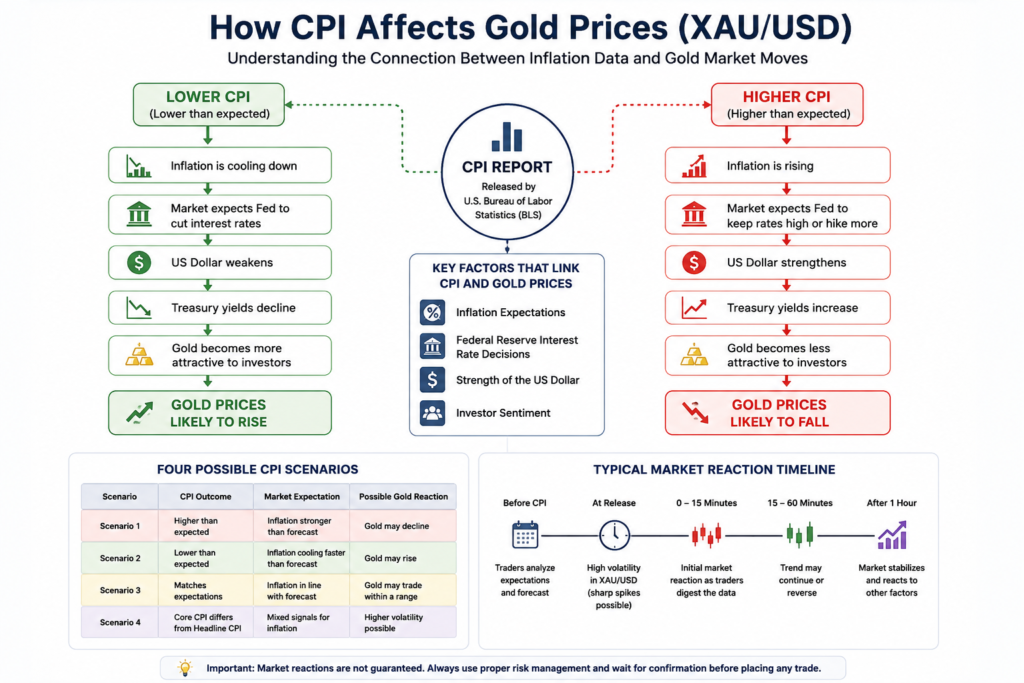
The Consumer Price Index measures inflation, and inflation plays a major role in the Federal Reserve’s interest rate decisions. If inflation remains above the Fed’s target, policymakers may decide to keep interest rates high or even raise them further to slow economic growth.
Higher interest rates generally strengthen the US dollar and increase Treasury yields. Because gold does not generate interest or dividends, investors may shift their money toward interest-bearing assets, reducing demand for gold. As a result, gold prices often decline.
On the other hand, if CPI data shows that inflation is cooling, traders may expect the Federal Reserve to slow down or reduce interest rates in the future. This can weaken the US dollar, lower bond yields, and increase demand for gold, which may push prices higher.
Four Factors That Connect CPI and Gold Prices
1. Inflation Expectations
Gold has long been viewed as a store of value during periods of rising inflation. When inflation increases, many investors buy gold to help protect the purchasing power of their money. However, the market often reacts to whether the CPI result is better or worse than expected, not just whether inflation is high.
2. Federal Reserve Interest Rate Decisions
The Federal Reserve uses inflation data as one of the key indicators when deciding whether to raise, lower, or maintain interest rates. Since CPI is one of the most important inflation reports, traders closely monitor every monthly release.
If investors believe the Fed will maintain higher interest rates, gold may come under pressure. If they expect rate cuts, gold often receives support.
3. Strength of the US Dollar
Gold is priced globally in US dollars. When the dollar becomes stronger, gold becomes more expensive for buyers using other currencies, which can reduce demand. Conversely, a weaker dollar often makes gold more affordable and can increase buying interest.
4. Investor Sentiment
CPI reports can change how investors feel about the economy. Strong inflation may increase uncertainty, while weaker inflation can improve confidence. These shifts in sentiment often create significant volatility in gold prices, especially during the first few minutes after the CPI announcement.
Real Examples of How CPI Affects Gold Prices
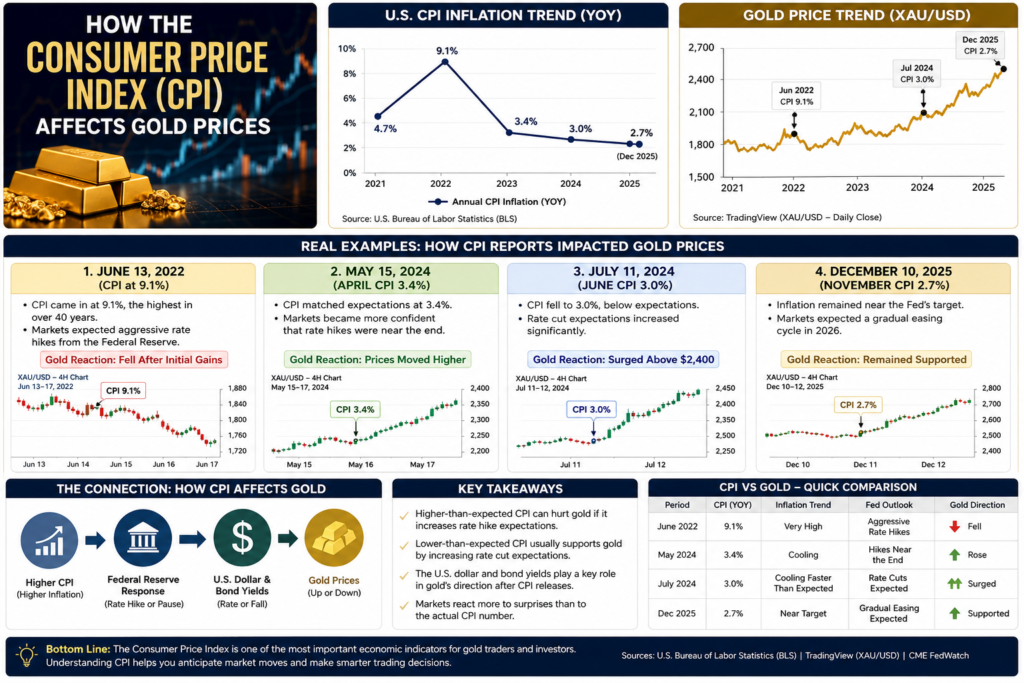
One of the best ways to understand the relationship between the Consumer Price Index (CPI) and gold prices is by looking at real market events. Each month, investors closely watch the U.S. CPI report because it influences inflation expectations, interest rate decisions, the U.S. dollar, and ultimately the price of gold.
Understanding how CPI affects gold prices becomes much easier when we examine real market events. Every CPI report is different because traders react not only to the inflation data itself but also to how it compares with market expectations. Sometimes gold rallies after a high CPI reading, while in other cases it declines sharply. The difference lies in how investors interpret the data and what they expect the Federal Reserve to do next.
Below are three real-world examples that demonstrate how CPI affects gold prices under different market conditions.
Example 1: June 2022 – High Inflation Pressured Gold
In June 2022, the United States reported one of the highest annual inflation readings in decades. The CPI data came in higher than economists had expected, increasing concerns that inflation was becoming more difficult to control.
Following the report, investors expected the Federal Reserve to continue raising interest rates aggressively. As a result:
- The US dollar strengthened.
- Treasury yields increased.
- Gold experienced selling pressure.
- Market volatility increased significantly
Key Takeaway
Higher-than-expected CPI can be bearish for gold if it causes traders to expect tighter monetary policy.
Example 2: October 2023 – Gold Rebounded After Initial Volatility
During the October 2023 CPI release, inflation data was close to market expectations. Gold initially experienced sharp price swings as traders reacted to the announcement.
However, once investors analyzed the report in more detail, expectations for future Federal Reserve rate hikes eased. This weakened the US dollar and encouraged buyers to return to the gold market.
Within a short period:
- Gold recovered from its initial decline.
- The US dollar lost momentum.
- Traders became more optimistic about future interest rate cuts.
Key Takeaway
Professional traders often wait for confirmation instead of entering trades immediately after the CPI release.
Example 4: December 2025 CPI Report – Lower Inflation Supported Gold
One of the best recent examples of how CPI affects gold prices occurred after the November 2025 CPI report, which was released on December 18, 2025. The U.S. Bureau of Labor Statistics reported that annual inflation rose 2.7%, which was below economists’ expectations of 3.1%. Core CPI also came in lower than expected at 2.6%.
The softer inflation data increased investor expectations that the Federal Reserve could begin lowering interest rates in 2026. As a result, financial markets reacted quickly:
- The US Dollar weakened.
- US Treasury yields moved lower.
- Investor confidence improved.
- Gold prices found support as demand for safe-haven assets increased.
How Professional Traders Prepare for a CPI Release
1. Check the Economic Calendar
Professional traders always know the exact date and time of the CPI release. They use an economic calendar to monitor important data, including:
- Previous CPI reading
- Market forecast
- Actual CPI result (released during the announcement)
- Core CPI data
These numbers help traders understand whether inflation is improving or worsening compared to market expectations.
2. Identify Key Support and Resistance Levels
Before the CPI report is released, traders mark important support and resistance zones on the gold chart. These price levels often become areas where the market may reverse or break out after the news.
For example, traders may identify:
- Daily high and low
- Weekly support and resistance
- Previous session high and low
- Psychological price levels (such as $3,300 or $3,350)
3. Watch the US Dollar and Treasury Yields
Gold rarely moves alone. Professional traders also monitor:
- US Dollar Index (DXY)
- US 10-Year Treasury Yield
If the CPI report strengthens the US dollar and pushes Treasury yields higher, gold may come under selling pressure. On the other hand, if both the dollar and yields decline, gold often finds support.
Looking at these markets together provides a better understanding of how CPI affects gold prices and improves decision-making.
4. Wait for Market Confirmation
One of the biggest mistakes beginners make is entering a trade immediately after the CPI numbers are released. The first few minutes are often filled with rapid price swings caused by algorithmic trading and high trading volume.
Professional traders usually wait for:
- The initial volatility to settle.
- A confirmed market direction.
- A candlestick confirmation.
- A breakout or rejection from a key price level.
5. Follow Strict Risk Management
Even experienced traders cannot predict every market reaction. That is why risk management is always the first priority.
Before opening a trade, professionals decide:
- How much of their account are they willing to risk?
- Their stop-loss level.
- Their take-profit target.
- Their desired risk-to-reward ratio.
Common Mistakes to Avoid During CPI Trading
Many traders lose money during CPI announcements because they ignore basic risk management principles. Here are some common mistakes:
- Entering trades without checking market expectations.
- Using excessive leverage.
- Trading without a stop-loss.
- Chasing the first large price candle.
- Ignoring the overall market trend.
- Letting emotions control trading decisions.
Avoiding these mistakes can improve your long-term trading performance.
Frequently Asked Questions (FAQs)
1. Does a higher CPI always cause gold prices to fall?
No. A higher Consumer Price Index (CPI) does not always cause gold prices to fall. The market reacts to the difference between the actual CPI reading and market expectations. If inflation is higher than expected, traders may anticipate higher interest rates, which can strengthen the US dollar and put pressure on gold. However, geopolitical events, economic uncertainty, and investor sentiment can also influence the direction of gold prices.
2. Why do gold prices become volatile during CPI announcements?
Gold becomes highly volatile during CPI releases because the report provides new information about inflation. Traders immediately reassess future Federal Reserve interest rate decisions, causing rapid movements in the US dollar, Treasury yields, and XAU/USD. Increased trading volume and algorithmic trading also contribute to sharp price swings.
3. What is the best way to trade gold during a CPI release?
The safest approach is to prepare before the announcement rather than reacting emotionally after the data is released. Professional traders monitor the economic calendar, compare the actual CPI result with market expectations, identify key support and resistance levels, and wait for price confirmation before entering a trade. Proper risk management is essential because market volatility can increase significantly during major economic news.
4. Does lower CPI always increase gold prices?
Not necessarily. Lower CPI often supports gold because it can reduce expectations for future interest rate increases, weakening the US dollar. However, gold prices are influenced by many factors, including central bank decisions, employment data, geopolitical events, and overall market sentiment. Traders should always analyze the broader market before making trading decisions.
5. Why does the US dollar affect gold prices?
Gold is priced globally in US dollars. When the dollar strengthens, gold becomes more expensive for buyers using other currencies, which may reduce demand and put downward pressure on prices. When the dollar weakens, gold generally becomes more affordable for international investors, which can increase demand.
Conclusion
Understanding how CPI affects gold prices is an essential skill for anyone trading XAU/USD. The monthly Consumer Price Index report provides valuable insight into inflation, influences Federal Reserve policy expectations, and often triggers significant movements in the gold market.
Rather than focusing only on whether CPI is higher or lower, successful traders compare the actual result with market forecasts, monitor the US dollar and Treasury yields, and wait for price confirmation before entering a trade. This disciplined approach can help reduce emotional decisions and improve long-term consistency.
As you continue learning about gold trading, remember that CPI is only one piece of the puzzle. Combining economic analysis with technical analysis, sound risk management, and continuous practice will help you make better-informed trading decisions.
Whether you’re a beginner or an experienced trader, understanding the relationship between inflation and gold can give you greater confidence as you navigate one of the world’s most actively traded markets.