Introduction
The Gold During FOMC Meeting is one of the most important topics every gold trader should understand. Whenever the Federal Reserve announces its interest rate decision, the gold market often experiences sharp price swings. Within minutes, gold can rise or fall significantly, creating both opportunities and risks for traders.. For
Understanding Gold During FOMC Meeting is essential because the market reacts to more than just the interest rate decision. Investors closely watch the Federal Reserve’s policy statement, economic projections, and the Federal Reserve Chair’s press conference for clues about future monetary policy. Even if interest rates remain unchanged, unexpected comments can trigger major moves in the gold market.
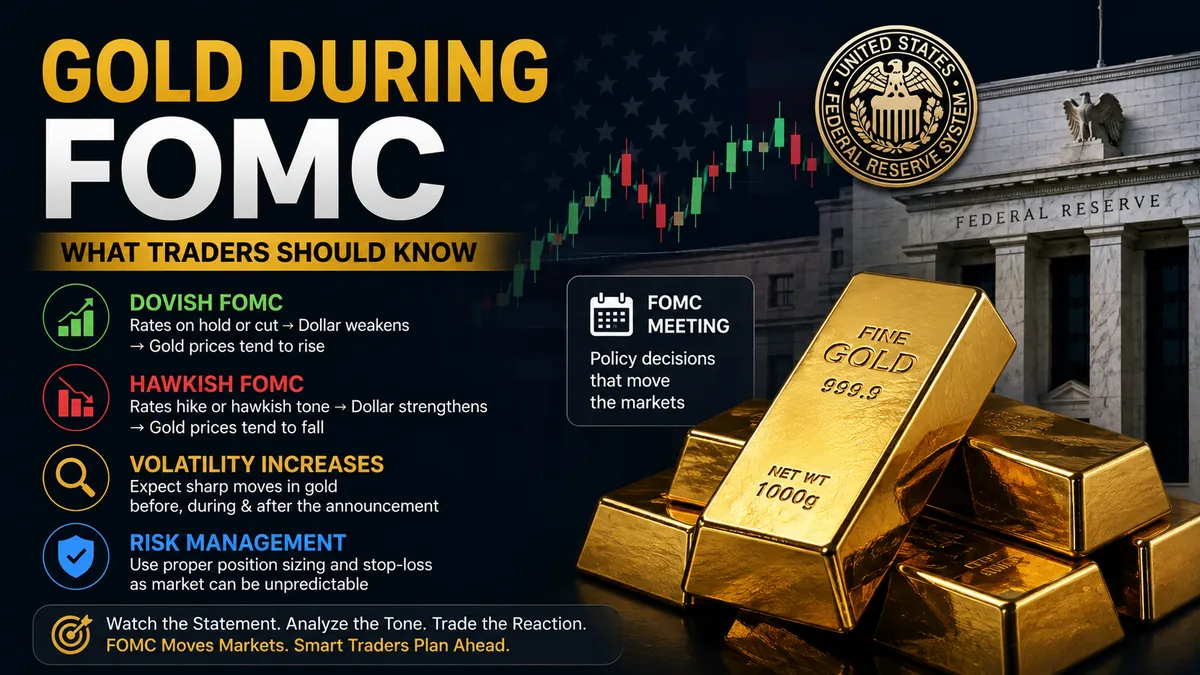
Gold has a strong relationship with the US dollar, Treasury yields, and inflation expectations. Since gold does not pay interest, higher interest rates usually increase the appeal of interest-bearing assets and can put pressure on gold prices. On the other hand, lower interest rates often weaken the US dollar and increase demand for gold as a safe-haven asset. This relationship makes Gold During FOMC Meeting a key focus for both short-term traders and long-term iFor beginners, trading Gold During FOMC Meeting can be challenging because volatility increases immediately after the announcement. Prices may move rapidly in both directions before settling into a clear trend. Entering trades too early without confirmation can lead to unnecessary losses, which is why patience and proper risk management are so important.
In this comprehensive guide, you’ll learn everything you need to know about Gold During FOMC Meeting, including why the Federal Reserve influences gold prices, how gold reacts to different interest rate decisions, and the best trading strategies to handle FOMC volatility. Whether you’re new to gold trading or looking to improve your trading plan, this guide will help you make more informed and confident decisions during one of the most influential economic events of the year.
What Is the FOMC Meeting?
The Federal Open Market Committee (FOMC) is the policy-making branch of the Federal Reserve (Fed) responsible for making key decisions about U.S. monetary policy. Its primary role is to promote stable prices, maximum employment, and sustainable economic growth by managing interest rates and the nation’s money supply.
Because the U.S. dollar is the world’s reserve currency, every FOMC meeting has a significant impact on global financial markets. Traders and investors closely watch these meetings because the decisions made by the Federal Reserve can move currencies, stocks, bonds, and especially gold prices.
What Is the Federal Reserve?
The Federal Reserve, often called the Fed, is the central bank of the United States. It oversees the country’s banking system and uses monetary policy tools to maintain economic stability.
The Fed aims to:
- Keep inflation under control
- Support maximum employment
- Maintain financial system stability
- Encourage sustainable economic growth
To achieve these goals, the Federal Reserve adjusts interest rates and controls the supply of money circulating in the economy.
What Is Monetary Policy?
Monetary policy refers to the actions taken by the Federal Reserve to influence borrowing costs, inflation, and overall economic activity.
The Fed mainly uses these tools:
- Setting the federal funds interest rate
- Buying or selling government securities
- Managing bank reserve requirements
- Providing guidance about future policy decisions
These actions affect consumer spending, business investment, mortgage rates, and financial markets worldwide.
Eight Scheduled FOMC Meetings Every Year
The FOMC holds eight regularly scheduled meetings each year, approximately every six to eight weeks. During these meetings, committee members review the latest economic data, including:
- Inflation reports
- Employment data (such as Non-Farm Payrolls)
- GDP growth
- Consumer spending
- Financial market conditions
At the end of each meeting, the Federal Reserve releases an official policy statement explaining its decisions and outlook. On selected meetings, the Fed also publishes updated economic projections and the famous dot plot, showing policymakers’ expectations for future interest rates.
Why Does Gold Move During FOMC Meetings?
1. Interest Rates
Interest rate decisions are the biggest reason gold becomes volatile during FOMC meetings. Gold does not generate interest or dividends, so when the Federal Reserve raises interest rates, investors often move their money into interest-bearing assets like bonds and savings accounts.
As a result:
- Higher interest rates usually push gold prices lower.
- Lower interest rates often make gold more attractive.
- Even hints of future rate changes can move gold before the actual decision.
Because of this, traders carefully analyze every statement from the Federal Reserve to anticipate future policy moves.
2. Inflation Expectations
Gold has long been viewed as a hedge against inflation. During FOMC meetings, investors pay close attention to how the Federal Reserve views inflation and whether it plans to tighten or loosen monetary policy.
When inflation is expected to remain high:
- Investors often buy gold to preserve purchasing power.
- Demand for gold increases.
- Gold prices may rise.
However, if the Fed signals aggressive rate hikes to control inflation, gold may initially fall because higher interest rates reduce its appeal.
3. Bond Yields
U.S. Treasury bond yields play a major role in determining gold prices.
When FOMC decisions cause bond yields to rise:
- Investors earn better returns from bonds.
- The opportunity cost of holding gold increases.
- Gold demand often weakens.
On the other hand, falling bond yields reduce the attractiveness of fixed-income investments, making gold a more appealing option for investors seeking portfolio diversification.
4. U.S. Dollar Strength
Gold is priced globally in U.S. dollars, creating a strong inverse relationship between the two.
During FOMC meetings:
- Hawkish policy usually strengthens the U.S. dollar.
- A stronger dollar makes gold more expensive for international buyers.
- Lower demand can push gold prices down.
Conversely, if the Federal Reserve adopts a dovish tone or signals future rate cuts, the U.S. dollar often weakens, making gold cheaper for global investors and supporting higher prices.
5. Safe-Haven Demand
Gold is widely recognized as a safe-haven asset during periods of economic uncertainty.
Sometimes, FOMC meetings create uncertainty about future economic growth or financial stability. If investors become worried about recession risks, market volatility, or geopolitical events, they often shift money into gold for protection.
Safe-haven demand tends to increase when:
- Economic uncertainty rises.
- Financial markets become volatile.
- Investors lose confidence in riskier assets.
This is why gold can sometimes rise even if interest rates increase, especially when market participants are more focused on protecting their wealth than maximizing investment returns.
What Happens to Gold Before an FOMC Meeting?
In the days leading up to a Federal Reserve announcement, Gold During FOMC Meeting preparation begins long before the actual decision is released. Professional traders closely monitor price action because market behavior often changes as investors wait for new guidance on interest rates and monetary policy.
Understanding how Gold During FOMC Meeting conditions develop before the event can help traders avoid unnecessary risks and identify potential trading opportunities.
1. Lower Liquidity
One of the first signs before an FOMC meeting is a decline in market liquidity. Many institutional investors and hedge funds reduce their trading activity until the Federal Reserve announces its decision.
Lower liquidity means:
- Fewer buyers and sellers in the market
- Larger price swings from relatively small orders
- Increased risk of sudden volatility
Because of this, Gold During FOMC Meeting preparations often involves reducing position sizes and avoiding unnecessary trades.
2. Reduced Trading Volume
Trading volume in the gold market often decreases before the FOMC announcement. Many traders prefer to stay on the sidelines rather than risk entering positions before a major economic event.
Reduced trading volume can result in:
- Slower market momentum
- Fewer breakout opportunities
- Less reliable technical signals
This cautious behavior is a common characteristic of Gold During FOMC Meeting periods, especially during the final trading session before the announcement.
3. Market Uncertainty
Uncertainty is one of the biggest drivers of gold price behavior before an FOMC meeting. Investors try to predict whether the Federal Reserve will raise, lower, or maintain interest rates, but no one knows the outcome with certainty.
This uncertainty causes traders to:
- Analyze economic reports
- Watch inflation and employment data
- Reassess their market expectations
As a result, Gold During FOMC Meeting often reflects hesitation rather than strong directional momentum before the official policy statement.
4. Traders Waiting for Confirmation
Professional traders rarely rush into large positions before high-impact news events. Instead, they wait for confirmation from the Federal Reserve’s interest rate decision and the Fed Chair’s press conference.
Waiting for confirmation helps traders:
- Avoid false breakouts
- Reduce emotional trading
- Make decisions based on confirmed market direction
Patience is one of the most effective strategies when trading Gold During FOMC Meeting, as the largest and most reliable moves usually occur after the announcement.
5. Range-Bound Movement
Before the FOMC decision, gold frequently trades within a narrow price range. Buyers and sellers remain cautious, preventing the market from developing a strong trend.
Range-bound conditions are characterized by:
- Repeated support and resistance tests
- Small price fluctuations
- Limited breakout opportunities
- Low market momentum
Traders should be careful not to mistake these temporary movements for the start of a new trend. Once the Federal Reserve releases its decision, gold during the FOMC Meeting can quickly transition from a quiet range into a highly volatile market with significant price swings.
Gold Reaction If the Fed Raises Interest
One of the most common questions traders ask is how Gold During FOMC Meeting reacts when the Federal Reserve raises interest rates. In most cases, higher interest rates strengthen the U.S. dollar, increase Treasury bond yields, and reduce the appeal of non-yielding assets like gold. Understanding this relationship helps traders anticipate potential market movements and manage risk more effectively.
1. Stronger U.S. Dollar
When the Federal Reserve raises interest rates, the U.S. dollar typically strengthens because higher rates attract foreign investors seeking better returns on dollar-denominated assets.
A stronger U.S. dollar affects gold in several ways:
- Gold becomes more expensive for international buyers.
- Global demand for gold may decline.
- Investors shift capital toward U.S. assets.
This is one of the main reasons why Gold During FOMC Meeting often comes under selling pressure after a hawkish interest rate decision.
2. Higher Bond Yields
Interest rate hikes also lead to higher U.S. Treasury yields. As bond yields rise, investors can earn better returns from fixed-income investments, making gold less attractive since it does not pay interest or dividends.
Higher yields generally result in:
- Reduced demand for gold
- Increased investment in government bonds
- Lower prices for precious metals
The combination of rising bond yields and a stronger dollar creates a challenging environment for Gold During FOMC Meeting, especially when markets expect additional rate increases.
3. Gold Usually Falls
Historically, gold prices tend to decline after the Federal Reserve announces an interest rate hike, particularly if the decision is more aggressive than the market expected.
The reasons include:
- Investors move toward higher-yielding assets.
- The stronger U.S. dollar reduces international gold demand.
- Expectations of tighter monetary policy decrease inflation concerns.
However, traders should remember that market expectations matter. If a rate hike is already fully priced in, gold may not fall significantly. In some cases, gold can even recover if the Federal Reserve signals that future rate hikes will be slower than expected.
4. Examples from Previous FOMC Meetings
Historical FOMC meetings provide clear examples of how gold reacts to higher interest rates.
- June 2022: The Federal Reserve raised interest rates by 75 basis points, one of its largest increases in decades. The U.S. dollar strengthened sharply, Treasury yields climbed, and gold faced significant downward pressure as investors shifted toward dollar-denominated assets.
- July 2023: Another rate increase reinforced expectations that monetary policy would remain restrictive. Gold experienced increased volatility and initially weakened as markets reacted to higher borrowing costs and stronger bond yields.
- Throughout the 2022 tightening cycle: Multiple rate hikes repeatedly created bearish pressure on gold, although temporary rallies occurred whenever investors expected the pace of future tightening to slow.
These historical examples show that while Gold During FOMC meetings often declines after interest rate hikes, the market’s expectations and the Federal Reserve’s forward guidance can influence the size and duration of the move.
Gold Reaction If the Fed Cuts Interest Rates
When the Federal Reserve cuts interest rates, gold usually becomes one of the strongest-performing assets in the financial markets. Lower interest rates reduce the appeal of interest-bearing investments, making gold more attractive to investors seeking stability and protection against inflation. As a result, Gold During FOMC Meeting often experiences strong bullish momentum after a surprise or expected rate cut.
Let’s look at the key reasons why Gold During FOMC Meeting frequently rises when the Fed lowers interest rates.
1. A Weaker US Dollar Supports Gold Prices
One of the first market reactions to a Fed rate cut is a weaker US dollar. Lower interest rates reduce the return on dollar-denominated assets, causing investors to shift money into other currencies and safe-haven assets like gold.
Since gold is priced in US dollars, a weaker dollar makes gold less expensive for international buyers. This increase in demand often pushes prices higher. For this reason, Gold During FOMC Meeting tends to rally when the Fed adopts a more accommodative monetary policy.
2. Lower Bond Yields Increase Gold’s Appeal
Gold does not pay interest or dividends, so it often competes with government bonds for investor capital. When the Federal Reserve cuts interest rates, Treasury yields usually decline as well.
Lower bond yields reduce the opportunity cost of holding gold, making the precious metal more attractive to both institutional and retail investors. This is another major reason why Gold During FOMC Meeting often moves upward after a rate cut.
3. Rising Inflation Expectations Benefit Gold
Interest rate cuts are commonly used to stimulate economic growth by encouraging borrowing and spending. While this can boost the economy, it may also increase inflation over time.
Gold has long been viewed as a hedge against inflation. If investors believe that lower interest rates will lead to higher inflation, they often increase their gold holdings to preserve purchasing power. As inflation expectations rise, Gold During FOMC Meeting can gain additional bullish momentum.
4. Gold Often Rises After a Fed Rate Cut
Historical market trends show that gold frequently performs well after the Federal Reserve begins cutting interest rates. Although short-term volatility is common immediately after the announcement, the overall trend is often positive if investors expect more rate cuts in the future.
For example:
- The US dollar weakens.
- Bond yields decline.
- Inflation expectations increase.
- Safe-haven demand for gold strengthens.
When these factors combine, Gold During FOMC Meeting often experiences significant price gains, especially if the Fed signals that additional rate cuts may follow.
Historical Gold Reactions During Major FOMC Meetings
| Year | FOMC Decision | Gold Reaction |
|---|---|---|
| 2024 | Rate Hold | Gold rose as the Fed signaled the possibility of future rate cuts, weakening the US dollar and boosting safe-haven demand. |
| 2025 | Rate Cut | Gold jumped sharply as lower interest rates reduced bond yields and increased investor demand for precious metals. |
| 2026* | Example Scenario: Rate Hold with Dovish Guidance | Gold could rise if the Fed signals future rate cuts or growing concerns about slowing economic growth. |
What History Tells Us About Gold During FOMC Meeting
Historical price movements show that Gold During FOMC Meeting is influenced by more than just the interest rate decision. Gold often reacts to:
- The tone of the Federal Reserve’s policy statement.
- Updates to the dot plot and future rate projections.
- Jerome Powell’s comments during the press conference.
- Whether the decision matches or surprises market expectations.
For example, gold has rallied after some rate-hold decisions because investors focused on dovish guidance rather than the unchanged interest rate. Similarly, rate cuts have often triggered strong bullish momentum as the US dollar weakened and bond yields declined.
Best Gold Trading Strategies During FOMC
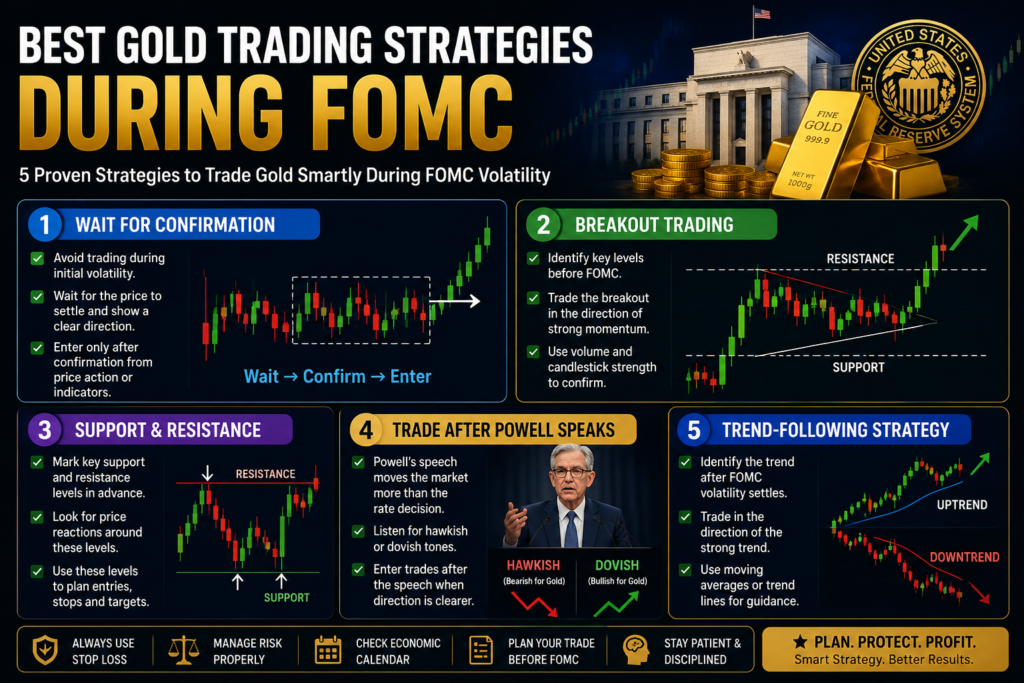
Strategy 1: Wait for Confirmation
One of the biggest mistakes traders make is entering a trade immediately after the FOMC announcement. The first few minutes often produce sharp price spikes in both directions due to algorithmic trading and market uncertainty.
Instead, wait for confirmation before opening a position. Look for:
- A confirmed candle close above resistance or below support.
- Increased trading volume.
- A clear directional move after the initial volatility.
Using this approach when trading Gold During FOMC Meeting helps reduce the risk of getting caught in false breakouts.
Strategy 2: Breakout Trading
FOMC meetings often cause gold to break out of its pre-meeting trading range. A breakout strategy focuses on entering trades only after price moves beyond a well-defined support or resistance level.
For better results:
- Identify key price levels before the announcement.
- Wait for the breakout candle to close.
- Confirm the move with strong momentum before entering.
Breakout trading works well because Gold During FOMC Meeting frequently experiences large directional moves once the market chooses a trend.
Strategy 3: Use Support and Resistance Levels
Support and resistance remain powerful technical tools during major news events. Before the FOMC meeting begins, mark important daily and four-hour price levels on your chart.
Watch how gold reacts around these zones:
- Resistance may become a breakout level.
- Support may trigger buying interest.
- Broken levels often become new support or resistance.
Combining these levels with price action provides a more structured approach to trading Gold During FOMC Meeting.
Strategy 4: Trade After Powell Speaks
Many traders avoid entering positions immediately after the Fed releases its interest rate decision. Instead, they wait until Federal Reserve Chair Jerome Powell begins and finishes his press conference.
Powell’s comments often change market sentiment and can reverse the initial price reaction. Waiting until his message becomes clear allows traders to identify the market’s true direction rather than reacting to short-term volatility.
This strategy can help traders make more informed decisions during Gold During FOMC Meeting, especially when the initial market reaction is confusing.
Strategy 5: Follow the Trend
Trend-following is one of the safest strategies during high-impact news events. Rather than predicting market direction, traders simply follow the established trend after confirmation.
Key tips include:
- Trade only in the direction of the dominant trend.
- Use moving averages or trendlines for confirmation.
- Place stop-loss orders below support or above resistance.
- Avoid trading against strong momentum.
Following the market trend instead of fighting it can improve consistency when trading Gold During FOMC Meeting.
Tools Every Gold Trader Should Use During FOMC
Trading gold during an FOMC meeting requires more than technical analysis alone. Professional traders rely on a combination of market data, economic calendars, price charts, and real-time news to make informed decisions. Having the right tools can help you understand market sentiment, manage risk, and identify high-probability trading opportunities. If you want to trade Gold During FOMC Meeting successfully, the following tools should be part of your trading routine.
1. Economic Calendar
An economic calendar is one of the most essential tools for every gold trader. It provides the exact date and time of the FOMC meeting, Federal Reserve announcements, and other high-impact economic events.
Before trading, use the calendar to:
- Check the FOMC announcement time.
- Monitor inflation reports such as CPI and PCE.
- Track employment data like Non-Farm Payrolls (NFP).
- Prepare for other market-moving events.
Planning ahead with an economic calendar helps traders avoid unexpected volatility during Gold During FOMC Meeting.
2. TradingView
TradingView is one of the most popular charting platforms used by professional and retail traders. It offers advanced technical analysis tools, customizable indicators, drawing features, and multiple chart timeframes.
Before and during the FOMC meeting, you can use TradingView to:
- Identify key support and resistance levels.
- Draw trendlines and chart patterns.
- Monitor moving averages and RSI.
- Watch real-time gold price action.
Using TradingView allows traders to make better technical decisions when trading Gold During FOMC Meeting, especially during periods of high volatility.
3. CME FedWatch Tool
The CME FedWatch Tool estimates the probability of future Federal Reserve interest rate decisions based on Fed Funds futures.
This tool helps traders understand:
- Market expectations before the FOMC meeting.
- The probability of a rate hike, rate cut, or rate hold.
- Whether the Fed’s actual decision is likely to surprise the market.
Knowing market expectations is extremely valuable because Gold During FOMC Meeting often reacts more to surprises than to the decision itself.
4. US Dollar Index (DXY)
The US Dollar Index (DXY) measures the strength of the US dollar against a basket of major currencies. Since gold and the US dollar usually move in opposite directions, monitoring DXY can provide valuable trading signals.
For example:
- Rising DXY often puts pressure on gold prices.
- Falling DXY generally supports higher gold prices.
Watching the US Dollar Index alongside gold can improve your understanding of market sentiment during Gold During FOMC Meeting.
5. Gold Price Charts
Real-time gold price charts are essential for identifying trends, breakout levels, and potential reversal zones.
Professional traders typically analyze:
- Daily trend direction.
- Four-hour support and resistance.
- One-hour momentum.
- Five-minute price action immediately after the FOMC announcement.
Combining multiple timeframes helps traders make more confident decisions during Gold During FOMC Meeting.
6. News Terminals
Real-time news platforms such as Bloomberg, Reuters, and other financial news services provide instant updates on Federal Reserve announcements and Jerome Powell’s press conference.
These platforms allow traders to:
- Read the Fed statement immediately.
- Follow Powell’s comments in real time.
- Stay informed about breaking economic news.
- React quickly to unexpected market developments.
Fast access to reliable news is a major advantage when trading highly volatile events like the FOMC meeting.
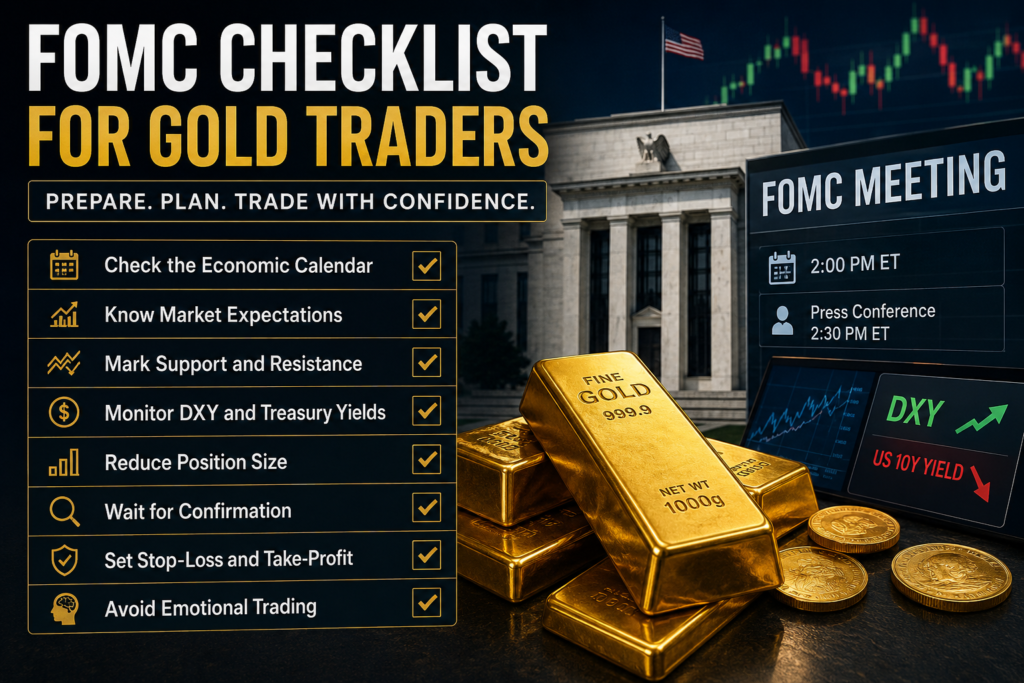
FOMC Checklist for Gold Traders
| ✅ Checklist Item | What You Should Do | Why It Matters |
|---|---|---|
| ☐ Check the Economic Calendar | Confirm the date and time of the FOMC meeting, interest rate decision, policy statement, and Fed Chair’s press conference. | Helps you prepare for periods of high market volatility. |
| ☐ Know Market Expectations | Review forecasts for interest rates and compare them with market sentiment. | Gold often reacts more to surprises than expected outcomes. |
| ☐ Mark Support & Resistance | Identify key support, resistance, trendlines, and major price zones on your Gold (XAU/USD) chart. | Important levels can act as entry, exit, or reversal points after the announcement. |
| ☐ Monitor DXY | Watch the US Dollar Index (DXY) before and after the FOMC announcement. | A stronger dollar generally pressures gold prices, while a weaker dollar often supports gold. |
| ☐ Monitor Treasury Yields | Keep an eye on the 2-Year and 10-Year US Treasury yields. | Rising yields can weigh on gold, while falling yields are usually supportive for gold prices. |
| ☐ Reduce Position Size | Trade with smaller lot sizes or lower leverage during FOMC events. | Reduces risk during periods of extreme price volatility. |
| ☐ Wait for Confirmation | Let the initial price reaction settle before entering a trade. Look for confirmed breakouts or reversals. | Helps avoid false breakouts and whipsaw price action. |
| ☐ Set Stop-Loss | Place a stop-loss based on your trading strategy before entering the trade. | Protects your capital if the market moves against you. |
| ☐ Set Take-Profit | Define realistic profit targets using support, resistance, or a favorable risk-to-reward ratio. | Prevents emotional decision-making and locks in profits systematically. |
| ☐ Stick to Your Trading Plan | Follow your trading rules without making impulsive changes during volatility. | Discipline is essential for long-term trading success. |
| ☐ Avoid Emotional Trading | Don’t chase the market or revenge trade after losses. Stay patient and objective. | Emotional trading often leads to unnecessary losses. |
| ☐ Review Your Trade | After the FOMC event, analyze your trades and note what worked and what didn’t. | Continuous review helps improve future trading performance. |
Quick Pre-FOMC Checklist
| Task | Status |
|---|---|
| 📅 Economic calendar checked | ☐ |
| 📊 Market expectations analyzed | ☐ |
| 📈 Support & resistance marked | ☐ |
| 💵 DXY monitored | ☐ |
| 📉 Treasury yields monitored | ☐ |
| ⚖️ Position size reduced | ☐ |
| ✅ Trade confirmation received | ☐ |
| 🛡️ Stop-loss set | ☐ |
| 🎯 Take-profit set | ☐ |
| 🧠 Emotions under control | ☐ |
| 📝 Trading plan followed | ☐ |
Frequently Asked Questions (FAQ)
Does gold always fall during FOMC meetings?
No. Gold does not always fall during FOMC meetings.
Gold’s direction depends on the Federal Reserve’s decision and, more importantly, its future guidance. For example:
- Gold may rise if the Fed signals interest rate cuts or a more dovish policy.
- Gold may fall if the Fed indicates higher interest rates or a hawkish stance.
- Sometimes, gold experiences sharp swings in both directions before settling into a trend.
2. Why Is Gold Volatile During FOMC?
Gold becomes highly volatile during FOMC meetings because the Federal Reserve’s decisions directly influence:
- Interest rates
- The US Dollar (USD)
- US Treasury yields
- Inflation expectations
- Investor confidence
3. Is It Safe to Trade Gold During FOMC?
Yes, but it comes with higher risk.
During FOMC announcements:
- Price movements can be extremely fast.
- Spreads often widen.
- Slippage may occur.
- False breakouts are common.
4. Should Beginners Trade Gold During FOMC?
Generally, beginners should avoid trading during FOMC announcements.
The market can move unpredictably within seconds, making it difficult for inexperienced traders to manage risk.
Instead, beginners should:
- Watch how the market reacts.
- Practice on a demo account.
- Learn how interest rate decisions affect gold.
- Trade after the market establishes a clearer direction.
5. What Time Is the FOMC Announcement?
The FOMC interest rate decision is typically released at:
- 2:00 PM Eastern Time (ET)
- 11:00 AM Pacific Time (PT)
- 11:00 PM Pakistan Standard Time (PKT) (during U.S. daylight saving time; this can shift to 12:00 AM PKT when standard time is in effect)
The Fed Chair’s press conference usually begins 30 minutes later.
No. Gold does not always fall during FOMC meetings.
Gold’s direction depends on the Federal Reserve’s decision and, more importantly, its future guidance. For example:
- Gold may rise if the Fed signals interest rate cuts or a more dovish policy.
- Gold may fall if the Fed indicates higher interest rates or a hawkish stance.
- Sometimes, gold experiences sharp swings in both directions before settling into a trend.
Gold becomes highly volatile during FOMC meetings because the Federal Reserve’s decisions directly influence:
- Interest rates
- The US Dollar (USD)
- US Treasury yields
- Inflation expectations
- Investor confidence
Yes, but it comes with higher risk.
During FOMC announcements:
- Price movements can be extremely fast.
- Spreads often widen.
- Slippage may occur.
- False breakouts are common.
Generally, beginners should avoid trading during FOMC announcements.
The market can move unpredictably within seconds, making it difficult for inexperienced traders to manage risk.
Instead, beginners should:
- Watch how the market reacts.
- Practice on a demo account.
- Learn how interest rate decisions affect gold.
- Trade after the market establishes a clearer direction.
The FOMC interest rate decision is typically released at:
- 2:00 PM Eastern Time (ET)
- 11:00 AM Pacific Time (PT)
- 11:00 PM Pakistan Standard Time (PKT) (during U.S. daylight saving time; this can shift to 12:00 AM PKT when standard time is in effect)
The Fed Chair’s press conference usually begins 30 minutes later.