Table of Contents
ToggleIntroduction
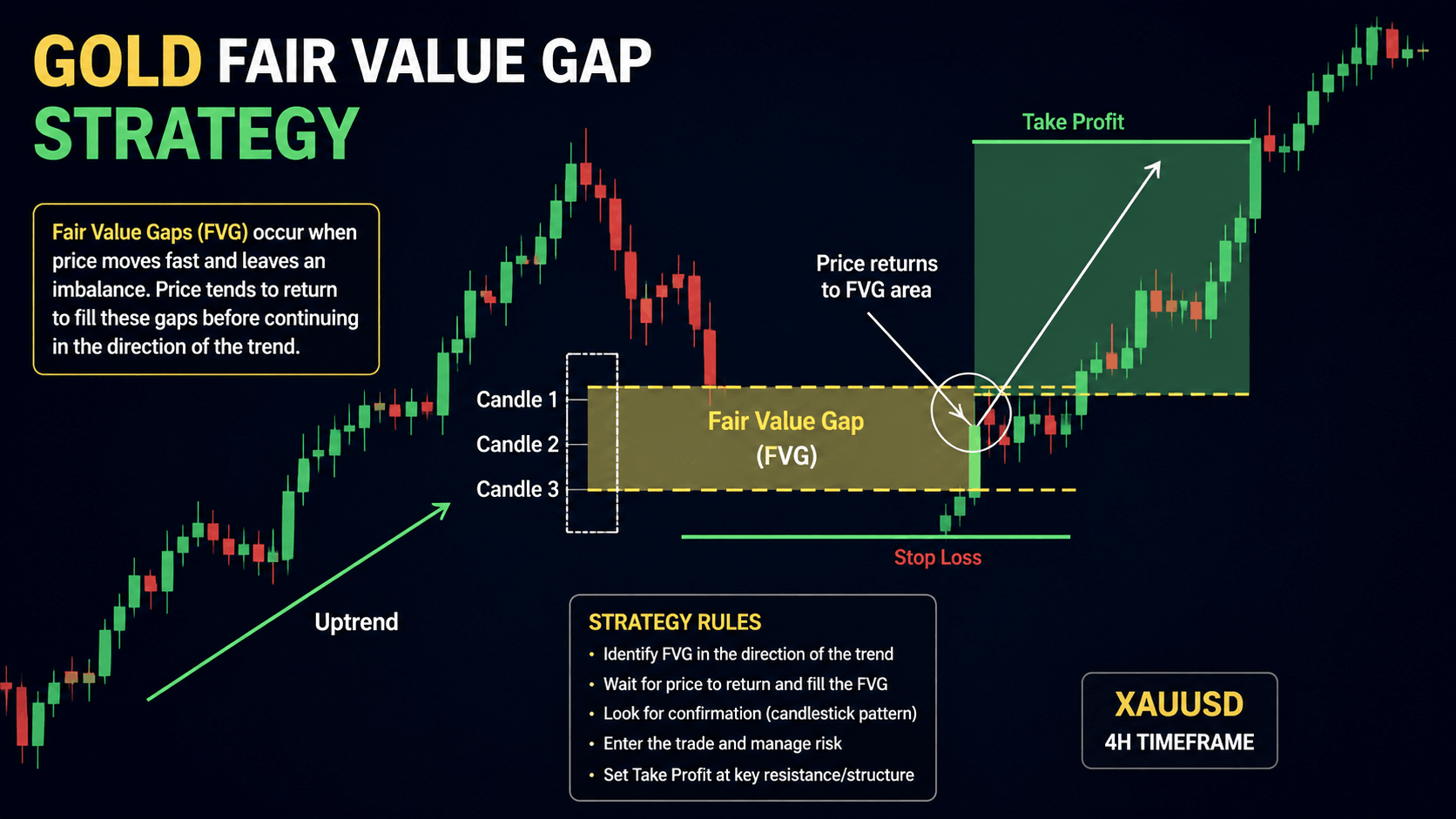
The Gold Fair Value Gap Strategy is one of the most effective price action trading methods used by both beginner and professional traders. It helps traders identify areas where the market has moved too quickly, leaving behind price imbalances that often attract future price reactions. By understanding these gaps, traders can find higher-probability entry and exit points when trading gold (XAU/USD).
In recent years, the Gold Fair Value Gap Strategy has become increasingly popular because it aligns with smart money concepts and institutional trading behavior. Instead of chasing the market, traders wait for the price to return to a fair value gap before entering a trade. This patient approach can improve trade accuracy while reducing unnecessary risk.
The main idea behind the Gold Fair Value Gap Strategy is that the market often revisits inefficient price zones before continuing its original trend. These retracements provide traders with opportunities to enter trades at better prices while maintaining favorable risk-to-reward ratios.
Whether you are a day trader, swing trader, or scalper, the Gold Fair Value Gap Strategy can be applied across multiple timeframes. When combined with market structure, liquidity sweeps, support and resistance, and proper risk management, it becomes a powerful strategy for identifying high-quality trading setups.
In this complete guide, you will learn how the Gold Fair Value Gap Strategy works, how to identify fair value gaps on gold charts, the best entry and exit techniques, common mistakes to avoid, and practical examples to help you trade with greater confidence and consistency.
What Is a Fair Value Gap (FVG)?
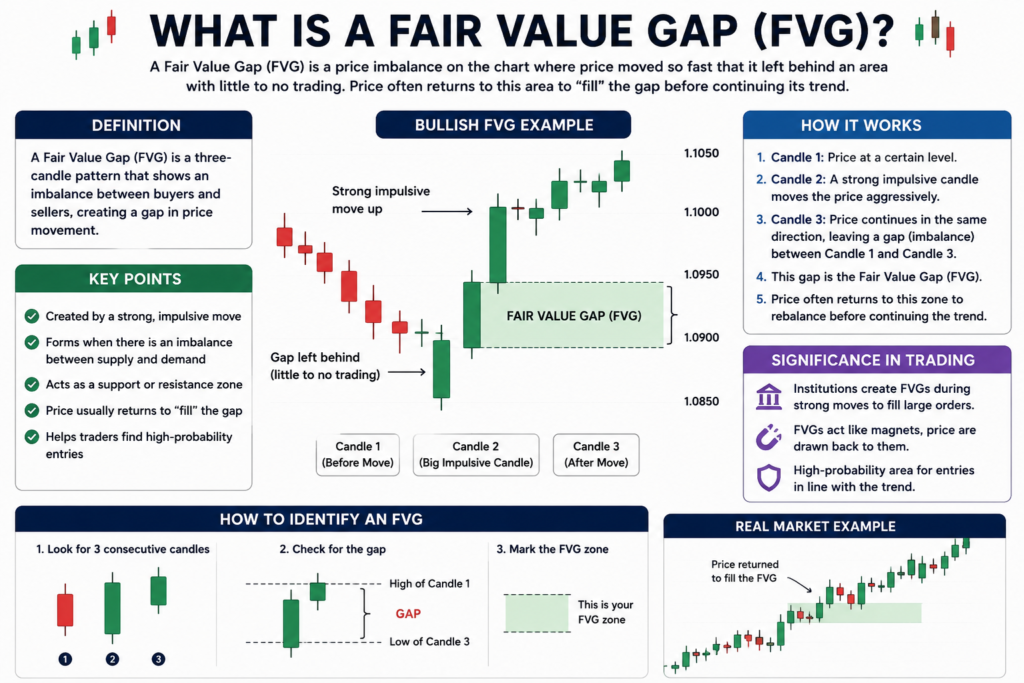
A Fair Value Gap (FVG) is a price imbalance that forms when the market moves aggressively in one direction, leaving a gap between candles where little or no trading activity occurs. This imbalance represents an area where buyers or sellers were so dominant that the price skipped over certain levels instead of trading through them gradually. In the Gold Fair Value Gap Strategy, these gaps are considered high-probability zones where price may return before continuing its trend.
The Gold Fair Value Gap Strategy is built on the idea that financial markets seek efficiency. After a strong bullish or bearish move, gold often retraces to fill or partially fill the fair value gap before resuming its original direction. Traders use these retracements to find precise entry points with better risk-to-reward ratios.
A Fair Value Gap is typically identified using a three-candle pattern:
- The first candle shows the existing market movement.
- The second candle is a large, impulsive candle that creates the imbalance.
- The third candle fails to overlap with the first candle, leaving a visible gap between the first and third candles.
This price gap is known as the Fair Value Gap and becomes a key area to monitor for future trading opportunities.
One of the reasons the Gold Fair Value Gap Strategy is so popular is that it helps traders avoid entering trades after price has already made a significant move. Instead of chasing momentum, traders patiently wait for gold to retrace into the Fair Value Gap, where institutional buying or selling activity may re-enter the market.
The Gold Fair Value Gap Strategy becomes even more effective when Fair Value Gaps align with other technical concepts, such as liquidity sweeps, order blocks, support and resistance, or a break of market structure. These confluences increase the probability of successful trades while improving overall trade management.
Although Fair Value Gaps can appear on any timeframe, many traders using the Gold Fair Value Gap Strategy prefer to identify the overall trend on higher timeframes, such as the 4-hour or daily chart, and then use lower timeframes like the 15-minute or 5-minute chart to find precise entries. This multi-timeframe approach helps traders follow the dominant market direction while taking advantage of short-term price retracements.
By understanding how Fair Value Gaps form and why they attract future price action, traders can use the Gold Fair Value Gap Strategy to identify high-quality setups, reduce emotional trading, and improve consistency in the gold market.
Why Fair Value Gaps Work in Gold Trading
The Gold Fair Value Gap Strategy is highly effective because gold is one of the most liquid and actively traded assets in the financial markets. Large institutional traders, banks, and hedge funds often create strong impulsive price movements, leaving behind price imbalances known as Fair Value Gaps (FVGs). These imbalances frequently attract price back before the trend continues, giving traders high-probability trading opportunities.
1. Gold Is Driven by Institutional Trading
Gold experiences significant trading volume during major market sessions, especially the London and New York sessions. When institutions place large buy or sell orders, the price can move rapidly, creating Fair Value Gaps. The Gold Fair Value Gap Strategy helps traders identify these institutional footprints and trade alongside the market’s dominant participants instead of against them.
2. Gold Often Retraces Before Continuing the Trend
One of the key reasons the Gold Fair Value Gap Strategy works is that gold rarely moves in a straight line. After a strong bullish or bearish impulse, the market commonly retraces to rebalance inefficient price movement. This retracement often fills all or part of the Fair Value Gap before the original trend resumes, providing traders with better entry prices.
3. High Volatility Creates More Trading Opportunities
Gold is known for its high volatility, especially during major economic events such as Federal Reserve meetings, Non-Farm Payroll (NFP) releases, inflation reports, and geopolitical developments. These events can create large impulsive candles that leave Fair Value Gaps on the chart. Traders using the Gold Fair Value Gap Strategy can capitalize on these recurring price inefficiencies to find precise trade setups.
4. Fair Value Gaps Align with Smart Money Concepts
The Gold Fair Value Gap Strategy is closely connected to Smart Money Concepts (SMC). Institutional traders often create liquidity, trigger stop losses, and then return to Fair Value Gaps before pushing the market in the intended direction. When an FVG aligns with liquidity sweeps, order blocks, or a break of market structure, it becomes an even stronger area for potential entries.
5. Improves Risk-to-Reward Ratios
Instead of entering trades after a large price movement, the Gold Fair Value Gap Strategy encourages traders to wait for a retracement into the imbalance zone. This approach allows for tighter stop-loss placement and larger profit targets, resulting in more favorable risk-to-reward ratios over time.
6. Works Across Multiple Timeframes
Another advantage of the Gold Fair Value Gap Strategy is its flexibility. Fair Value Gaps appear on every timeframe, from the 1-minute chart to the daily and weekly charts. Many traders use higher timeframes to determine the overall trend and lower timeframes to identify precise FVG entry points, increasing the probability of successful trades.
Understanding Gold Market Structure
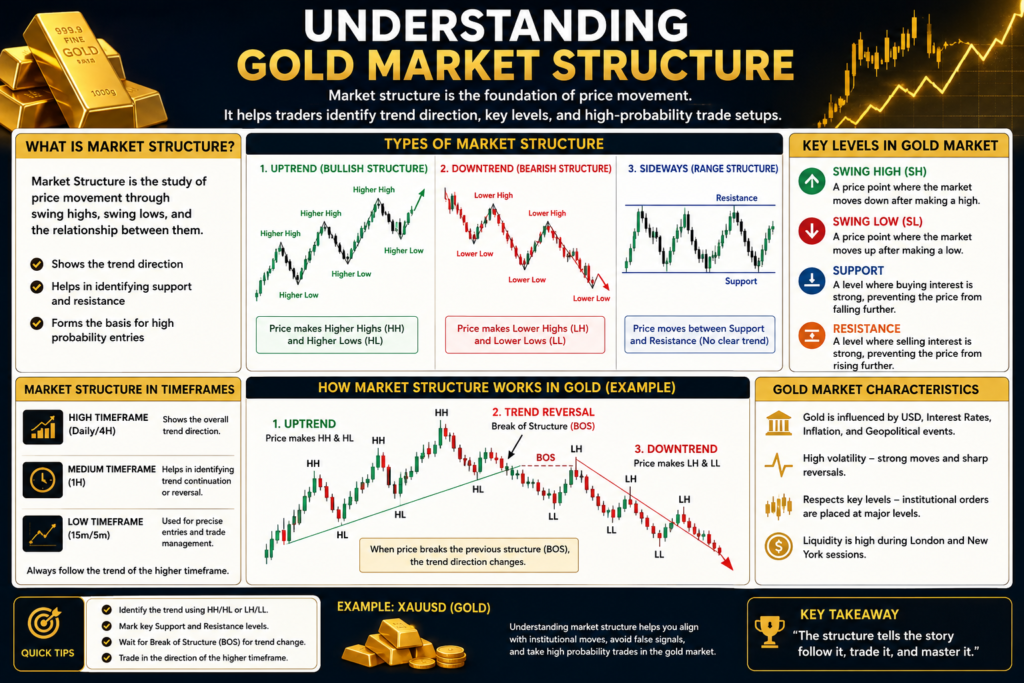
Understanding market structure is essential for successful gold trading. Before using the Gold Fair Value Gap Strategy, traders should learn how price forms trends through Higher Highs (HH), Higher Lows (HL), Lower Highs (LH), and Lower Lows (LL). These patterns help identify whether the market is bullish, bearish, or ranging, allowing traders to trade in the direction of the prevailing trend.
The Gold Fair Value Gap Strategy becomes much more reliable when Fair Value Gaps are traded in line with the overall market structure rather than against it.
Higher High (HH)
A Higher High (HH) occurs when the price rises above the previous swing high. This indicates that buyers are in control and the market is gaining bullish momentum.
When using the Gold Fair Value Gap Strategy, traders should look for bullish Fair Value Gaps after a Higher High has formed. If the price retraces into the Fair Value Gap and finds support, it often presents a strong buying opportunity in the direction of the uptrend.
Example:
- Gold breaks above the previous high.
- A bullish Fair Value Gap forms during the breakout.
- Price retraces into the gap.
- Buyers step in, and the uptrend continues.
Higher Low (HL)
A Higher Low (HL) forms when the price pulls back but remains above the previous swing low. This confirms that buyers are still defending the trend and that bullish momentum remains intact.
The Gold Fair Value Gap Strategy works particularly well when a Fair Value Gap forms after a Higher Low. These retracement zones often provide ideal entry points for traders looking to join an existing bullish trend with lower risk.
Key Point:
Higher Lows signal healthy pullbacks rather than trend reversals.
Lower High (LH)
A Lower High (LH) occurs when the price attempts to move higher but fails to break the previous high. This is a sign that sellers are becoming stronger and bullish momentum is weakening.
In the Gold Fair Value Gap Strategy, bearish Fair Value Gaps that appear after a Lower High can offer high-probability selling opportunities. Traders often wait for the price to retrace into the bearish Fair Value Gap before entering short positions.
Example:
- Gold fails to create a new high.
- A bearish Fair Value Gap forms after a strong downward move.
- Price retraces into the gap.
- Sellers regain control, and the downtrend continues.
Lower Low (LL)
A Lower Low (LL) forms when the price falls below the previous swing low. This confirms that sellers are dominating the market and the downtrend remains strong.
The Gold Fair Value Gap Strategy is most effective when bearish Fair Value Gaps appear after a Lower Low. As price retraces into these imbalance zones, traders can look for confirmation before entering sell trades in the direction of the trend.
Key Point:
Lower Lows indicate strong bearish momentum and increase the probability of trend continuation.
Why Market Structure Matters in the Gold Fair Value Gap Strategy
Market structure provides the context needed to trade Fair Value Gaps effectively. Rather than taking every FVG that appears, traders should use the Gold Fair Value Gap Strategy to focus only on setups that align with the current trend. Buying during Higher Highs and Higher Lows, and selling during Lower Highs and Lower Lows, can significantly improve trade accuracy and reduce false signals.
By combining market structure with Fair Value Gaps, liquidity sweeps, and proper risk management, traders can identify higher-probability setups and make more informed trading decisions in the gold market.
Types of Fair Value Gaps
To use the Gold Fair Value Gap Strategy successfully, traders must understand the two main types of Fair Value Gaps: Bullish Fair Value Gaps and Bearish Fair Value Gaps. Each type provides trading opportunities based on the current market trend and price direction.
Recognizing the difference between bullish and bearish Fair Value Gaps allows traders to make better entry decisions and trade with the prevailing market momentum.
Bullish Fair Value Gap
A Bullish Fair Value Gap forms when gold makes a strong upward move, creating a price imbalance between three consecutive candles. This gap shows that buyers were in control and pushed the price higher without allowing enough trading activity in that area.
In the Gold Fair Value Gap Strategy, traders wait for the price to retrace into the bullish Fair Value Gap before looking for buying opportunities. If the overall market structure remains bullish, the gap often acts as a support zone where institutional buyers may re-enter the market.
Characteristics of a Bullish Fair Value Gap
- Forms during a strong bullish impulse.
- Indicates aggressive buying pressure.
- Acts as a potential support area.
- Offers buying opportunities after a retracement.
- Works best when aligned with Higher Highs and Higher Lows.
Example
Imagine gold rallies from $3,350 to $3,380 with a large bullish candle, leaving a Fair Value Gap behind. Instead of buying at the top, traders using the Gold Fair Value Gap Strategy wait for the price to pull back into the gap. If bullish confirmation appears, they enter a buy trade with a stop loss below the gap and target the next resistance level.
Bearish Fair Value Gap
A Bearish Fair Value Gap forms when gold experiences a strong downward move, leaving a price imbalance between three candles. This indicates that sellers dominated the market and drove the price lower without allowing sufficient trading within that range.
The Gold Fair Value Gap Strategy uses bearish Fair Value Gaps as potential resistance zones. Traders wait for the price to retrace into the gap before looking for selling opportunities that align with the overall downtrend.
Characteristics of a Bearish Fair Value Gap
- Forms during a strong bearish impulse.
- Indicates aggressive selling pressure.
- Acts as a potential resistance area.
- Offers selling opportunities after a retracement.
- Works best when aligned with Lower Highs and Lower Lows.
Example
Suppose gold drops sharply from $3,400 to $3,365, creating a bearish Fair Value Gap. Traders using the Gold Fair Value Gap Strategy avoid selling immediately after the sharp decline. Instead, they wait for the price to retrace into the Fair Value Gap. If sellers regain control and bearish confirmation appears, they enter a sell trade with a stop loss above the gap and aim for the next support level.
Which Fair Value Gap Is More Reliable?
Both bullish and bearish Fair Value Gaps can produce high-probability trading setups when they align with the overall market trend. The Gold Fair Value Gap Strategy is most effective when traders:
- Trade bullish Fair Value Gaps in an uptrend.
- Trade bearish Fair Value Gaps in a downtrend.
- Confirm entries using market structure, liquidity sweeps, or order blocks.
- Apply proper risk management before entering any trade.
By understanding both types of Fair Value Gaps, traders can identify higher-quality setups and use the Gold Fair Value Gap Strategy to trade gold with greater confidence and consistency.
How to Identify a Fair Value Gap on Gold Charts
Learning how to identify a Fair Value Gap (FVG) is one of the most important skills for traders using the Gold Fair Value Gap Strategy. A Fair Value Gap represents an imbalance in price caused by a strong buying or selling move. These gaps often become areas where gold retraces before continuing in the direction of the trend.
By correctly identifying Fair Value Gaps, traders can improve their entries, reduce risk, and increase the probability of successful trades.
Step 1: Look for a Strong Impulsive Move
The first step in the Gold Fair Value Gap Strategy is to identify a large bullish or bearish candle. This strong move shows that buyers or sellers dominated the market and created a price imbalance.
A valid Fair Value Gap usually forms after:
- Strong buying momentum
- Strong selling momentum
- High-impact economic news
- A breakout from consolidation
The stronger the impulsive move, the more significant the Fair Value Gap is likely to be.
Step 2: Find the Three-Candle Pattern
A Fair Value Gap is identified using a three-candle formation.
- First Candle: The market begins moving in one direction.
- Second Candle: A large impulsive candle creates the imbalance.
- Third Candle: Fails to overlap with the first candle, leaving a visible gap.
This gap between the first and third candles is the Fair Value Gap.
Step 3: Mark the Fair Value Gap Zone
Once the gap is identified, draw a rectangle or highlight the imbalance zone on your chart.
In the Gold Fair Value Gap Strategy, traders do not enter immediately after the impulsive move. Instead, they patiently wait for gold to retrace into the Fair Value Gap before looking for confirmation to enter a trade.
This disciplined approach helps avoid chasing the market and provides better entry prices.
Step 4: Confirm the Market Structure
Not every Fair Value Gap leads to a profitable trade. Before entering, confirm the overall market trend.
For example:
- Buy only if the market is making Higher Highs and Higher Lows.
- Sell only if the market is making Lower Highs and Lower Lows.
The Gold Fair Value Gap Strategy performs best when Fair Value Gaps align with the prevailing market structure.
Step 5: Wait for Price to Return to the Gap
After marking the Fair Value Gap, allow the market to retrace naturally.
Many traders make the mistake of entering too early. Instead, the Gold Fair Value Gap Strategy teaches patience. Wait until price revisits the imbalance zone and shows signs of rejection, such as:
- Bullish or bearish engulfing candles
- Pin bars
- Strong rejection wicks
- Break of lower timeframe structure
These confirmations increase the probability of a successful trade.
Step 6: Combine FVG with Other Technical Tools
Although Fair Value Gaps are powerful on their own, they become even more reliable when combined with additional technical analysis.
Consider using:
- Liquidity Sweeps
- Order Blocks
- Break of Structure (BOS)
- Support and Resistance
- Fibonacci Retracement
- Trendlines
- Volume Analysis
Using these tools together with the Gold Fair Value Gap Strategy helps filter out weak setups and identify high-probability trading opportunities.
Common Mistakes When Identifying Fair Value Gaps
Avoid these common errors:
- Trading every Fair Value Gap without considering the trend.
- Entering before the price retraces into the gap.
- Ignoring major support and resistance levels.
- Trading during low-liquidity market conditions.
- Forgetting to use stop-loss and proper risk management.
Key Takeaway
The Gold Fair Value Gap Strategy is most effective when traders identify strong price imbalances, confirm the market structure, and patiently wait for the price to revisit the Fair Value Gap before entering a trade. By combining Fair Value Gaps with liquidity, order blocks, and sound risk management, traders can consistently identify higher-probability setups in the gold market.
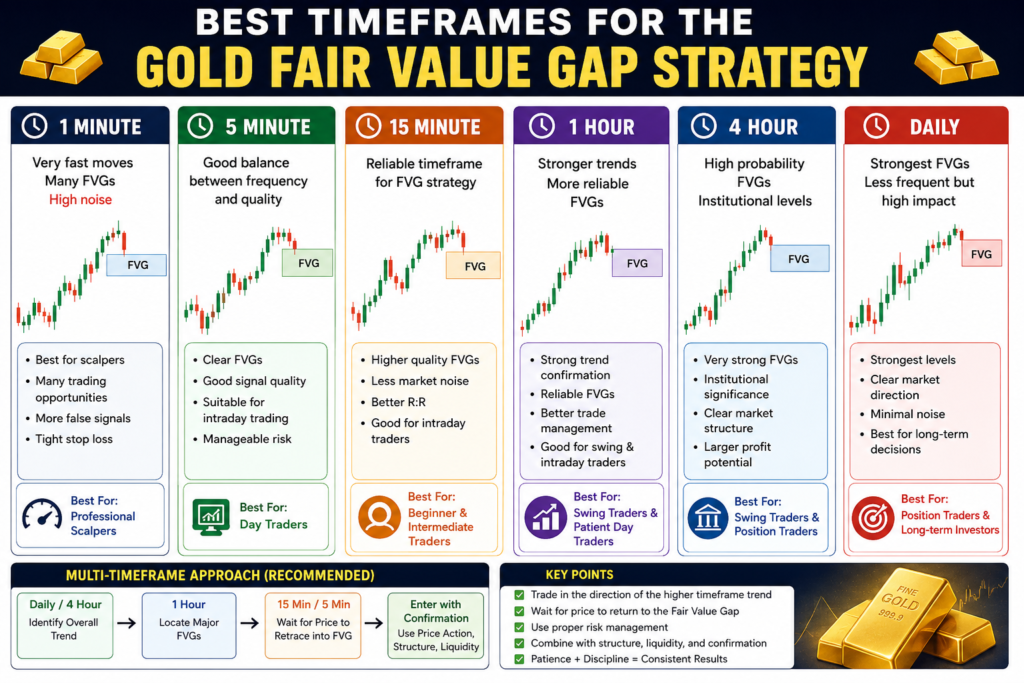
Best Timeframes for the Gold Fair Value Gap Strategy
The Gold Fair Value Gap Strategy can be used on almost any timeframe, making it suitable for scalpers, day traders, and swing traders. However, not all timeframes produce the same quality of trading setups. Higher timeframes generally provide stronger and more reliable Fair Value Gaps, while lower timeframes offer more frequent trading opportunities.
Choosing the right timeframe depends on your trading style, risk tolerance, and available trading time.
1 Minute Timeframe
The 1-minute chart is best suited for experienced scalpers who want to capture small price movements in gold. Fair Value Gaps form frequently on this timeframe, but they also generate more false signals due to market noise.
When using the Gold Fair Value Gap Strategy on the 1-minute chart:
- Focus on trading during the London and New York sessions.
- Wait for strong momentum before identifying an FVG.
- Always confirm with higher-timeframe market structure.
- Use tight stop losses and quick profit targets.
Best for: Professional scalpers.
5 Minute Timeframe
The 5-minute chart is one of the most popular choices for day traders. It provides a good balance between trade frequency and setup quality.
The Gold Fair Value Gap Strategy performs well on this timeframe because Fair Value Gaps are easier to identify while still offering multiple trading opportunities throughout the day.
Advantages
- Clear Fair Value Gaps
- Better signal quality than the 1-minute chart
- Suitable for intraday trading
- Easier risk management
Best for: Day traders.
15 Minute Timeframe
The 15-minute chart is considered one of the most reliable timeframes for trading Fair Value Gaps. Price movements are smoother, reducing market noise and improving the quality of trade setups.
Many professional traders use the Gold Fair Value Gap Strategy on the 15-minute chart after identifying the overall trend on higher timeframes.
Advantages
- Higher-quality Fair Value Gaps
- Fewer false breakouts
- Better risk-to-reward opportunities
- Excellent for intraday traders
Best for: Beginner and intermediate traders.
1 Hour Timeframe
The 1-hour chart is ideal for traders who prefer fewer but higher-quality trades. Fair Value Gaps formed on this timeframe often represent institutional order flow and carry greater significance.
The Gold Fair Value Gap Strategy becomes more reliable because the market noise seen on lower timeframes is greatly reduced.
Advantages
- Stronger trend confirmation
- More reliable Fair Value Gaps
- Better trade management
- Suitable for swing and intraday traders
Best for: Swing traders and patient day traders.
4 Hour Timeframe
The 4-hour chart is one of the strongest timeframes for identifying major Fair Value Gaps. Institutional traders often monitor this timeframe, making the price imbalances more meaningful.
The Gold Fair Value Gap Strategy on the 4-hour chart is commonly used to identify the dominant market trend before looking for entries on lower timeframes.
Advantages
- High-probability trading zones
- Strong institutional price levels
- Excellent trend confirmation
- Larger profit potential
Best for: Swing traders and position traders.
Daily Timeframe
The daily chart provides the clearest view of the overall market direction. Fair Value Gaps on this timeframe are less common but often have the greatest impact on future price movements.
Traders using the Gold Fair Value Gap Strategy frequently analyze the daily chart first to determine whether the market is bullish or bearish before moving to lower timeframes for entries.
Advantages
- Strongest Fair Value Gaps
- Clear market structure
- Minimal market noise
- Best for long-term trading decisions
Best for: Position traders and long-term investors.
Which Timeframe Is Best?
There is no single “best” timeframe because it depends on your trading style. However, many professional traders use a multi-timeframe approach.
A common method is:
- Daily or 4-Hour: Identify the overall trend.
- 1-Hour: Locate major Fair Value Gaps.
- 15-Minute or 5-Minute: Wait for the price to retrace into the Fair Value Gap and look for entry confirmation.
This approach allows the Gold Fair Value Gap Strategy to align with the broader market trend while providing precise entry points.
Step-by-Step Gold Fair Value Gap Strategy
The Gold Fair Value Gap Strategy is a structured trading method that helps traders identify high-probability entry points by combining market structure, price imbalances, and confirmation signals. Instead of entering trades impulsively, this strategy focuses on waiting for the market to return to a Fair Value Gap (FVG) before executing a trade.
Follow these seven steps to apply the strategy effectively.
1. Identify the Trend
The first step in the Gold Fair Value Gap Strategy is identifying the overall market trend. Trading in the direction of the trend significantly increases your chances of success.
Use the Daily or 4-Hour chart to determine whether gold is:
- Bullish: Higher Highs (HH) and Higher Lows (HL)
- Bearish: Lower Highs (LH) and Lower Lows (LL)
Only look for buy trades in an uptrend and sell trades in a downtrend.
Pro Tip: Never trade against the higher timeframe trend unless you have a strong reason to do so.
2. Find Market Structure
Once the trend is confirmed, analyze the market structure to understand how the price is behaving.
Look for:
- Higher Highs and Higher Lows in an uptrend.
- Lower Highs and Lower Lows in a downtrend.
The Gold Fair Value Gap Strategy becomes much more reliable when Fair Value Gaps align with the current market structure.
3. Wait for an Impulsive Move
A Fair Value Gap is created after a strong impulsive move in the market.
These moves usually occur because of:
- Institutional buying or selling
- High-impact economic news
- Breakouts from consolidation
- Strong market momentum
A large bullish candle creates a Bullish Fair Value Gap, while a large bearish candle creates a Bearish Fair Value Gap.
Avoid trading if the market is moving sideways, as Fair Value Gaps are less reliable during consolidation.
4. Mark the Fair Value Gap
After the impulsive move, identify the Fair Value Gap using the three-candle pattern.
Draw a rectangle around the price imbalance between the first and third candles.
This highlighted area becomes your potential entry zone.
In the Gold Fair Value Gap Strategy, the Fair Value Gap often acts as:
- Support in a bullish trend.
- Resistance in a bearish trend.
5. Wait for Price Retracement
Patience is one of the most important aspects of successful trading.
Do not enter immediately after the impulsive move.
Instead, wait for the price to retrace into the Fair Value Gap.
This retracement allows traders to enter at a better price with a smaller stop loss and a higher reward potential.
Many beginners lose money by chasing price, while experienced traders wait for the market to come back to them.
6. Confirm Your Entry
Never enter a trade solely because the price reaches the Fair Value Gap.
Wait for additional confirmation, such as:
- Bullish or bearish engulfing candle
- Pin bar rejection
- Strong rejection wick
- Break of lower timeframe market structure
- Liquidity Sweep
- Order Block confirmation
- Increased buying or selling momentum
The more confirmations you have, the stronger the trade setup.
7. Execute the Trade
Once confirmation appears, enter your trade with proper risk management.
Buy Setup
- Enter after bullish confirmation.
- Place your stop loss below the Fair Value Gap or recent swing low.
- Target the next resistance level or use a 1:2 or 1:3 risk-to-reward ratio.
Sell Setup
- Enter after bearish confirmation.
- Place your stop loss above the Fair Value Gap or recent swing high.
- Target the next support level while maintaining a favorable risk-to-reward ratio.
Always risk only a small percentage of your trading account on each trade.
Summary of the Gold Fair Value Gap Strategy
| Step | Action |
|---|---|
| Step 1 | Identify the overall market trend. |
| Step 2 | Confirm the market structure (HH, HL, LH, LL). |
| Step 3 | Wait for a strong, impulsive move that creates a Fair Value Gap. |
| Step 4 | Mark the Fair Value Gap on the chart. |
| Step 5 | Wait for the price to retrace into the gap. |
| Step 6 | Look for confirmation using price action or Smart Money Concepts. |
| Step 7 | Execute the trade with proper stop loss, take profit, and risk management. |