Introduction
The Gold Liquidity Sweep Strategy is one of the most effective smart money trading techniques used by professional traders to identify high-probability trade setups. Instead of chasing every price movement, this strategy focuses on understanding where liquidity exists and how institutional traders often move the market before the real trend begins. Whether you are new to gold trading or already have some experience, learning the Gold Liquidity Sweep Strategy can help you make more informed trading
Gold (XAU/USD) is known for its high volatility, especially during major economic events such as Non-Farm Payroll (NFP), CPI releases, and Federal Reserve meetings. These sharp price movements often create liquidity sweeps that trap retail traders before the market reverses in the intended direction. By mastering the Gold Liquidity Sweep Strategy, you can learn to recognize these market traps and improve your trade entries with better timing.
In this comprehensive guide, you will discover what a liquidity sweep is, why it happens, how smart money uses it, and how to identify high-probability setups on different timeframes. You will also learn practical entry techniques, risk management rules, common mistakes to avoid, and real trading examples. By the end of this article, you’ll have a solid understanding of the Gold Liquidity Sweep Strategy and how to apply it confidently in your own trading plan.
If your goal is to stop getting caught in false breakouts and start trading alongside institutional order flow, the Gold Liquidity Sweep Strategy is a valuable skill to develop. With patience, proper confirmation, and disciplined risk management, the Gold Liquidity Sweep Strategy can become a powerful addition to your gold trading strategy and help you improve consistency over the long term.
decisions.
What Is the Gold Liquidity Sweep Strategy?
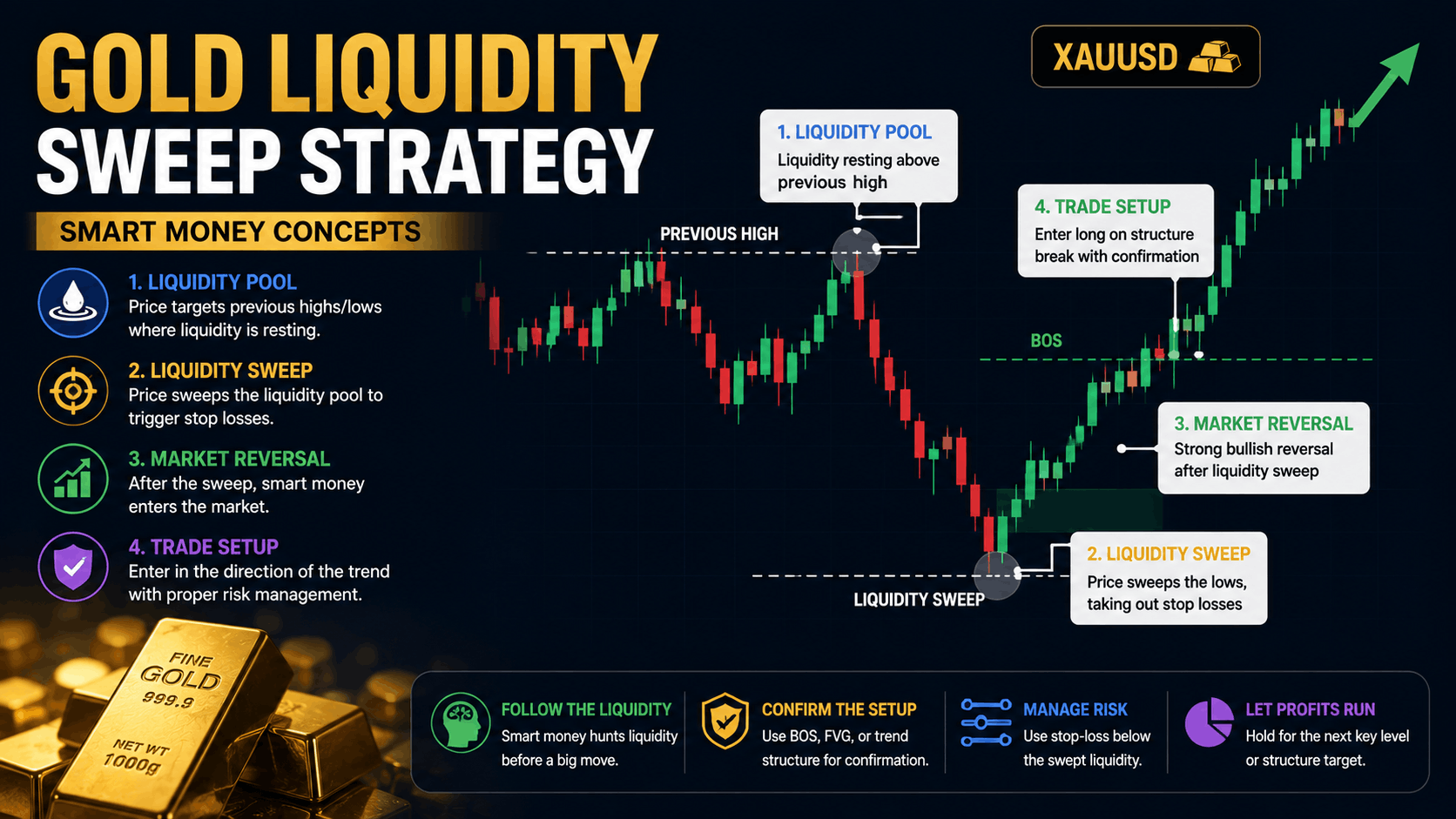
The Gold Liquidity Sweep Strategy works by identifying areas where retail traders are likely to place their stop-loss orders or pending buy and sell orders. These liquidity zones are usually found above recent highs and below recent lows.
When the gold price reaches one of these levels, it often moves beyond it for a short time. This sudden move triggers stop-losses and attracts breakout traders into the market. However, this breakout is often temporary and is created to collect liquidity for large institutional orders.
Once enough liquidity has been gathered, the market frequently reverses and begins moving in the real direction. This is the key principle behind the Gold Liquidity Sweep Strategy. Instead of chasing the breakout, experienced traders wait for the reversal and enter the trade after receiving confirmation.
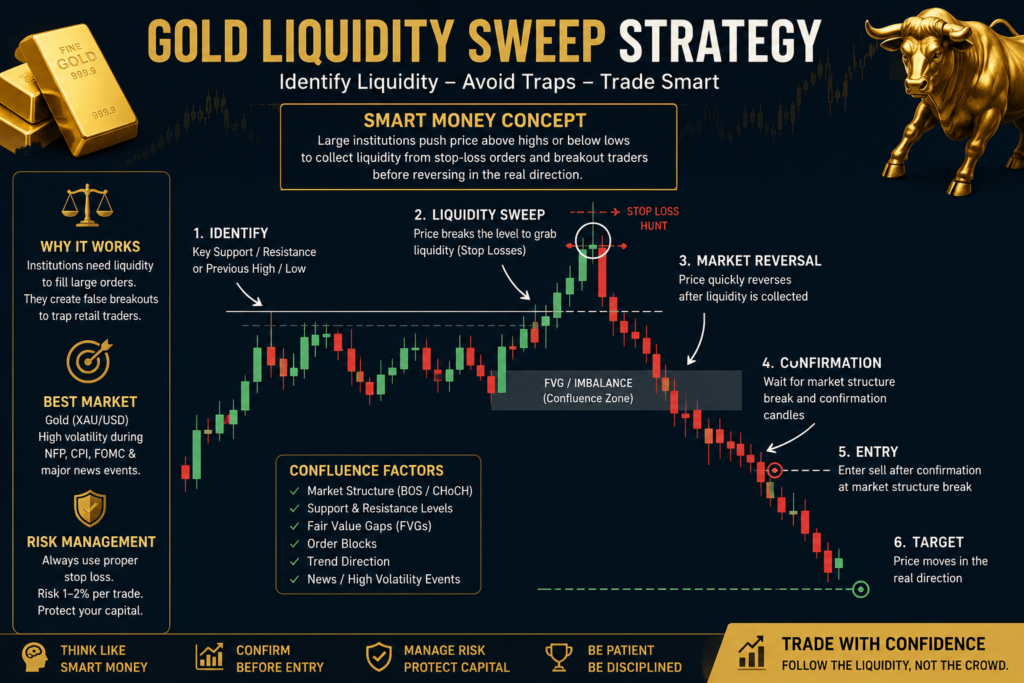
For example, if gold breaks above a previous high and quickly falls back below that level, it may indicate that buyers have been trapped. Traders using the Gold Liquidity Sweep Strategy look for bearish confirmation before entering a sell trade.
Similarly, when gold drops below a previous low and then quickly recovers above it, sellers may have been trapped. This creates a potential buying opportunity using the Gold Liquidity Sweep Strategy, especially when supported by strong market structure.
To increase the probability of success, traders often combine the Gold Liquidity Sweep Strategy with support and resistance, fair value gaps (FVGs), order blocks, and candlestick confirmation. This helps filter out weak setups and improves overall trade accuracy.
How Does a Liquidity Sweep Work in Gold Trading?
The Gold Liquidity Sweep Strategy works by identifying areas where retail traders are likely to place their stop-loss orders or pending buy and sell orders. These liquidity zones are usually found above recent highs and below recent lows.
When the gold price reaches one of these levels, it often moves beyond it for a short time. This sudden move triggers stop-losses and attracts breakout traders into the market. However, this breakout is often temporary and is created to collect liquidity for large institutional orders.
Once enough liquidity has been gathered, the market frequently reverses and begins moving in the real direction. This is the key principle behind the Gold Liquidity Sweep Strategy. Instead of chasing the breakout, experienced traders wait for the reversal and enter the trade after receiving confirmation.
For example, if gold breaks above a previous high and quickly falls back below that level, it may indicate that buyers have been trapped. Traders using the Gold Liquidity Sweep Strategy look for bearish confirmation before entering a sell trade.
Similarly, when gold drops below a previous low and then quickly recovers above it, sellers may have been trapped. This creates a potential buying opportunity using the Gold Liquidity Sweep Strategy, especially when supported by strong market structure.
To increase the probability of success, traders often combine the Gold Liquidity Sweep Strategy with support and resistance, fair value gaps (FVGs), order blocks, and candlestick confirmation. This helps filter out weak setups and improves overall trade accuracy.
Why Institutions Use Liquidity Sweeps
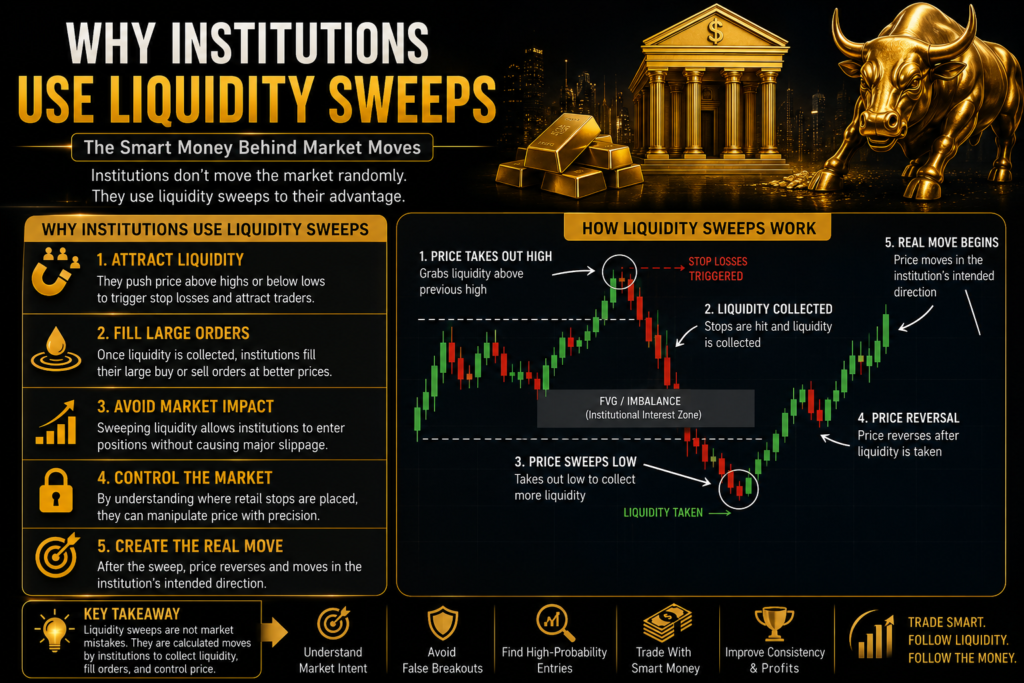
Large financial institutions, such as banks and hedge funds, trade with positions that are much larger than those of retail traders. They cannot always enter or exit these positions instantly without affecting the market. This is why the Gold Liquidity Sweep Strategy is closely linked to institutional trading behavior.
Institutions use liquidity sweeps to find enough buy and sell orders to fill their large trades. They often push the gold price above recent highs or below recent lows because these areas contain stop-loss orders and pending orders from retail traders. This creates the liquidity they need to execute their positions efficiently.
The Gold Liquidity Sweep Strategy helps traders recognize these intentional price movements. Instead of viewing every breakout as the start of a new trend, traders learn to identify when the market is simply collecting liquidity before reversing.
Another reason institutions use liquidity sweeps is to trap emotional traders. Many beginners enter trades as soon as price breaks a key level. After enough traders join the breakout, institutions may reverse the market, causing those traders to hit their stop-losses.
By understanding the Gold Liquidity Sweep Strategy, traders can avoid chasing false breakouts and wait for confirmation before entering the market. This approach helps align trades with institutional order flow rather than trading against it.
Learning why institutions use liquidity sweeps is an important step toward mastering the Gold Liquidity Sweep Strategy. When combined with market structure, support and resistance, and proper risk management, this strategy can help traders identify higher-probability opportunities in the gold market.
Types of Liquidity Sweeps in XAU/USD
Understanding the different types of liquidity sweeps is essential for applying the Gold Liquidity Sweep Strategy effectively. In the gold market (XAU/USD), there are two main types of liquidity sweeps that traders should learn to identify.
Buy-Side Liquidity Sweep
A buy-side liquidity sweep happens when the gold price moves above a previous high or a well-known resistance level. This move triggers the stop-loss orders of sellers and attracts breakout buyers who believe the market will continue higher.
However, after collecting this liquidity, the price often reverses and starts moving downward. This false breakout traps buyers and creates a potential selling opportunity. Traders using the Gold Liquidity Sweep Strategy wait for bearish confirmation before entering a short position instead of buying the breakout.
Common signs of a buy-side liquidity sweep include:
- Price breaks above a recent high.
- Stop-losses and buy orders are triggered.
- A strong bearish rejection candle appears.
- The market quickly falls back below the breakout level.
Sell-Side Liquidity Sweep
A sell-side liquidity sweep occurs when the gold price falls below a previous low or a major support level. This move triggers the stop-loss orders of buyers and encourages breakout sellers to enter the market.
Once enough sell-side liquidity has been collected, the price often reverses and begins moving upward. Traders who follow the Gold Liquidity Sweep Strategy look for bullish confirmation before opening a buy trade.
Common signs of a sell-side liquidity sweep include:
- Price breaks below a recent low.
- Stop-losses and sell orders are triggered.
- A strong bullish rejection candle forms.
- The market quickly moves back above the support level.
By learning to recognize both buy-side and sell-side liquidity sweeps, traders can use the Gold Liquidity Sweep Strategy to avoid false breakouts and trade alongside institutional order flow. Combining these setups with market structure, support and resistance, and sound risk management can significantly improve trading accuracy.
How to Identify Liquidity Zones on Gold Charts
Identifying liquidity zones is one of the most important steps in applying the Gold Liquidity Sweep Strategy. These are areas on the chart where a large number of stop-loss orders and pending orders are likely to be placed. Institutions often target these zones before the market moves in the real direction.
Previous Swing Highs and Lows
The easiest way to find liquidity zones is by marking previous swing highs and swing lows. These levels usually contain stop-loss orders from traders who entered earlier positions. The Gold Liquidity Sweep Strategy focuses on these areas because they are common targets for institutional traders.
Equal Highs and Equal Lows
Equal highs and equal lows are strong liquidity zones. Many traders place their stop-loss orders just above equal highs or just below equal lows. When price briefly breaks these levels and quickly reverses, it often signals a liquidity sweep.
Major Support and Resistance Levels
Support and resistance zones attract a large number of buy and sell orders. When gold temporarily moves beyond these levels before reversing, it may indicate that institutions are collecting liquidity. This is a key concept in the Gold Liquidity Sweep Strategy.
Round Psychological Price Levels
Gold prices such as $3,300, $3,350, or $3,400 often act as psychological levels where many traders place orders. These round numbers frequently become liquidity zones because they attract significant market attention.
Use Higher Timeframes
The Gold Liquidity Sweep Strategy becomes more reliable when liquidity zones are identified on higher timeframes such as the 1-hour, 4-hour, or daily chart. These levels usually carry more market significance than those found on lower timeframes.
Wait for Confirmation
Never assume that every breakout is a liquidity sweep. Wait for confirmation, such as a strong rejection candle, a break of market structure, or a return inside the previous trading range. Combining these signals with the Gold Liquidity Sweep Strategy can help you identify higher-probability trade setups while avoiding false entries.
Step-by-Step Gold Liquidity Sweep Strategy
Following a structured approach can help you apply the Gold Liquidity Sweep Strategy with greater confidence and consistency. Instead of entering trades based on emotions, use these steps to identify high-probability setups.
Step 1: Identify the Market Trend
Start by analyzing the overall market trend on the 4-hour or daily chart. Trading in the direction of the higher-timeframe trend increases the probability of success. The Gold Liquidity Sweep Strategy performs best when it follows the broader market structure.
Step 2: Mark Key Liquidity Zones
Draw previous swing highs, swing lows, equal highs, equal lows, and major support and resistance levels. These are the areas where institutions are most likely to target liquidity before making a significant move.
Step 3: Wait for a Liquidity Sweep
Be patient and allow the gold price to sweep above resistance or below support. Avoid entering the trade immediately. The Gold Liquidity Sweep Strategy is based on waiting for the market to collect liquidity before looking for a reversal.
Step 4: Look for Confirmation
After the sweep, wait for confirmation such as a strong rejection candle, a break of market structure (BOS), a change of character (CHOCH), or a return inside the previous range. These signals increase the likelihood that the reversal is genuine.
Step 5: Enter the Trade
Once confirmation appears, enter the trade in the direction of the expected reversal. Traders using the Gold Liquidity Sweep Strategy avoid chasing false breakouts and instead enter after institutional activity becomes visible.
Step 6: Set Stop-Loss and Take-Profit
Place your stop-loss just beyond the liquidity sweep high or low. Set your take-profit near the next key support or resistance level, or aim for a minimum risk-to-reward ratio of 1:2 or higher.
Step 7: Manage the Trade
Monitor the trade and adjust your stop-loss as the price moves in your favor. The Gold Liquidity Sweep Strategy becomes even more effective when combined with disciplined risk management and proper trade management, helping traders protect profits while minimizing losses.
Entry Rules
Successful traders wait for confirmation before entering a position. In the Gold Liquidity Sweep Strategy, the ideal entry comes after the market sweeps liquidity and shows clear signs of reversing.
Look for confirmation signals such as a strong rejection candle, a break of market structure (BOS), a change of character (CHOCH), or a bullish or bearish engulfing pattern. Entering after these signals can reduce the risk of getting caught in a false breakout.
Avoid entering trades while the liquidity sweep is still happening. Patience is an important part of the Gold Liquidity Sweep Strategy, as waiting for confirmation often leads to higher-quality trade setups.
Stop Loss Placement
Proper stop-loss placement is essential for protecting your trading capital. In the Gold Liquidity Sweep Strategy, the stop-loss should be placed beyond the highest point of a buy-side liquidity sweep or below the lowest point of a sell-side liquidity sweep.
Adding a small buffer beyond the sweep level helps avoid being stopped out by normal market volatility. Placing the stop-loss too close to the entry may result in unnecessary losses.
Always calculate your position size based on your stop-loss distance and risk only a small percentage of your account on each trade. Consistent risk management is just as important as finding the right entry.
Take Profit Targets
Take-profit levels should be based on logical price targets rather than emotions. In the Gold Liquidity Sweep Strategy, traders often aim for the next major support or resistance level, previous swing high or low, or an opposing liquidity zone.
Many professional traders target a minimum risk-to-reward ratio of 1:2 or 1:3, meaning they aim to make at least two or three times the amount they risk on each trade.
As the trade moves in your favor, consider moving your stop-loss to break even or trailing it behind the price. Combining disciplined exits with the Gold Liquidity Sweep Strategy can help maximize profits while protecting gains over the long term.
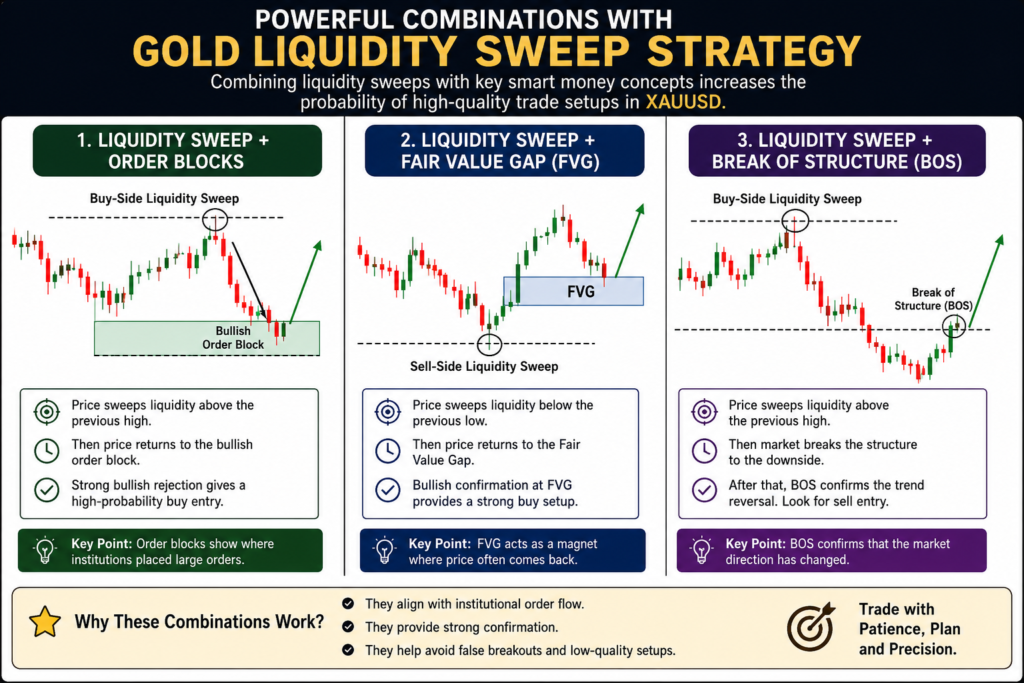
Liquidity Sweep + Order Blocks Strategy
Combining the Gold Liquidity Sweep Strategy with order blocks is a powerful way to improve trade accuracy. An order block is an area where large institutions have previously placed significant buy or sell orders.
After a liquidity sweep occurs, wait for the price to return to a bullish or bearish order block. If the market shows a strong rejection from that zone, it can provide a high-probability entry in the direction of the new trend.
Using order blocks with the Gold Liquidity Sweep Strategy helps traders avoid false entries and align their trades with institutional order flow.
Liquidity Sweep + Fair Value Gap (FVG)
A Fair Value Gap (FVG) is an imbalance created when price moves aggressively, leaving a gap between candles. These gaps often act as areas where the market returns before continuing its trend.
When a liquidity sweep is followed by an FVG, traders can wait for the price to retrace into the gap and look for confirmation before entering a trade. This approach provides more precise entries and often improves the risk-to-reward ratio.
The Gold Liquidity Sweep Strategy becomes even more effective when combined with Fair Value Gaps because both concepts focus on institutional market behavior and smart money movements.
Liquidity Sweep + Break of Structure (BOS)
A Break of Structure (BOS) confirms that the market direction has changed after a liquidity sweep. Instead of entering immediately after the sweep, traders wait for the market to break an important swing high or swing low.
For example, after a sell-side liquidity sweep, a bullish Break of Structure indicates that buyers have taken control. Likewise, after a buy-side liquidity sweep, a bearish Break of Structure suggests that sellers are gaining momentum.
Combining a BOS with the Gold Liquidity Sweep Strategy provides additional confirmation and helps traders avoid false reversals. This combination is widely used by professional traders because it increases confidence in trade entries and supports more consistent trading decisions.
Example of a Gold Liquidity Sweep Trade
Let’s look at a simple example of how the Gold Liquidity Sweep Strategy works in a real trading scenario.
Imagine that gold (XAU/USD) is trading in an uptrend, and the previous day’s high is located at $3,350. Many retail traders place their buy stop orders above this level, while sellers place their stop-loss orders there, creating a strong liquidity zone.
During the London or New York trading session, the gold price briefly rises above $3,350, triggering those stop-losses and breakout buy orders. However, instead of continuing higher, the market quickly reverses and closes back below the previous high. This is a classic buy-side liquidity sweep.
A trader using the Gold Liquidity Sweep Strategy does not enter the trade during the breakout. Instead, they wait for additional confirmation, such as a bearish engulfing candle or a break of market structure (BOS).
Once confirmation appears, the trader enters a sell position. The stop-loss is placed a few points above the liquidity sweep high, while the take-profit is set at the next major support level or the previous swing low.
In another scenario, gold falls below a previous swing low, triggering the stop-losses of buyers and attracting breakout sellers. The price then quickly reverses and moves back above the support level. This is a sell-side liquidity sweep and may present a buying opportunity.
This example shows how the Gold Liquidity Sweep Strategy helps traders avoid false breakouts and trade alongside institutional order flow. By waiting for confirmation and following proper risk management, traders can improve their entry timing and increase the probability of successful trades.
Frequently Asked Questions (FAQs)
1. What is a Gold Liquidity Sweep Strategy?
A Gold Liquidity Sweep Strategy is a Smart Money trading approach that identifies areas where large institutions trigger retail traders’ stop losses before moving the price in the intended direction. Traders look for these liquidity grabs to find high-probability entry opportunities.
2. What is a liquidity sweep in Gold trading?
A liquidity sweep occurs when the price of Gold (XAU/USD) briefly breaks above resistance or below support to trigger stop-loss and pending orders before reversing or continuing the trend.
3. How do I identify a liquidity sweep on a Gold chart?
Look for:
- Equal highs or equal lows
- Previous swing highs and lows
- Support and resistance levels
- A sharp wick through these levels followed by a strong rejection or market structure shift.
5. Which timeframe is best for trading Gold liquidity sweeps?
Most traders use:
- 1H or 4H for market bias
- 15M for identifying liquidity
- 5M or 1M for precise entries
Using multiple timeframes improves trade accuracy.
A Gold Liquidity Sweep Strategy is a Smart Money trading approach that identifies areas where large institutions trigger retail traders’ stop losses before moving the price in the intended direction. Traders look for these liquidity grabs to find high-probability entry opportunities.
A liquidity sweep occurs when the price of Gold (XAU/USD) briefly breaks above resistance or below support to trigger stop-loss and pending orders before reversing or continuing the trend.
Look for:
- Equal highs or equal lows
- Previous swing highs and lows
- Support and resistance levels
- A sharp wick through these levels followed by a strong rejection or market structure shift.
Most traders use:
- 1H or 4H for market bias
- 15M for identifying liquidity
- 5M or 1M for precise entries
Using multiple timeframes improves trade accuracy.