Table of Contents
ToggleIntroduction
You buy Bitcoin, the price moves higher, and you sell it for more than you paid. That sounds simple, but what actually happens between pressing Buy and Sell? This is where crypto spot trading comes in, and understanding how it works can make a big difference before you put real money into the market.
In spot trading, you buy or sell a cryptocurrency at the current market price and generally own the asset you purchase. But spot trading is more than simply buying Bitcoin and hoping it goes up. Your entry, exit, trading strategy, risk management, fees, and choice of platform can all affect the outcome.
In this guide, we’ll break down crypto spot trading from a practical perspective. You’ll learn how spot trading works on Binance, see a real trading example, explore practical strategies, understand the difference between spot and futures trading, and find out whether spot trading can actually be profitable.
What Is Crypto Spot Trading?
Crypto spot trading is the process of buying and selling cryptocurrencies at their current market price. When you purchase an asset through a spot market, you generally receive the actual cryptocurrency rather than a contract that tracks its price. This makes spot trading one of the more straightforward ways to participate in the crypto market.
For example, imagine Bitcoin is trading at $60,000. If you believe the price could rise, you can use your available funds to purchase Bitcoin. If the price later reaches $65,000 and you sell your holdings, the difference between your buying and selling price represents your gross profit, before trading fees and other costs. If the price falls instead, your position loses value.
Crypto spot trading is the process of buying and selling cryptocurrencies at their current market price. When you purchase an asset through a spot market, you generally receive the actual cryptocurrency rather than a contract that tracks its price. This makes spot trading one of the more straightforward ways to participate in the crypto market.
For example, imagine Bitcoin is trading at $60,000. If you believe the price could rise, you can use your available funds to purchase Bitcoin. If the price later reaches $65,000 and you sell your holdings, the difference between your buying and selling price represents your gross profit, before trading fees and other costs. If the price falls instead, your position loses value.
Crypto spot trading usually takes place through an exchange where buyers and sellers trade different cryptocurrency pairs. A pair such as BTC/USDT shows the price of Bitcoin in terms of USDT. Traders can choose different order types depending on how they want their transactions executed. A market order aims to execute quickly at available prices, while a limit order allows the trader to specify the price they are willing to accept.
One important feature of spot trading is that traders do not need leverage to participate. This makes the process easier to understand than leveraged futures trading. However, lower complexity does not mean lower market risk. Cryptocurrency prices can change rapidly because of market sentiment, economic developments, regulatory announcements, liquidity conditions, and other factors.
How Does Crypto Spot Trading Work?
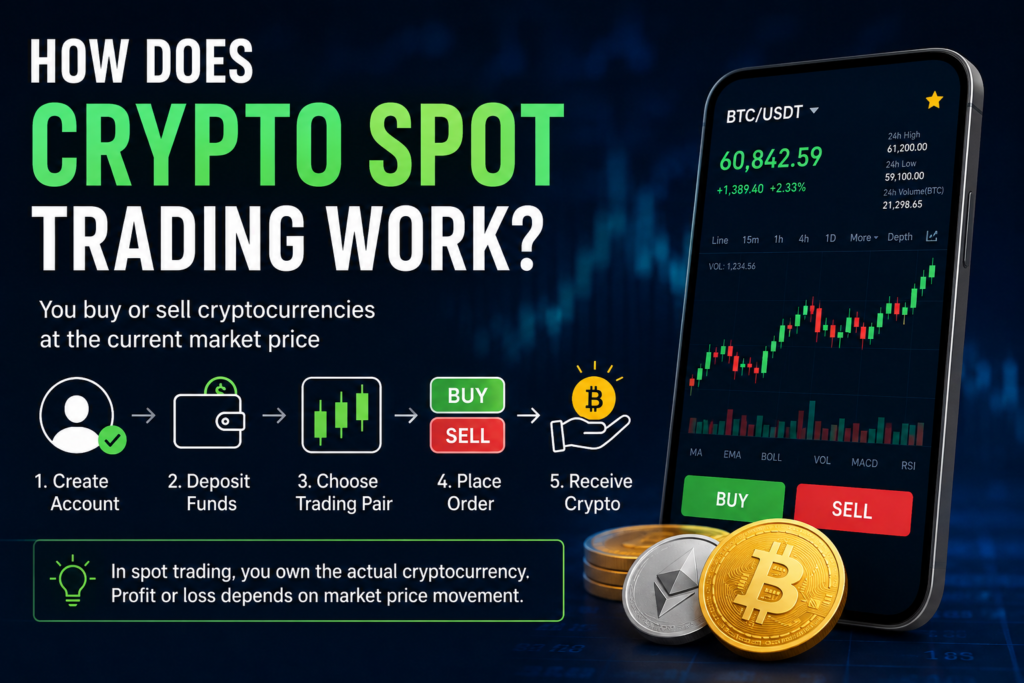
Understanding how crypto spot trading works is important before placing your first order. The process is relatively simple because you buy or sell the cryptocurrency directly through a spot market. Instead of trading a contract, you exchange one asset for another based on the current market price or a price you choose.
First, you need an account with a cryptocurrency exchange that supports spot markets. After depositing funds, you select the cryptocurrency you want to trade and choose an available trading pair. For example, BTC/USDT allows you to trade Bitcoin against USDT. The price shown for the pair tells you how much USDT is required to buy a specific amount of Bitcoin.
The next step is choosing an order type. A market order executes your trade at the best available price in the market at that moment. A limit order works differently because you specify the price at which you want to buy or sell. The order only executes if the market reaches your selected price and sufficient liquidity is available.
Suppose Bitcoin is trading at $60,000 and you decide to buy $500 worth of BTC. If Bitcoin later moves to $63,000, the value of your holding increases, excluding fees. You can then decide whether to sell, continue holding, or wait for another price level based on your trading plan.
The same process works when selling a cryptocurrency you already own. You select the appropriate trading pair, enter the amount you want to sell, choose your order type, and confirm the transaction. Your proceeds then appear in the currency received from the sale.
Although the mechanics are simple, successful trading requires more than knowing how to place an order. Traders need to consider market direction, liquidity, fees, volatility, and potential losses. Having a defined entry and exit plan can also reduce emotional decisions when prices move quickly.
My Crypto Spot Trading Strategy
When I started learning crypto spot trading, I quickly realized that entering a trade just because a cryptocurrency was moving was not a reliable approach. I wanted a simple strategy that could help me make decisions without constantly reacting to every price movement. Over time, I started focusing more on market structure, support and resistance, and risk management rather than trying to predict every move.
My first step is to identify the overall market direction. If the market is showing a clear uptrend, I prefer to look for buying opportunities during pullbacks instead of chasing a coin after a sharp rise. When the market looks weak or uncertain, I become more selective and sometimes stay out completely.
I also pay close attention to support and resistance. Before entering a trade, I want to know where buyers and sellers have previously reacted. These areas give me a better idea of where price could potentially reverse, continue, or break through.
Another part of my crypto spot trading strategy is waiting for confirmation. I do not want to enter simply because price reaches a particular level. I look at the price reaction around that area and consider whether the market is actually supporting my trade idea.
Risk management has become one of the most important parts of my approach. I avoid putting too much of my trading capital into one position, because even a setup that looks strong can fail. I also decide my exit plan before entering rather than making an emotional decision after the trade starts moving against me.
My goal is not to win every trade. I focus on following the same process consistently, controlling my downside, and learning from each position. That mindset has made my approach to crypto trading much more structured.

Crypto Spot Trading Example
Let’s look at a simple spot trading example to understand how a real trade can work. Suppose Bitcoin is trading at $60,000 and I believe the price has a good chance of moving higher after finding support. Instead of entering with my entire trading capital, I decide how much I am comfortable putting into the position and buy a fixed amount of BTC.
After entering, I do not immediately react to every small price movement. I watch how Bitcoin behaves around the levels I identified before taking the trade. If the price moves in my expected direction, I can decide whether to take profit based on my original plan. If the setup becomes invalid, I prefer to exit rather than keep holding simply because I hope the price will recover.
For example, if I buy $1,000 worth of Bitcoin and its price increases by 10%, my position would be worth approximately $1,100 before trading fees. That gives me a potential $100 gain. But if Bitcoin falls by 10%, the same position would be worth approximately $900.
This is something I learned through experience with crypto spot trading: the trade should not be judged only by its potential profit. Before entering, I need to know what could go wrong and how much I am prepared to lose.
I also avoid chasing a cryptocurrency after a sudden price spike. Earlier, it was easy to feel that I was missing an opportunity when a coin started moving quickly. With more experience, I learned that another setup will eventually appear. Waiting for a trade that matches my plan is often better than entering late because of fear of missing out.
The main lesson from this approach is simple. A spot trading example may look easy on paper, but the real challenge is following your plan when the market starts moving against you. Good preparation, patience, and controlled risk matter just as much as finding a good entry.
Is Crypto Spot Trading Profitable?
One of the first questions people ask before starting is, is crypto spot trading profitable? The honest answer is that it can be, but profitability is never guaranteed. Buying a cryptocurrency at a lower price and selling it higher sounds simple, yet the difficult part is making sensible decisions when the market becomes unpredictable.
In my experience, I found that focusing only on potential profit can create unnecessary pressure. A trade that looks promising can quickly move in the opposite direction. Instead of asking how much I could make from every position, I started asking how much I could reasonably lose if my analysis was wrong.
Another lesson is that you do not need to trade constantly to be successful. There are days when the market offers several opportunities and other days when the price action is unclear. Forcing a trade during uncertain conditions can be worse than doing nothing.
Trading fees also matter. A strategy may appear profitable when you look only at the entry and exit prices, but frequent transactions can reduce the actual result. I therefore pay attention to the number of trades I take and whether each position has a clear reason behind it.
Market selection matters as well. Highly liquid cryptocurrencies usually provide more trading activity, while smaller coins can experience sudden price movements and wider execution differences. A strong-looking chart does not automatically make an asset a good trade.
For me, the biggest change came from treating crypto spot trading as a process rather than a quick way to make money. I focus on finding reasonable setups, managing downside, and reviewing my decisions afterward. Some trades work, some fail, and some are simply avoided.
So, is crypto spot trading profitable? It can be, but the outcome depends on the strategy, market conditions, costs, and risk management. Anyone entering the market should approach potential returns with realistic expectations rather than treating trading as guaranteed income.
Best Crypto Spot Trading Platforms
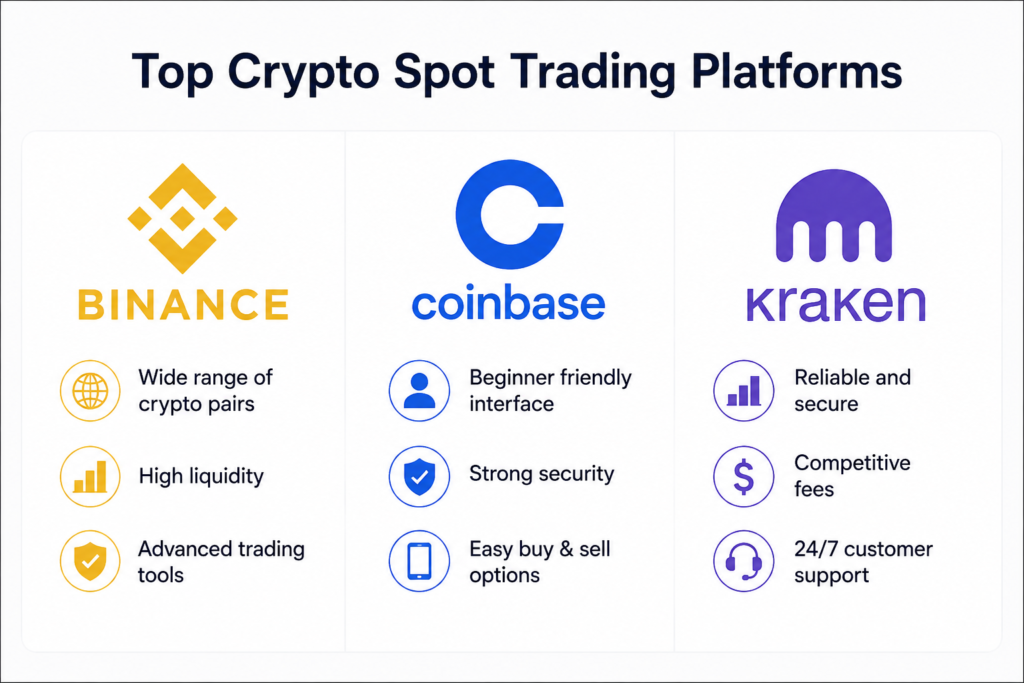
Choosing the right platform is an important part of crypto spot trading because the exchange you use affects the available trading pairs, fees, order types, liquidity, and overall trading experience. I would not choose a platform simply because someone calls it the “best.” I prefer checking whether it actually supports the assets I want to trade and whether its services are available in my region.
| Platform | Best For | Spot Trading Features | What to Consider |
|---|---|---|---|
| Binance | Wide range of crypto markets | Market orders, limit orders, stop-limit orders, OCO orders, large selection of trading pairs | Check regional availability, fees, and withdrawal conditions |
| Coinbase Advanced | Beginner-friendly advanced trading | Advanced charts, order books, multiple order types, numerous spot pairs | Trading fees vary by volume and order type |
| Kraken | Security-focused trading | Spot markets, advanced order types, charting, multiple crypto pairs | Check supported assets and availability in your country |
Tip: Before choosing a spot trading platform, compare fees, liquidity, available cryptocurrencies, security features, order types, withdrawal options, and regional availability. The platform with the most features is not necessarily the best choice for every trader.
Conclusion
Crypto spot trading offers a straightforward way to participate in the cryptocurrency market by buying and selling actual digital assets without relying on leverage. Its simple structure makes it easier to understand, but that does not remove the risks that come with volatile crypto markets.
From my experience, having a clear plan matters more than trying to predict every price movement. I focus on understanding the market, waiting for suitable setups, managing my position size, and knowing when to walk away from a trade. Not every opportunity deserves an entry.
A practical crypto spot trading strategy should also account for trading fees, liquidity, market conditions, and potential losses. Beginners can start by learning how orders work, practicing with small amounts, and keeping realistic expectations about profitability.
Frequently Asked Questions About Spot Trading
1. What is spot trading in cryptocurrency?
Spot trading is the buying or selling of cryptocurrencies at the current market price, with the asset being exchanged directly between the buyer and seller.
2. Is spot trading different from futures trading?
Yes. In spot trading, you trade the actual cryptocurrency without leverage. Futures trading involves contracts and can include leverage, allowing traders to speculate on price movements without directly owning the asset.
3. Can I make money with spot trading?
Yes, traders can potentially profit by buying an asset at a lower price and selling it at a higher price. However, cryptocurrency prices are highly volatile, and losses are also possible.
4. Is spot trading safe for beginners?
Spot trading is generally simpler than leveraged trading because you are not exposed to liquidation from leverage. However, it still carries significant market risk.
5. What is a spot trading pair?
A trading pair shows which cryptocurrency you are buying and what you are using to pay for it. For example, BTC/USDT means you can buy or sell Bitcoin using USDT.